
Delaware County advances Indian Run Lateral No. 3 drainage petition to a second hearing after mixed testimony
Get AI-powered insights, summaries, and transcripts
Subscribe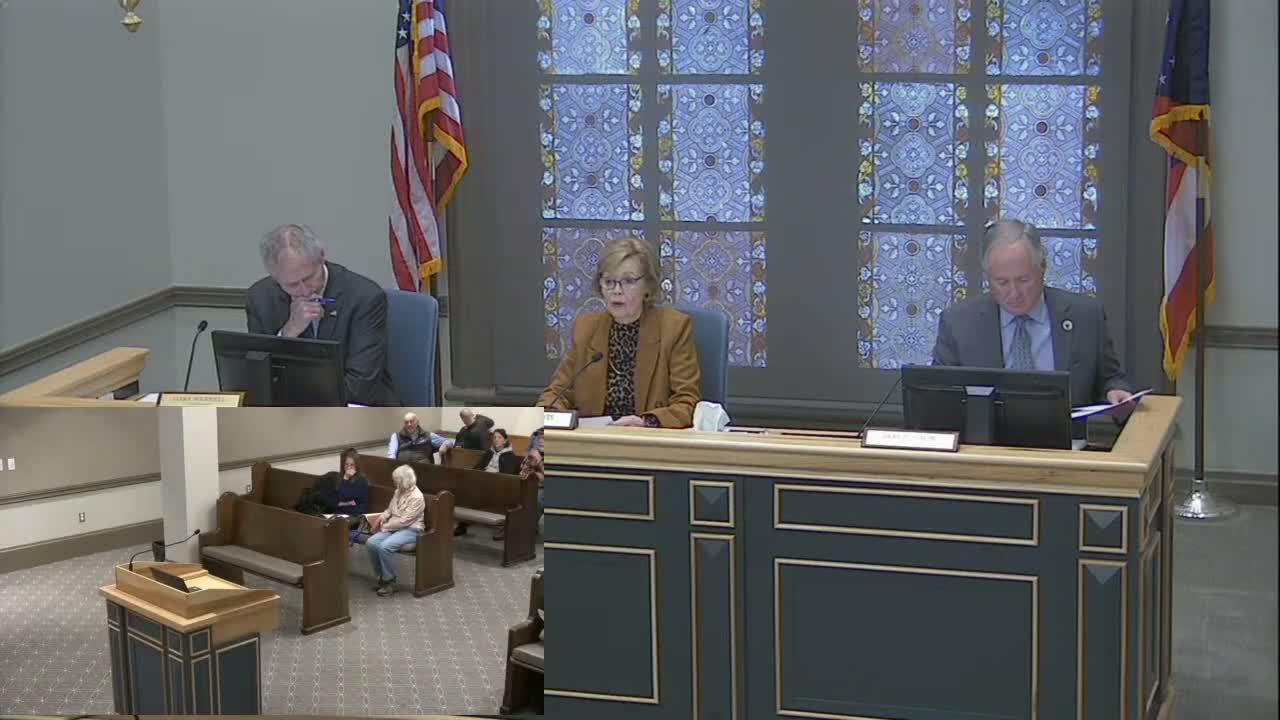
Summary
After presentations from county engineers, three landowners and the Stream and Wetlands Foundation, the Delaware County Board of Commissioners voted Dec. 8, 2025 to advance the Indian Run Lateral No. 3 drainage-improvement petition to a second hearing for survey and design, while requesting more information on stewardship and financial assurances.
Delaware County commissioners voted Dec. 8, 2025 to advance a petition to study drainage improvements in the Indian Run Lateral No. 3 watershed to a second hearing, after hearing technical findings from county staff, testimony from nearby landowners who support a petition-based improvement and competing testimony from the Stream and Wetlands Foundation proposing a mitigation‑bank alternative.
The board’s decision followed a report read into the record by Brett Bacon, deputy administrator for the Delaware Soil and Water Conservation District, who said the watershed covers approximately 193 acres, is mostly agricultural with a small portion in the village of Ashley, and has an existing subsurface tile system that was privately improved in 2024. Bacon read the preliminary cost estimate for replacement-style work: a construction estimate of $65,384, project administration and engineering of $2,500, first‑year drainage maintenance estimated at 5% ($3,269), for a total current‑value estimate of $71,153; he noted contingencies typically run 15–20% and that individual parcel assessments will be calculated only if the petition moves forward to a final hearing.
"Currently, we have no reason to believe it's not functioning properly," Bacon said when commissioners asked whether immediate repairs were needed.
Several landowners testified in favor of proceeding under the petition process. Ruby Smith of 4966 State Route 229 said she spent about $220,000 in 2024 to install replacement tile on roughly 106 acres and urged the board to adopt a drainage‑maintenance plan to protect farms and homes from standing water. William John Thurston of 5800 McCurdy Road and Pat Tuggle of 4543 State Route 229 also spoke in support, saying subsurface drainage is critical for agriculture and that landowners deserve protection.
Opposing the petition, Vince Messerly, president of the Stream and Wetlands Foundation, said his nonprofit — which he described as a 501(c)(3) mitigation bank operator — bought the parcel and plans to daylight the 12‑inch tile, restore a natural stream channel with a wider floodplain bench and donate the property to Preservation Parks of Delaware County after a monitoring period. Messerly said the foundation’s plan would be completed "at no cost to any of the other landowners in the watershed" and "would require no assessments to any of the landowners." He added the foundation would provide the financial assurances and endowment required under federal and state mitigation rules and that the U.S. Army Corps of Engineers and environmental agencies would oversee performance bonds and long‑term compliance.
"Our proposed project will provide a drainage outlet that will provide more capacity and numerous environmental benefits," Messerly said, adding that federal and state mitigation rules require long‑term stewardship and financial guarantees.
Commissioners pressed Messerly on details: whether the foundation would remove the existing tile (he said it would), which parcels were involved, how long monitoring and stewardship would last (he said about 10 years before transfer), and whether written guarantees or a mitigation instrument would be provided. Greg Snowden of the foundation said the mitigation bank instrument and management plan are public documents that would specify obligations and that the Corps retains authority to require fixes if the stewardship fails.
Some commissioners expressed discomfort relying primarily on federal rules and oversight for a very local drainage outcome and asked for a concise, written explanation of the foundation’s management plan, endowment and the parties responsible for maintenance at each stage. One commissioner said Delaware County’s drainage petition process and perpetual maintenance under Ohio Revised Code section 6137 is a proven local mechanism and sought clearer assurances before forgoing it.
After discussion and requests for additional documentation from Stream and Wetlands and Preservation Parks, the board voted to proceed to a second hearing to allow the county engineer to prepare plans, cost estimates and an individual schedule of assessments — the step that triggers formal calculation of parcel assessments if the project advances. The resolution (No. 251035) was moved by Commissioner Benton and seconded by Commissioner Lewis and recorded by the clerk; commissioners indicated support and the motion advanced (vote recorded in the hearing record).
Next steps: the county engineer’s office will complete survey-level plans, specifications, cost estimates and a schedule of assessments and file a second‑hearing report; when that report is filed, the county will set a final hearing date and notify landowners in the watershed.
Costs and statutory context: the board’s review relied on the Ohio Revised Code drainage petition process under section 6131 and the drainage maintenance easement provisions under section 6137, which authorize the board to act on behalf of benefited property owners to make drainage improvements and to place improvements under county maintenance in perpetuity. Testimony also referenced federal Clean Water Act permitting (sections 401 and 404) as relevant to mitigation banking and Corps oversight.
The board closed the hearing and adjourned with no immediate final action beyond moving the petition to the next hearing stage.