
Lakewood council approves 20‑year development agreement for The Bend after hours of debate and amendments
Get AI-powered insights, summaries, and transcripts
Subscribe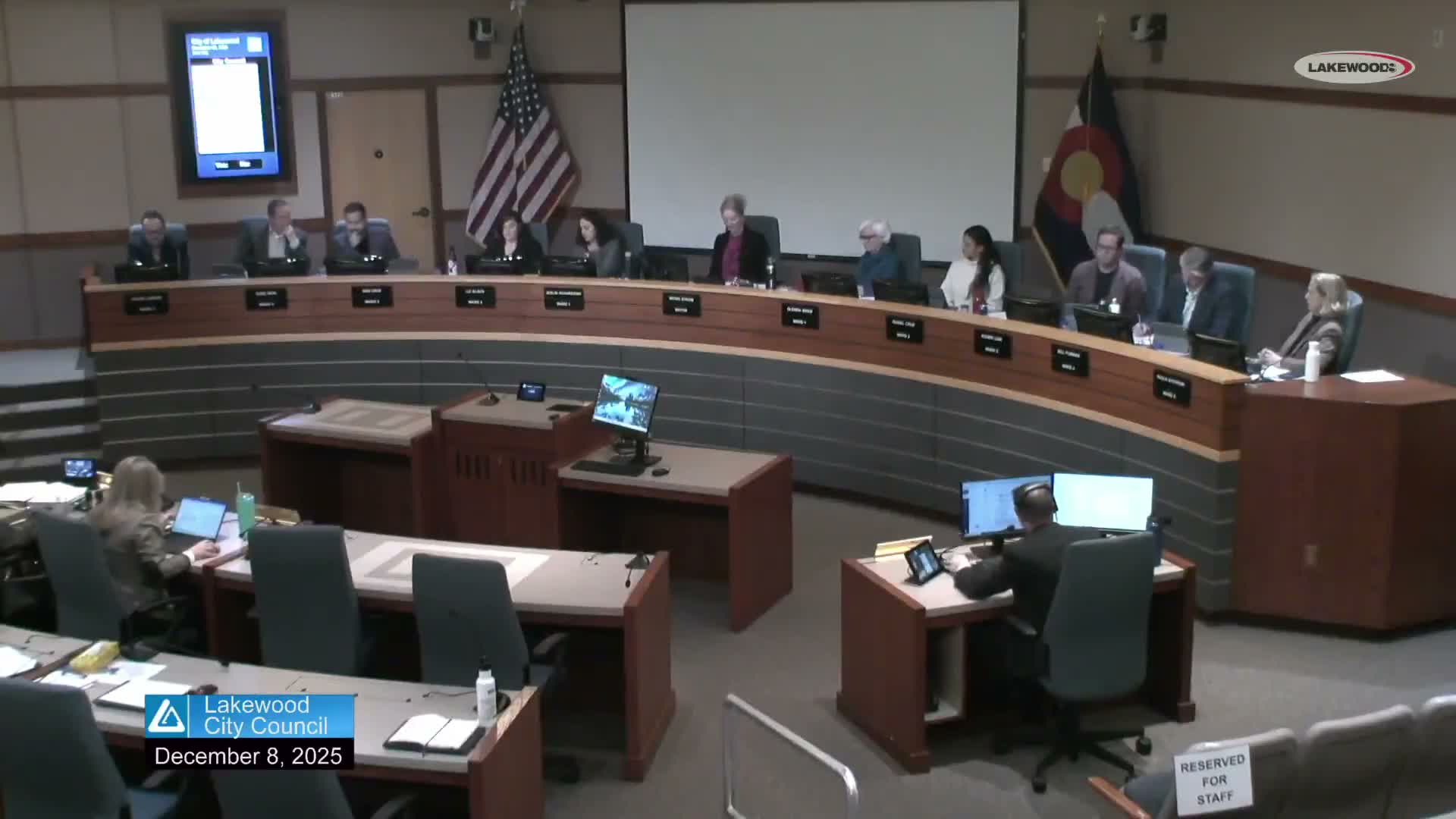
Summary
After extensive public testimony and multiple amendments, the Lakewood City Council approved a 20‑year development agreement for The Bend, a 59‑acre, transit‑oriented mixed‑use project that pledges 10% deed‑restricted affordable housing, residential electrification, new parkland including a home for Car 25, and phased environmental remediation.
The Lakewood City Council on Dec. 8 adopted a development agreement that vests The Bend, a roughly 59‑acre mixed‑use project near the Federal Center, for 20 years and sets a framework for up to about 2,000 residential units and roughly 100,000 square feet of commercial development.
The council’s vote came after more than three hours of staff and developer presentations, dozens of public comments both in favor and raising concerns, and multiple amendments the council added to the agreement. The ordinance passed on second and final reading by an 11‑0 vote after the council adopted amendments requiring affordability and other commitments.
Why it matters: The project is the city’s largest remaining undeveloped parcel and the agreement locks in zoning, affordable‑housing commitments, parkland dedication and a timeline for public improvements. Supporters said the development will add hundreds of deed‑restricted affordable units and create new public space and transit connections; critics warned that remediation, transparency and the mix of housing and commercial uses required clearer, enforceable language.
Details in the agreement and amendments - Affordable housing: Staff and the developer said the agreement requires at least 10% of residential units to be deed‑restricted affordable. During the meeting, Councilor Lowe moved an amendment that the 10% commitment must be met or exceeded in each phase and include a minimum 30‑year deed restriction; councilors adopted the amendment unanimously. As staff explained, the rental units will target households at or below 60% of area median income (AMI), and for‑sale units would target households at or below 100% AMI.
- Electrification: The council added a requirement that all residential units be fully electrified with no gas hookups. Councilor Nystrom’s motion to enshrine residential electrification passed 11‑0; commercial spaces were carved out for practical exceptions such as specific restaurant needs.
- Parkland and CAR 25: City staff described a parkland obligation equivalent to about 17.73 acres for the full build‑out, or a fee in lieu that staff calculated at roughly $7,670,000. The development agreement includes land dedication, easements and an identified plan to provide a permanent public home and viewing space for the historic Car 25 trolley artifact.
- Environmental remediation and phasing: The site includes areas with prior federal environmental controls. The developer’s environmental consultant said the southern parcel was largely cleaned in earlier work under a consent decree and monitored, while portions of the northern parcel remain capped and will require mitigation before certain construction can occur. After extended debate, the council adopted language directing that remediation of the northern plot be undertaken by the applicant “concurrent with the development” of that portion, leaving technical phasing and exact remediation steps to staff and the developer under state review.
- Commercial space: Councilors negotiated a commercial‑floor minimum after lengthy discussion about market feasibility and retail vacancy risk. The council adopted a scaled minimum that requires no less than 10,000 square feet of commercial space in Phase 1 and no less than 30,000 square feet in Phase 2. Developers described those numbers as aspirational targets aligned to market conditions; the council used that floor to ensure early ground‑floor activation.
Developer commitments and timeline Scott Caldwell, executive vice president with Lincoln Property Company, told the council the firm bought the site in April 2023 and has pursued entitlements since. “We’re bringing significant affordable housing to this area of the city,” Caldwell said during the presentation, and added the project is intended to be fully electric for residential buildings and to include plazas, bike lanes and transit platform extensions.
Council discussion and votes Councilors probed how the proposed commitments “flow down” if parcels are sold, how enforceable the affordability and deed‑restriction language is, and how remediation will be sequenced. Staff and the developer repeatedly explained that many detailed obligations will be implemented through later public‑improvement agreements, site plans and intergovernmental agreements that the city must approve.
The council adopted several amendments during the hearing to add clarity and enforceability before adopting the ordinance on second and final reading. Key votes included the affordability/per‑phase amendment (passed 11‑0), a community‑engagement amendment requiring the developer to continue outreach and checkpoints with the registered neighborhood organization (passed 11‑0), a residential electrification requirement (passed 11‑0), commercial minimums (passed 9‑2 after negotiation), and remediation language directing cleanup concurrent with northern‑parcel development (passed 10‑1). The final ordinance, as amended, carried 11‑0.
What happens next Adoption of the development agreement vests current zoning for the project and authorizes the city manager to finalize and execute the agreement and related documents. The developer still must complete phased major site plans, public improvement agreements, sewer intergovernmental agreements and other exhibits that staff said will spell out detailed construction, maintenance and enforcement provisions. The city and state environmental agencies will review and approve remediation plans for any areas that will be disturbed.
By the numbers and local impact The proposal describes about 2,000 residential units, roughly 10% as deed‑restricted affordable, about 5.6 acres of parkland to be achieved through a mix of dedication and easements, and an aspirational ~100,000 square feet of commercial space across phases. Staff noted the agreement is intended to balance developer certainty needed to invest with city priorities for affordability, parkland and sustainability.
The council’s action represents a major step to activate one of Lakewood’s largest undeveloped sites and to lock in several public benefits, while leaving staff and the parties to negotiate technical implementation items in follow‑on agreements.