
Livestock Board warns of animal-health gaps after APHIS cuts; EID tag debate continues
Get AI-powered insights, summaries, and transcripts
Subscribe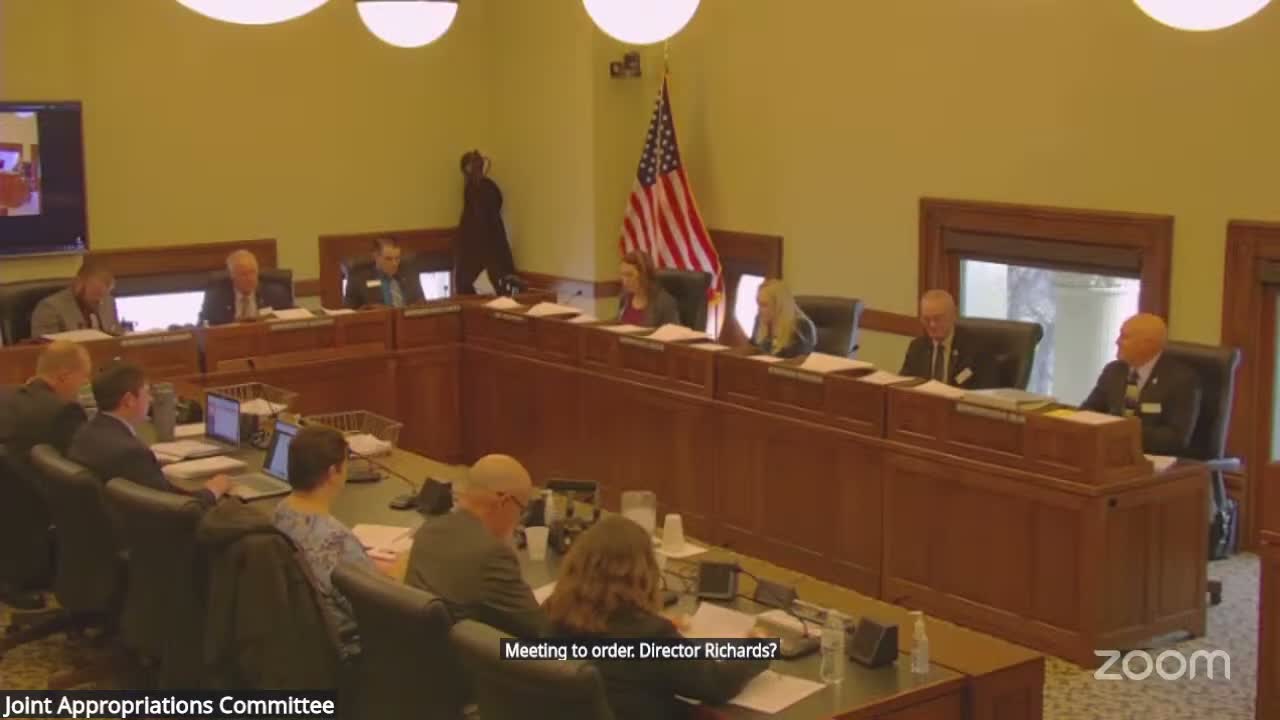
Summary
Wyoming Livestock Board leaders told the Joint Appropriations Committee that USDA APHIS staffing losses left state veterinarians stretched thin, reducing outreach and response capacity; lawmakers pressed the board on EID-tag MOUs, brucellosis rules and exception requests for IT funding.
The Wyoming Livestock Board told the Joint Appropriations Committee that state animal-health capacity has tightened after a reorganization at the U.S. Department of Agriculture’s Animal and Plant Health Inspection Service (APHIS).
"There are no veterinarians now from APHIS that help us cover the state of Wyoming," Dr. Hazel, the state veterinarian, said, describing the loss of APHIS veterinarians and other animal-health staff and the effect on routine outreach, market visits and response time for emerging diseases. Director Steve True said the agency now relies on three state veterinarians to cover statewide responsibilities and faces staff burnout and reduced educational outreach to producers.
The board’s witnesses described several disease threats that require readiness — avian influenza, equine herpes and the newly discussed threat of new-world screwworm. Dr. Hazel said Wyoming participates in multi-state response planning for screwworms and that response would likely rely on county-level quarantines and trained brand inspectors if an outbreak occurred.
Lawmakers pressed the agency on electronic identification (EID) tags, an issue tied to a 2024 law requiring the board to seek memoranda of understanding (MOUs) with receiving states so Wyoming producers would not be forced into a national EID mandate. Director True said the board contacted brand-state counterparts across the region and secured a narrow MOU with Utah but that most states declined to reciprocate because their producers and agencies are moving ahead with federal traceability rules.
"We have an MOU with Utah… none of the other states were willing to try it on," True said, describing the agency’s outreach.
Committee members asked for documentary evidence of the outreach; Representative Alejandro Aleman asked the board to provide the emails and responses used in those contacts. The board agreed to provide the email correspondence to the committee.
On counts and use of EID tags, the witnesses gave multiple figures in the hearing. The agency said it has distributed at least 100,000 EID tags a year since 2013; in other testimony officials said the agency now uses "just over 300,000 tags per year" and has used hundreds of thousands of tags cumulatively since 2013. Dr. Hazel cautioned that different classes of cattle are subject to different identification rules and that the designated surveillance area (DSA) for brucellosis has stronger identification requirements: "100% of the animals in the DSA that are breeding animals, females specifically, have official identification," she said.
The agency also told lawmakers about other operational items: brand inspection and recording (about 28,000 recorded brands); a small two-person enforcement unit that relies on MOUs with county sheriffs; and exception requests in the budget packet. Director True listed two exception requests: $3,600 per biennium for ADA compliance work on the agency website, and a relicense payment (listed in the agency materials as about $14,893) to maintain an Animal Health core operating system used to preserve confidentiality and animal-health records.
On livestock theft, True said the MOU program with county sheriffs appears to have reduced theft and missing-livestock reports over the last two years, though he described that result as anecdotal and said he had not compiled formal data.
The committee asked the agency to resubmit a corrected special-revenue table (page 56 of the packet) and indicated it may have follow-up questions; the agency said it would provide requested emails and revise the table.
Next steps: The board signaled the pending brucellosis rule will be handled by the board in January (the director said an ex parte restriction currently prevents detailed discussion of a rule pending on the board’s desk). Committee members asked for follow-up materials and a corrected special-revenue schedule.