
Council approves Harrison Road Phase 2 design to improve school crossing safety
Get AI-powered insights, summaries, and transcripts
Subscribe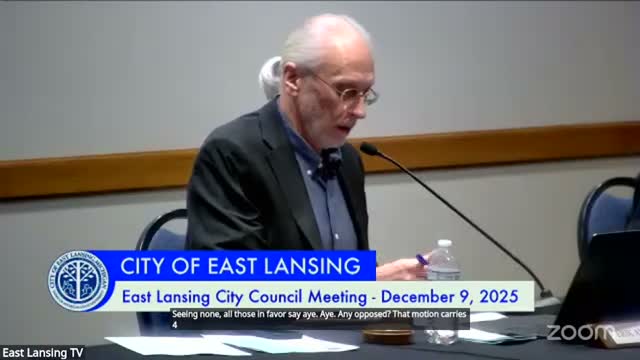
Summary
East Lansing approved Phase 2 design recommendations for Harrison Road, including a rapid rectangular flashing beacon, raised crosswalk and truck restrictions, intended to improve student and pedestrian safety at the Glencairn crossing.
The East Lansing City Council on Dec. 9 approved design recommendations for phase two of the Harrison Road Rehabilitation Project focused on improving a mid‑block crosswalk used by Glencairn Elementary School.
Spicer Group, the project consultant, presented data collected during the school year that supported installation of a rapid rectangular flashing beacon (RRFB) at the crossing, retention of speed-feedback radar signs, widened centerline and edge-line pavement markings, and a raised crosswalk in front of the school. The consultant also recommended truck restrictions (class 8 and greater) through the corridor, optical speed bar pavement markings, yield-triangle markings and an overhead crosswalk sign as options to improve driver attention and pedestrian visibility.
The analysis included vehicle and pedestrian counts, three-year crash review and consideration of roadway geometry and a downhill vertical curve north of the crossing. Spicer Group concluded the corridor did not meet criteria for a pedestrian hybrid beacon (HAWK) but did qualify for an RRFB and complementary traffic-calming measures. The raised crosswalk was recommended as having a higher crash‑reduction factor (about 45%) than a pedestrian refuge island (about 32%), though staff noted possible noise concerns from trucks crossing raised elements.
Council member Whelan moved to adopt the phase two recommendations as presented; the motion passed 4-0. Council asked staff to work with adjacent property owners and the Transportation Commission as the project advances into final design and implementation (phase 3).
The project will proceed to detailed design and eventual construction in a later phase; staff said the work would be coordinated with MDOT requirements where intersections are state‑controlled and with neighborhood feedback on features such as mast-arm overhead signage or wood-pole/span-wire alternatives.