
Goodyear staff recommend joining Maricopa County HOME Consortium to access HUD housing funds
Get AI-powered insights, summaries, and transcripts
Subscribe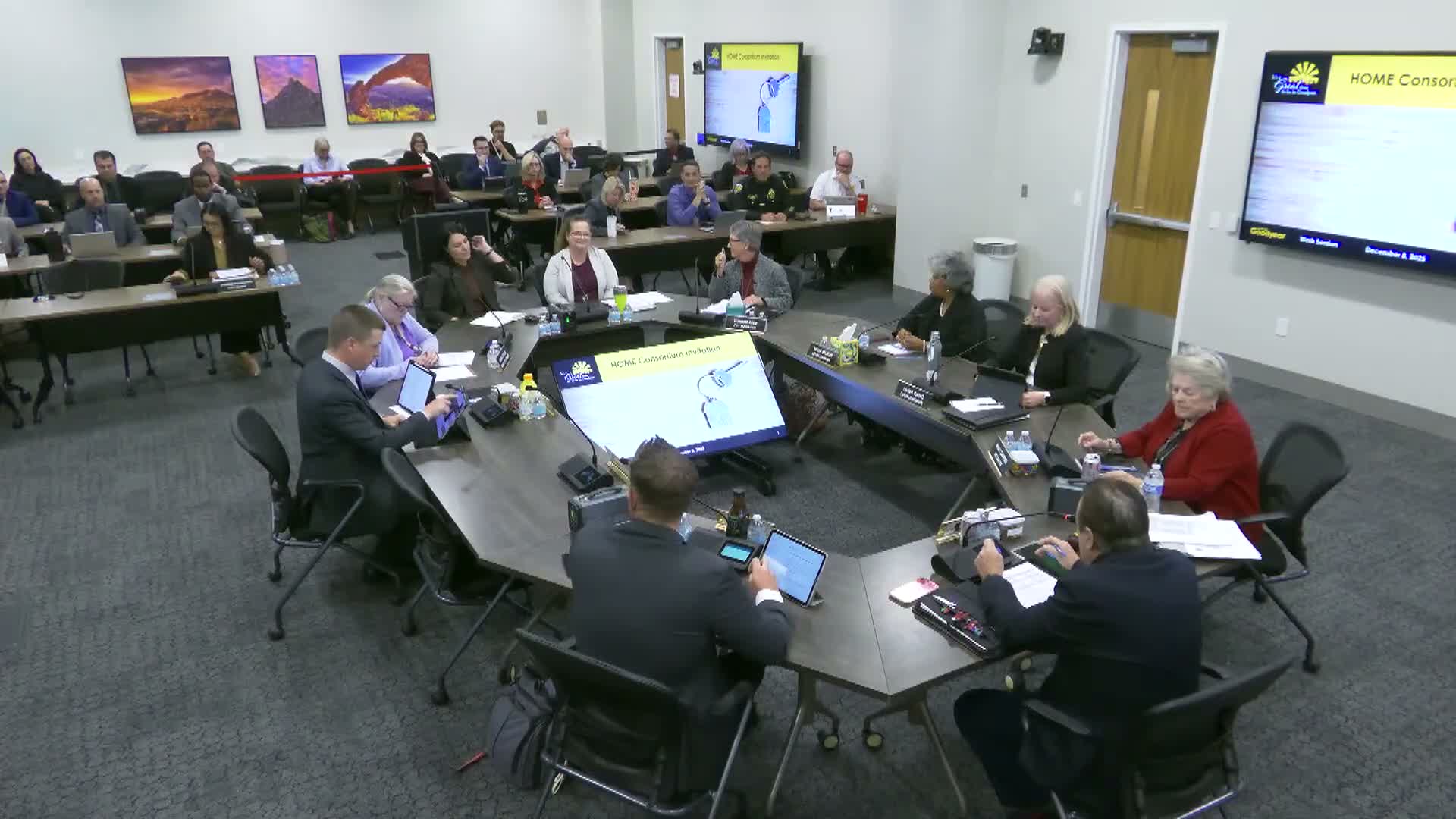
Summary
City staff told the Goodyear City Council a membership invitation would let the city access an estimated $100,000 in HOME (HUD) funds for housing activities; staff said the city must meet match and reporting requirements and will return next week with a resolution to join.
GOODYEAR, Ariz. — City staff briefed the Goodyear City Council at its Dec. 8 work session on an invitation to join the Maricopa County HOME Consortium, which city staff said is the only way a municipality Goodyear’s size can receive HOME program dollars from the U.S. Department of Housing and Urban Development (HUD).
“If you’re not a part of the consortium, a city our size, you cannot access the grant dollars,” said Christina Panateescue, community partnerships program manager, explaining the consortium structure and eligibility rules.
Panateescue told council members that HOME funds can be used for a range of affordable-housing activities — including new rental or owner housing for income-eligible households, down-payment or other home-purchase assistance, rental assistance, and housing rehabilitation. Staff estimated Goodyear’s pro rata HOME allocation would be “around $100,000.”
Council members pressed staff on the city’s obligations if it joins. Panateescue said the primary cost to the city would be staff time folded into existing Community Development Block Grant (CDBG) planning and administration. She also described a non-federal match obligation: "to use easy math, 25,000 is the high end," meaning roughly a 25% non-federal match is a reasonable upper estimate on a $100,000 allocation. Panateescue added that up to 5% of the HOME allocation can be used for the city’s own administration and that administrative expenses paid to the county are drawn from the grant allocation.
Panateescue said consortium membership would occur through a three-year agreement and that the county would either amend an existing intergovernmental agreement (IGA) or negotiate a new one with members. She also said the agreement would need to be certified by the state and that HOME-related planning will be coordinated with the city’s consolidated-plan submissions to HUD.
Council members asked whether the city would select recipients and screen eligibility. Panateescue said the city could perform eligibility screening in-house (for example, using the Goodyear Cares navigator), or subcontract the work to an outside agency that could count its staff time toward the required match. She named several Valley organizations that administer similar programs for other jurisdictions.
Several council members said they support joining the consortium but raised practical concerns about tracking and administering assistance and about ensuring funds are directed to residents rather than developers. One councilmember summarized the caution: “It’s not free money and [the county does not] just pass it out like it’s free money,” and Panateescue said staff would return with more specifics when they present the resolution.
Panateescue also gave income-targeting guidance: rental projects are generally targeted to roughly 50–60% of area median income (AMI) and purchase assistance typically targets around 80% AMI, although she noted those limits are under federal review and could change.
Next steps: staff will return to council next week with a formal resolution to join the Maricopa County HOME Consortium; no vote or formal commitment was taken at the Dec. 8 work session.
Authorities and related materials referenced at the meeting include the HOME program (HUD), the Consolidated Plan process, and the intergovernmental agreement (IGA) between consortium members and Maricopa County.