
Neighbors press commissioners over blasting, buffers and expired permits at Natick Solar hearing
Get AI-powered insights, summaries, and transcripts
Subscribe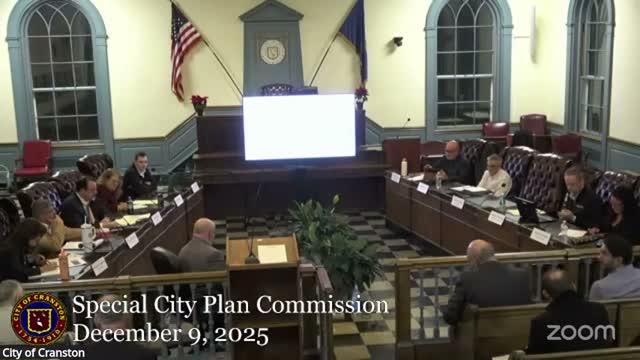
Summary
At a lengthy Cranston Planning Commission hearing, the Natick Solar applicant defended changes that reduce panel count and use screw-driven foundations while abutters and attorneys raised concerns about blasting near a high-pressure pipeline, the adequacy of visual buffers in winter, an expired DEM permit renewal, and alleged undisclosed changes to the project. The commission continued the hearing to January for further review.
The Cranston City Planning Commission took up a contested preliminary-plan review for the Natick Avenue solar project, where technical revisions and longstanding neighborhood opposition dominated nearly the entire meeting.
Applicant engineers confirmed the proposed array’s output is 6.25 megawatts (AC) while previously cited 8.1 MW represented the DC rating; panel count fell from 16,200 to 14,280 due to higher-efficiency panels. The project team said they switched to a screw-driven foundation system that reduces the need for deep blasting in many parts of the site, but acknowledged limited blasting will still be required where outcrops occur.
Commissioners and residents pressed the applicant on stormwater, permitting and public-safety issues. The engineer said the controlling stormwater reports date to 2019–2020 and follow Rhode Island DEM guidance; the applicant has filed for an updated DEM permit after the prior permit recently expired and expects renewal before final plan approval. The team presented a network of stone infiltration basins and trenches and an estimated inspection/maintenance cost of roughly $23,000 per year; they said inspection reports are submitted to DEM and can be provided to city staff on request.
Blasting and proximity to a high-pressure Tennessee Gas / Kinder Morgan pipeline featured prominently. Applicant witnesses said blasting near the pipeline will follow the pipeline owner’s handbook and state fire-marshal regulations, that utility review is triggered within 300 feet, and that, in practice, blasting within 100 feet is generally avoided as uneconomic. Construction manager David Punchak said targeted blasts typically require drilled holes (6–8 feet) and that blasting is used mainly to remove surface outcrops rather than to excavate deeply across broad areas.
Landscape testimony focused on 14 sight-line transects and a supplemental planting plan. Landscape architect John Carter said transects were drawn from representative ground-floor viewpoints (not second-floor windows), that proposed shrubs and trees are shown at planting height (evergreens 5–8 ft; deciduous 8–10 ft), and that the project will add supplemental plantings and opaque slats in the chain-link fence in areas where buffers are thin. Carter and applicant counsel noted maintenance guidelines and replacement provisions; the applicant offered periodic post-construction inspections and discussed bonding to ensure long-term buffer health.
Scores of neighbors testified, raising recurring concerns: (1) the accuracy of the transects and whether they capture second-floor sightlines; (2) noise, traffic and road safety on narrow Natick Avenue during construction; (3) potential damage to wells, septic systems and barns from blasting; (4) flooding and altered runoff after tree clearing; and (5) property-value impacts. Neighbors’ attorney asked the commission to deny or delay action, alleging undisclosed changes to the project footprint and raising questions about interconnection filings with ISO New England and Rhode Island Energy.
Applicant counsel and the project team disputed many of the opponents’ assertions, saying the revised plan responds to prior concerns (moving the access road away from the northern boundary, supplemental plantings, pollinator seed mix) and that the interconnection and permitting processes remain on established tracks. Counsel said some disputed items (for example, a potential future residential building on a different part of the larger parcel) are not part of the current application and would be handled separately.
After extensive public comment and rebuttal, the commission voted to continue the matter to its January meeting for additional staff review and commissioner questions. The motion to continue was approved with one commissioner recorded in opposition.
What’s next: the commission asked staff to post the materials submitted at the meeting and indicated it will review updated permit documentation, respond to specific technical questions on blasting, stormwater and long-term buffer maintenance, and consider whether a site visit or additional conditions (inspection reporting to city staff, bond for buffer maintenance or blasting contingency) are needed before final plan approval.