
Palo Alto approves consent calendar including RV/oversized-vehicle rules after extensive public comment
Get AI-powered insights, summaries, and transcripts
Subscribe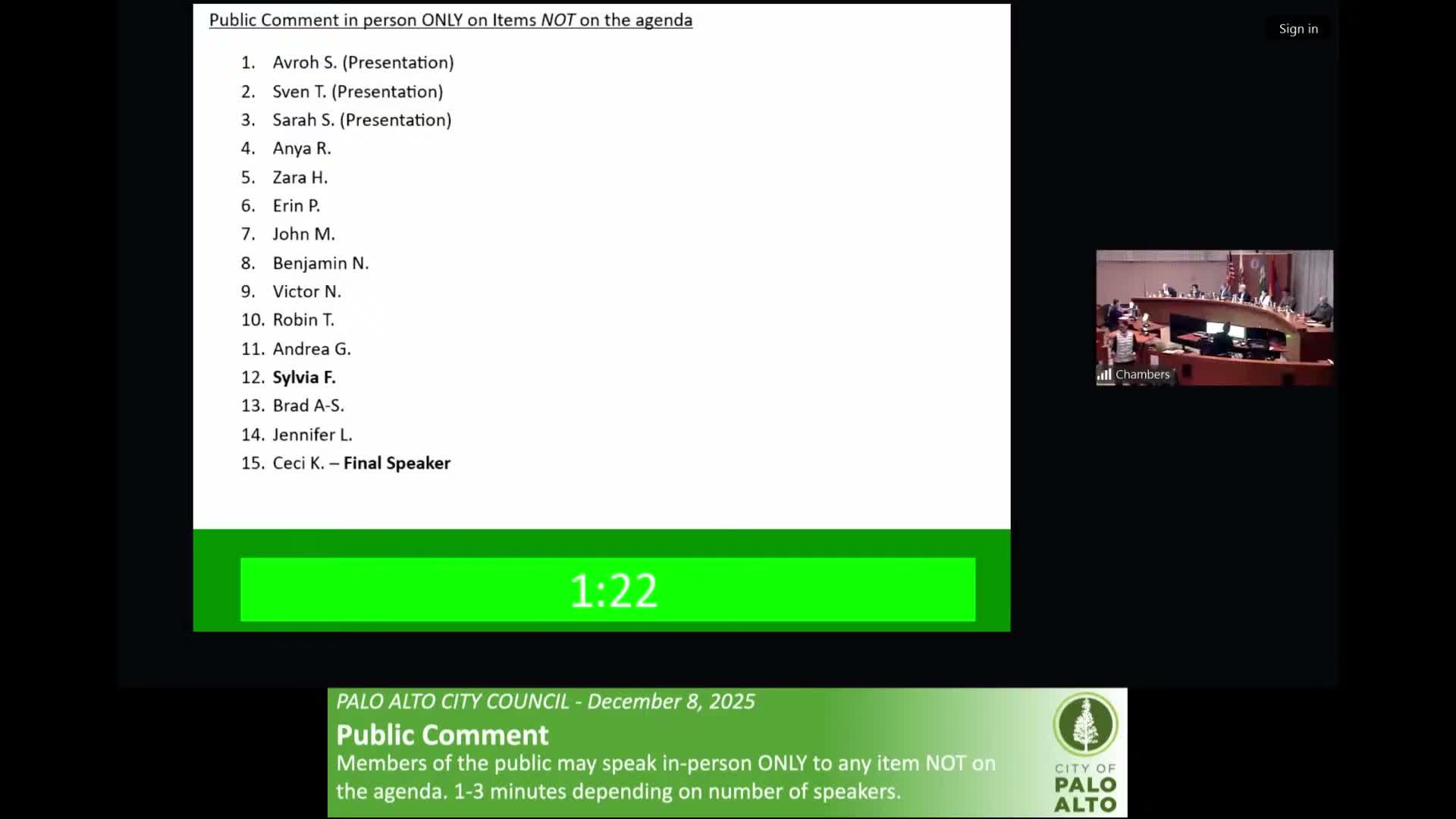
Summary
Despite many residents and local businesses urging stronger enforcement and removal of the item from the consent calendar, the council approved the consent calendar (including item 4 on oversized vehicles and related parking rules); public commenters described safety, sanitation and business impacts from RV dwellers.
Palo Alto’s City Council on Dec. 8 approved its consent calendar, including emergency measures and code amendments addressing oversized vehicles, van loading and detached trailers, after extended public comment from businesses and neighborhood residents who said the city’s business districts are being harmed by a large-and-growing presence of RVs and other vehicle residents.
Dozens of speakers — business owners, residents and advocates — told the council the presence of roughly 200 RVs in some commercial corridors has caused persistent parking loss, blocked sight lines, sanitation concerns, trash on sidewalks, and safety risks for drivers, bicyclists and pedestrians. Speakers asked the council to remove the item from consent for additional staff work or to adopt stricter, immediate prohibitions and stronger enforcement. Several business owners said their revenue had dropped, and one speaker urged adopting language used by neighboring cities to ban RV parking in business districts.
Public commenters included Bob Maranau, who said he walked affected neighborhoods and found ‘‘garbage on the streets, in the bushes’’ and alleged business theft of utilities; Lauren B. said the presence of RVs has ‘‘devastated our business parks’’ and urged a complete ban in business districts; others described blocked driveways and nights of disrupted sleep.
Council moved and seconded the consent calendar and conducted a roll call. The clerk recorded affirmative votes for Council members Rechtel, Lythcott Hames, Stone, Vice Mayor Venker, Council member Liu, Mayor Loughing and Council member Burt; the motion carried. After the vote, one council member said they had voted no on item 4 and explained concerns about enforcement capacity, tow-lot availability and the need to create safe-parking options rather than simply removing people’s homes (vehicles).
City staff and at least one outside speaker urged the council to consider alternatives that reduce enforcement cost and legal risk and to pursue safe-parking and sanitation options. A representative of the National Vehicle Residency Coalition urged the city to reject criminalizing trailers and rental RVs and recommended investment in managed safe parking with sanitation and fire prevention rather than heavy enforcement and signage spending.
Council members and staff flagged that the earlier committee report’s full rollout-signage cost estimate had been widely cited in public comment and that the number shown in committee material was an upper-end estimate rather than a budget commitment.