
Salinas approves conditional awards for affordable housing but some council members question allocations
Get AI-powered insights, summaries, and transcripts
Subscribe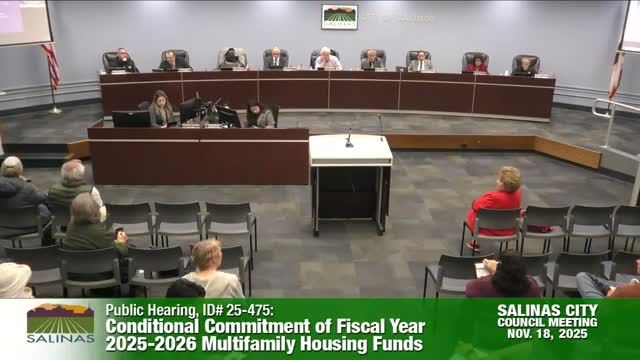
Summary
The Salinas City Council voted Nov. 18 to approve staff'recommended conditional awards from the latest NOFA, directing roughly $8 million toward three projects and $1.2 million for Republic Cafe stabilization. Council members pressed staff over readiness and unit yields, and staff said awards are conditional and subject to financing and entitlement steps.
Salinas City Council on Tuesday approved staff recommendations for preliminary awards from the city's recent Notice of Funding Availability (NOFA), allocating about $8 million in local housing trust and federal funds to several multifamily and rehabilitation projects while leaving some applicants unfunded because they lacked project readiness.
The council's vote endorsed conditional awards recommended by city staff and presented by Orlando Reyes, assistant director of community development, who said staff prioritized 'readiness''''''entitlements, site control and near-term ability to expend funds''''' over simply maximizing the immediate unit count. ''''''''''''''''''''''''''''''''''
''''''''''''"What the NOFA showed us was more demand than supply," Reyes said. "We received requests that were more than double what was available, so we evaluated the applications based on the NOFA guidelines, conversations with developers and their ability to move forward to meet HUD timeliness tests."
Staff recommended preliminary awards to three projects: CHISPA's Vista De La Terraza (rehab) at a combined recommendation of $960,000; Milestone Housing's Casentini Street family apartments at $3.8 million; and CHISPA's St. George senior project at $2.3 million. The council also approved a $1.2 million allocation from local housing trust funds to secure and stabilize the Republic Cafe property in Chinatown, which staff described as part of a larger, multi-parcel Chinatown revitalization effort.
Reyes and other staff told the council that the Republic Cafe allocation is tied to timeliness and site control: the city already owns or controls parcels in the Chinatown master-plan area and has advanced schematic designs and remediation steps for the Republic Cafe property. "We're at a point where we need to stabilize this building so it can be used as part of a larger plan to bring the museum and housing to fruition," Lisa Brenton, community development director, said.
Councilmembers pressed staff over the trade-offs. Councilmember (last name) asked why projects that would create more units now were not funded instead. "If we look strictly at units, it looks like there might be a different outcome," the councilmember said. Reyes replied that readiness, entitlement status and the ability to spend federal dollars in the HUD timeliness window were decisive factors.
Developers and project managers, including representatives from CHISPA and Milestone Housing, told the council their projects were at various stages of entitlement or financing and explained how recommended funds would be leveraged alongside state and federal sources.
The council voted to accept staff recommendations after discussion and public comment. City staff emphasized that awards are conditional and that funding agreements, additional financing and environmental reviews will follow before any construction begins. Councilmembers asked for continued outreach to nearby residents and regular reporting on project milestones.
What happens next: Conditional awards enable applicants to seek additional financing (tax credits, bonds, other grants); if projects fail to move forward staff said the council could consider reallocating funds in a future action. The city also signaled it would continue to pursue state and federal funding and explore ways to expand the local housing trust fund.
Funding and scope notes: the NOFA round generated requests exceeding $18 million while available awardable funds totaled roughly $8 million; the proposed HOME/CDBG amendments discussed earlier in the meeting and approved by the council will also shift money to projects that can meet the HUD timeliness test.
The council's vote was procedural approval of staff recommendations and does not constitute final grant agreements or construction approvals.