
Council advances downtown land-disposition agreement with Taylor Fresh Foods; parking, inclusionary housing flagged
Get AI-powered insights, summaries, and transcripts
Subscribe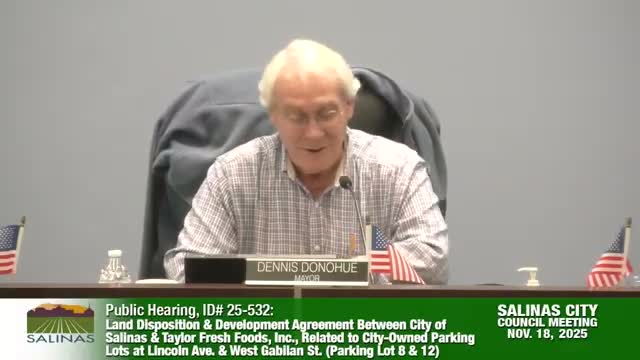
Summary
The Salinas City Council introduced for first reading a land-disposition and development agreement with Taylor Fresh Foods to sell two city-owned downtown parking lots for mixed-use development. Council members and public commenters raised questions about employee parking, inclusionary units and how sale proceeds will be used.
The Salinas City Council on Nov. 18 voted to introduce an ordinance authorizing a negotiated land disposition and development agreement with Taylor Fresh Foods for two city-owned parking lots downtown (Lots 8 and 12), advancing the project to the next review steps and appraisal negotiations.
Under the agreement presented by Community Development staff, Lot 12 would be developed first as a mixed-use parcel including about 66 residential units with retail on the ground floor and administrative site-plan review for design approval; because the project proposes more than 10 units, it will be subject to the city's inclusionary housing ordinance for rental projects (the requirement equates to roughly 12% set-aside: approximately eight inclusionary units under existing rules). Lot 8 is proposed for a hotel/retail use and would act as staging for Lot 12.
Catherine Abala of Abala Construction, representing the applicant, said current renderings show approximately 90 parking stalls for the residential portion and described a partially submerged parking solution that would protect first-floor units and provide on-site stalls.
Councilmembers asked detailed questions about staff and applicant commitments: whether the inclusionary units would be built on-site or satisfied by payment of rental housing impact fees, what employee parking would look like while the lots remain in use, and whether a share of sale proceeds could be set aside for the city's housing trust fund. The applicant said Taylor Fresh Foods intends to comply with the inclusionary requirements but could not finalize an answer until price and due diligence were complete.
City attorney and staff counsel reminded the council that the land-disposition ordinance introduced tonight does not finalize the sale; it starts a sequence of steps including appraisal, negotiation of purchase price and further due diligence. If council approves final terms at a later meeting, staff will report how sale proceeds would be allocated.
Public commenters, business groups and neighborhood advocates offered both support and cautions: downtown business representatives argued that housing in the core helps vibrancy and economic activity, while neighborhood residents and nearby employers expressed concern about lost surface parking and traffic impacts. Several council members pressed staff to ensure robust outreach beyond the minimum notice and to return with options for parking solutions for city staff and nearby employees.
The council's action was an introduction (first reading) of the ordinance; because unanimous consent was not achieved for immediate adoption, the ordinance will return for a subsequent hearing and adoption (second reading) at the next meeting.
What's next: staff will complete appraisal and escrow negotiations and return to the council with a proposed purchase price and related terms for final approval. If the project proceeds, subsequent site-plan and administrative approvals, entitlements and construction timelines will follow.