
Witnesses and detectives describe officer extraction, rifles and extensive ammunition in State v. Jesus Prado trial
Get AI-powered insights, summaries, and transcripts
Subscribe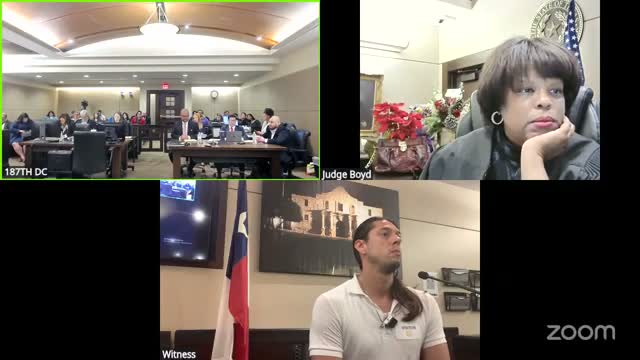
Summary
Jurors heard surveillance and body‑worn camera footage plus CSI testimony showing an AR‑style rifle, multiple magazines and hundreds of rounds recovered from a house where prosecutors say a suspect fired on officers on Oct. 19, 2023; officers described high‑risk extractions to remove injured colleagues.
A San Antonio jury on the first day of testimony in State v. Jesus Prado heard multiple witnesses and crime‑scene detectives describe an October 19, 2023 confrontation in which two officers were injured and an occupied residence yielded an AR‑style rifle, multiple magazines and large amounts of ammunition.
Detective Greg Deason of the San Antonio Police Department, called by the state, described arriving after radio traffic reported an officer down and said he and other officers reversed a civilian vehicle and patrol cars down a cul‑de‑sac to extract the injured officer. Deason testified they believed a rifle had been used from inside a residence, and that he observed a rifle in a bedroom and multiple holes in the bedroom window consistent with gunfire. "That's where the shooting took place," Deason told jurors when asked about damage to the bedroom window.
Detective Peter Donahue of the department's crime scene unit authenticated a series of interior photographs and testified that investigators recovered a loaded AR‑style rifle (admitted as State's Exhibit 76), at least one loaded magazine found inserted in that weapon and numerous additional magazines and ammunition from a closet. Donahue told jurors the items taken from the house included magazines that together contained 31 rounds at the time they were collected and that he recovered about 70 spent shell casings from the bedroom area and exterior near the window; he acknowledged it was possible some casings were not recovered.
Detective Albert Trevino, also with the crime scene unit, authenticated exterior photographs showing multiple bullet strikes to a front window, a tan vehicle with apparent bullet impacts and a blood trail in the cul‑de‑sac. Trevino said the photographs introduced as State's Exhibits 79–110 fairly represented the items he photographed and collected at the scene.
Detective Scott Stover, who responded as a second‑responder member of a crime scene unit, described the scene's urgency when officers reported gunfire and an officer down. Stover recounted repositioning to create cover, putting on heavier rifle plates and using a patrol vehicle as a ballistic barrier while extracting an injured officer, then transferring that officer to EMS. "It didn't look like he could physically move himself from the road," Stover testified about the injured officer he found in the roadway.
A civilian witness, Joshua Rao, whose home surveillance footage was admitted as State's Exhibit 26, identified images of himself and neighbors moving children to safety and said he initially considered arming himself because of the immediate threat, though he said the rifle he sought was locked. Rao also told jurors that when officers arrived and saw a person with a rifle, "they freaked out for a minute," reflecting the high stress and confusion at the scene.
Defense counsel cross‑examined several witnesses on the timing and direction of particular gunshots, noting that perception in a high‑adrenaline scene can affect counts of shots fired. The defense also sought clarification about which shots were audible on the body‑worn recordings and whether particular rounds could be attributed to the extraction vehicle or an interior vantage point.
The court admitted numerous exhibits without objection, including home surveillance video, multiple officer body‑worn camera files and an array of photographic evidence and weapons recovered from the house. Detectives described using a Leica laser scan to preserve the scene and collect measurements for later trajectory analyses.
No verdict or dispositive action was reached today; testimony will continue. The state presented multiple forensic exhibits that will be considered along with body‑worn camera footage and live testimony as the trial proceeds.