
Local outreach director frames homelessness as complex; urges layered services, treatment capacity and coordinated enforcement
Get AI-powered insights, summaries, and transcripts
Subscribe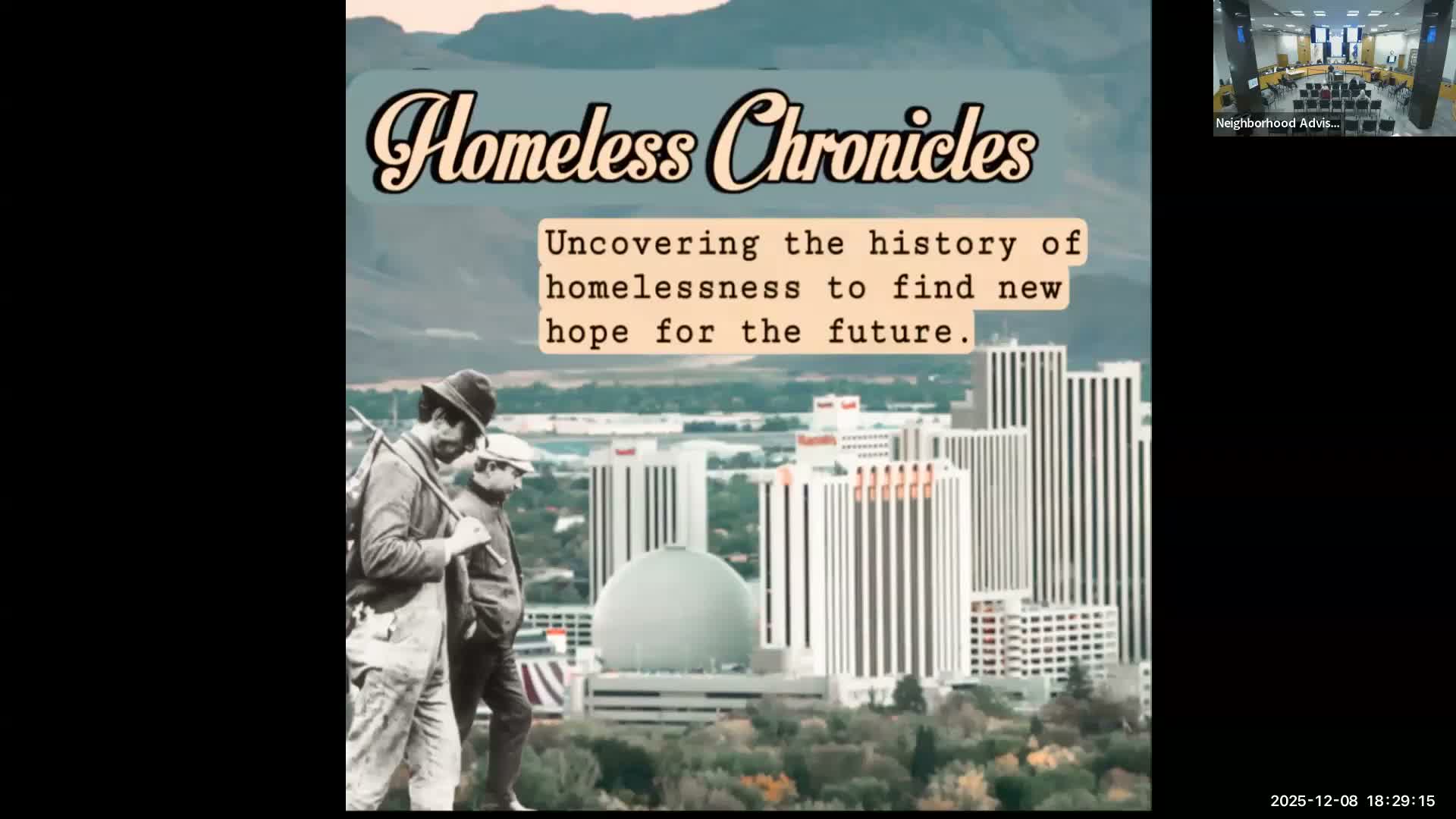
Summary
Grant Denton of the Karma Box Project gave a comprehensive presentation tracing historical drivers of homelessness and arguing for a tiered ecosystem of prevention, intervention, treatment and housing supports; he discussed local practices including CARES campus intake, low‑barrier policies, outreach and the limits posed by treatment bed shortages and privacy rules.
Grant Denton, founder of the Karma Box Project, told the board that homelessness stems from overlapping situational and behavioral causes and cannot be resolved by a single intervention. Denton traced historical and policy drivers — from early settlement houses and poor farms to deinstitutionalization, changes in drug policy and welfare reform — and argued that effective practice requires a mix of prevention, triage, treatment and long‑term supports rather than a single model.
Denton drew a clear distinction between situational homelessness (for example, sudden rent increases or job loss) and homelessness sustained or complicated by behavioral health and substance use disorders. He said successful programs historically combined basic housing, job training and ongoing services (the settlement‑house model) and warned that Housing First without accompanying treatment and supports can fall short for some subgroups. Denton urged a hybrid approach that combines compassion with structured, evidence‑based programming.
At the local level, Denton described the Karma Box Project's outreach and pre‑employment cleanup programs, and discussed the CARES campus and its operating model. He explained that CARES uses a Homeless Management Information System (HMIS) intake with a photograph and a Clarity card to coordinate services, but that client data is protected and cannot be disclosed publicly, which limits what providers can tell family members without law enforcement involvement.
Board members asked about treatment capacity, involuntary commitment models and the risk of legal challenges. Denton said several jurisdictions are exploring higher‑barrier or involuntary commitment facilities (he cited Salt Lake City and developments in Vancouver, Canada) but warned of legal complexity and the need to clearly define "harm to self" thresholds. He described efforts to direct people into treatment options when possible and to use the justice system to mandate treatment as an alternative to incarceration in some cases.
Denton also critiqued well‑intentioned but unmanaged feeding programs in parks, saying they can create congregation points without linking recipients to services; he recommended using meals as a vehicle for engagement rather than an end in itself. He argued the service ecosystem should allow for "tiered mobility" so people who fail at one program can move to another rather than back onto the street.
The presentation concluded with Denton's offer to share materials and a community resources barcode he created that aggregates regional homeless service providers and instructions for neighbors on how to route service requests. He encouraged board members to participate in outreach walks and to coordinate with DRP and city staff to maintain public spaces and connect people to services.