
Philomath council holds listening session as residents push to reshape proposed utility rate increases
Get AI-powered insights, summaries, and transcripts
Subscribe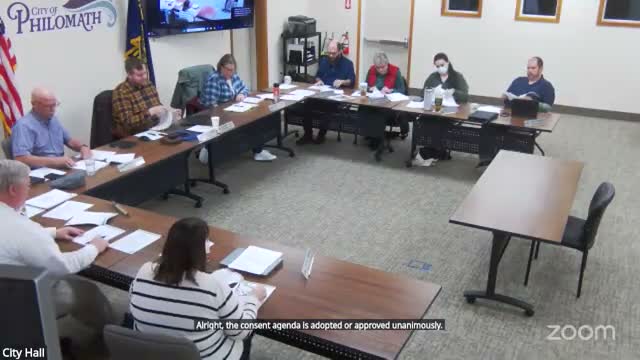
Summary
At a Dec. 8 listening session the Philomath City Council sought public feedback on a multi-year utility‑rate proposal. Residents questioned the pace of increases, tier cutoffs and treatment-plant sizing; the council asked staff for modeling and usage data before deciding on final rates.
Philomath — The Philomath City Council spent most of its Dec. 8 meeting hearing residents' concerns about proposed water, sewer and stormwater rate changes and the structure that would determine who pays more.
Council President Christopher McMoran opened the non‑voting listening session, saying the proposals are still a work in progress and that the council would not take action that night. He framed two separate questions for residents: how to structure rates (base vs. volumetric, tiers) and what dollar amounts are needed to support system costs and the new treatment plant.
Public testimony emphasized affordability and fairness. Van Hunsaker said the proposal would raise his household bill by roughly $450 a year and urged the council to examine tier thresholds so larger households are not unfairly penalized. “We need the city to have more money…and this is all definitely needed,” Hunsaker said, but asked councilors to reconsider some tier cutoffs.
Mark Knutson and Grant Gardner, local residents who compared Philomath with other Oregon cities, urged more transparency and a slower pace. Gardner told the council the combined increases being discussed add up to about a 43% increase over several years in his reading of the materials and questioned whether the new treatment plant’s stated 2.5 million gallons‑per‑day capacity is sized substantially above near‑term demand estimates.
Councilors debated alternatives. Councilor Crocker said she did not want to “penalize families” and favored a unified (flat) rate unless staff can show tiering would avoid undue harm to families. Councilor Carter proposed a two‑tier option (for example, a broad first tier up to 11 or 12 units and a higher rate above that). Councilors sought clearer inputs from staff: the percentage of customers in each proposed tier, scenarios that move more revenue into the base charge, and stormwater impacts on large institutional users such as the school district.
City staff and consultants defended the structure as designed to protect small users while encouraging conservation. City staff also noted that system development charges (SDCs) will cover a portion of the treatment‑plant cost, but not replacement or maintenance costs for existing customers.
After discussion the council asked staff to return with at least the following: a breakdown showing what percentage of customers fall into each tier under current and proposed structures; budget impact estimates for alternate tier thresholds (suggestions included 0–11 or 0–12 units for a single broad tier); scenarios moving weight from volumetric charges to higher base charges; and examples of stormwater impacts on large landowners and businesses. Mayor McMoran closed the listening session and said staff had time to refine options before any decision.
The council did not vote on rates; staff will present the modeled scenarios and underlying inputs at a future meeting before any ordinance or resolution is scheduled.