
APCD staff allege lack of transparency, retaliation in public comments; board does not take action
Get AI-powered insights, summaries, and transcripts
Subscribe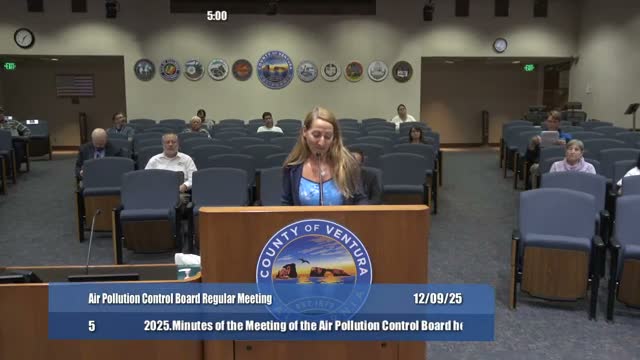
Summary
Two APCD employees told the Ventura County Air Pollution Control Board that leadership moved ahead with recruiting a high-salary deputy role without promised staff review and that complaints about retaliation and bullying have not been fully investigated. The board acknowledged procedural limits under the Brown Act and did not direct a new investigation.
Two Ventura County Air Pollution Control District employees used the public-comment period at the board's regular meeting to allege procedural irregularities and workplace mistreatment, telling the board they've been promised but not given meaningful staff review of a proposed high-salary administrative position and that county investigations into complaints have been incomplete.
At the podium, Laura Kranzler, an APCD air quality engineer who said she has worked for the district since 2012 (and previously from 1996 to 1999), told board members the agency's executive officer had moved forward with recruiting an "administrative services director / assistant deputy director" without review by the Performance Improvement Team (PITT), despite prior assurances that the PITT would review the job duties and scope. "Staff are left feeling confused, discouraged, and defeated by what appears to be a lack of transparency," Kranzler said, adding that staff fear retaliation for speaking up.
Kranzler also questioned whether the new position would duplicate responsibilities of the existing HR manager and called for clearer, documented processes for how staff input is solicited and used. She said previously submitted public-comment letters and internal emails raised the same concerns and that promised PITT involvement was not reflected in subsequent recruitment steps.
Hayden (Hay) McPherson, an APCD inspector, echoed Kranzler's concerns and described months of staff frustration. McPherson said the deputy director role would be "a very high salary position costing the district at at most $300,000 a year," and said staff were repeatedly shut down when attempting discussion at an all-hands meeting. "I do not feel respected by Ollie," McPherson said, using the executive officer's familiar name, and added that some former employees who submitted complaints had not received responses.
An unidentified speaker reminded the board that the Brown Act limits substantive board discussion of items not on the agenda. Chair McQueen LeJeune said the board had approved the documentation required for the hiring action and directed the executive officer to share relevant information; she otherwise did not open the topic for substantive discussion.
No formal action was taken in response to the public comments during the meeting. The public speakers asked the board for independent or more thorough investigations; the record shows board members acknowledged the concerns but cited procedural limits on discussing unagendized personnel matters in an open meeting.
Next steps: The public commenters requested investigations and follow-up; the board did not vote on initiating any new investigation at the meeting.