
House Insurance Committee hears industry plea to change PIP priority for limousine and private passenger carriers
Get AI-powered insights, summaries, and transcripts
Subscribe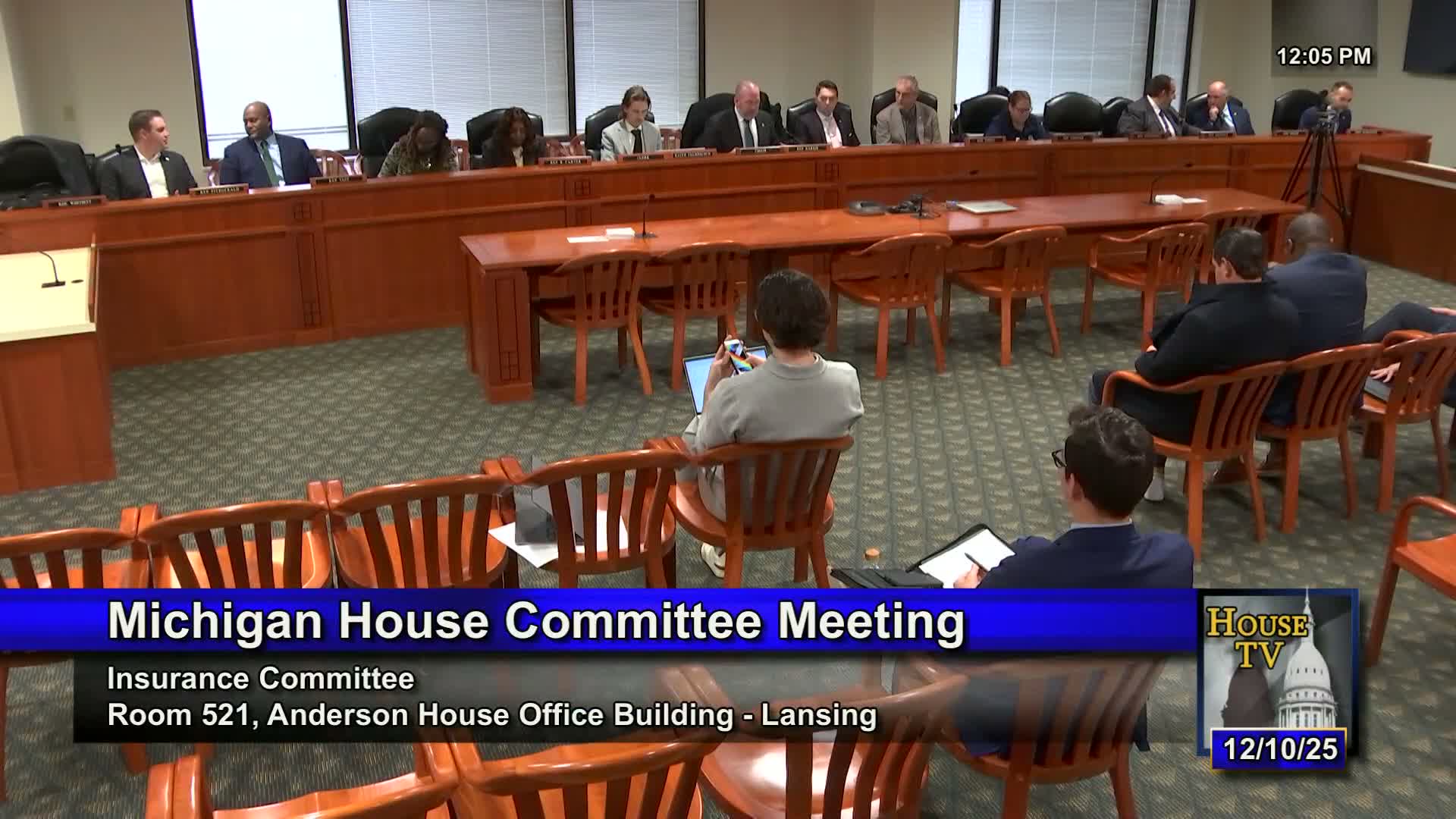
Summary
Industry representatives told the House Insurance Committee that Michigans current order-of-priority for personal injury protection (PIP) puts limousine and certain private passenger carriers first, creating outsized medical exposures that have driven up premiums and pushed some Michigan operators out of the market; the committee heard testimony but took no vote.
LANSING — The House Insurance Committee on Thursday heard testimony on two bills, introduced by the committee chair and Representative Jason Morgan, that would change who pays personal injury protection (PIP) medical benefits when passengers are injured in limousines and similar private passenger carriers.
Industry operators told the committee the bills aim to place limousines and other private carriers on the same PIP priority level as taxis, transit and ride-hail services so injured passengers would first claim through their own auto or household insurance and then through the Michigan assigned claims mechanism. "Under Michigan's current no-fault structure, certain passenger transportation providers are placed at or near the front of the PIP order of priority," said Sean Duvall, an industry operator, explaining the proposed change. He added that the problem is not liability coverage but the requirement that some carriers' PIP policies pay medical benefits first.
Why it matters: Operators said the current priority rules have made it difficult for Michigan-based carriers to get competitive insurance quotes and have driven premium spikes. "This collision on a $30 trip cost me and my $50,000 deductible $17,000 to repair my vehicle, and almost $25,000 in medical benefits for the person in the back seat of the car," Duvall told the committee as an example of the financial strain. Chad Cushman, president of Indian Trails Michigan Flyer, told members his company's loss ratios averaged about 20 percent while premiums climbed roughly 112 percent in recent years. Cushman said insurers often decline to quote because of "venue" — the state of Michigan — and because carriers serve a high share of riders without cars or medical insurance.
What witnesses proposed: Witnesses asked the committee to amend the insurance code so that, for PIP medical benefits, passengers of limousines and similar privately operated carriers would claim through their own auto or household policies and then the assigned-claims mechanism rather than the carrier's commercial PIP. "We're not asking not to pay insurance. We're not asking to reduce coverage for anybody. We're just asking for parity with all of the rest of the passenger carrying industry," Duvall said.
Questions from lawmakers focused on where the risk would fall if PIP responsibility shifted and on alternatives such as captive insurance. Representative Fitzgerald noted higher repair and jury-award costs and asked whether captive insurance or other alternative risk solutions had been explored. Cushman said his company pursued a captive option through a broker but was declined, and that underwriters were concerned about the passenger profile and resulting medical exposure.
No formal action: The committee did not vote on either bill. The only formal actions recorded in the hearing were procedural: a motion to approve the Oct. 29 minutes (moved by Minority Vice Chair Carter and approved without objection) and a motion to excuse absent members (handled by Representative Schuette and approved without objection). The committee chair said staff are working on subcommittee language and thanked stakeholders for input ahead of further consideration.
Whatcomes next: Committee staff indicated they are drafting subcommittee language for future consideration. No hearing date or vote was announced at adjournment.