
Mayors urge regional collaboration to tackle housing, homelessness and economic growth
Get AI-powered insights, summaries, and transcripts
Subscribe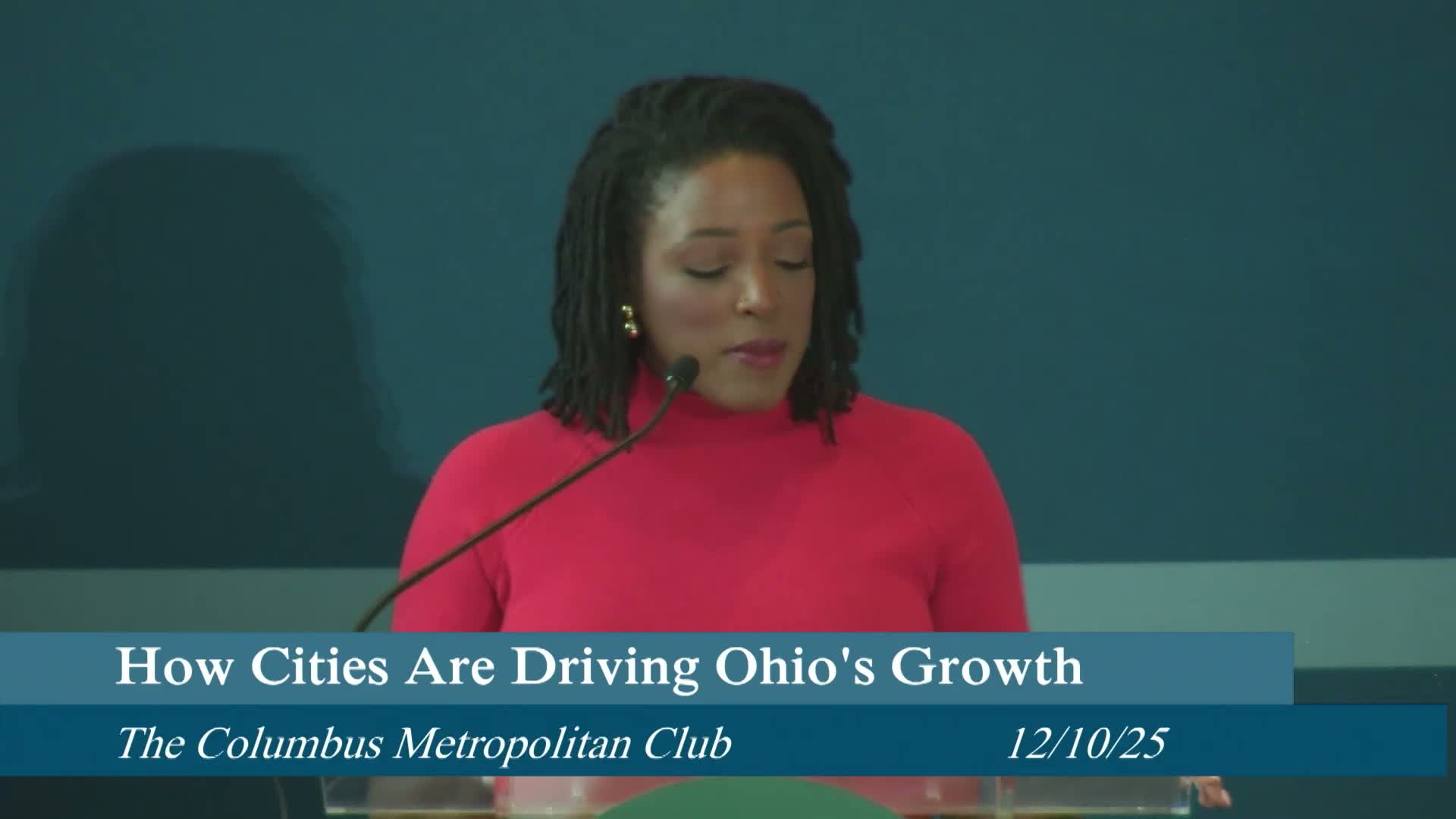
Summary
Mayors from Columbus, Toledo, Findlay and Lima told a Columbus Metropolitan Club forum that Ohio cities must act regionally to attract investment, expand housing and respond to federal funding cuts that threaten homelessness services.
Columbus, Toledo, Findlay and Lima mayors said at a Columbus Metropolitan Club forum in Downtown Columbus that Ohio cities must work together to sustain growth, expand affordable housing and plug gaps left by federal funding changes.
The forum, hosted at the National Veterans Memorial and Museum and moderated by Stacia Nakhwin, brought four mayors to the same stage to discuss regional collaboration for talent, investment and visibility. Columbus Mayor Andy Ginther described the city’s recent bond package as the largest housing commitment in the city’s history and said the city is pursuing a regional housing coalition with the goal of getting 200,000 housing units into the pipeline over the next decade to make housing affordable for workers. "If you work in this community, you should be able to afford to live here," Ginther said.
Mayors said federal policy shifts are complicating local responses. Panelists referred to a recent U.S. Department of Housing and Urban Development (HUD) policy change to local assistance programs and warned that reduced federal support could push thousands of Ohioans back into homelessness. Findlay and Lima mayors described shelters and emergency housing operating at or near capacity and said local stop-gap measures — such as low-barrier shelters and warming centers — are already being expanded.
Toledo Mayor Wade Kapsakovich highlighted recent improvements in the city’s fiscal position, including bond-rating upgrades after many years and growing reserve balances, but cautioned that local job gains fall short of broader economic needs. He noted a recent commitment that will add hundreds of manufacturing jobs at the region’s Stellantis (Jeep) plant but said the city still needs many more jobs to close its estimated budget gap.
On data centers and other large corporate investments, mayors urged early, practical negotiations to protect ratepayers and local capacity. Speakers said cities should evaluate energy and water availability, secure infrastructure investments from developers, and structure agreements so that local taxpayers do not absorb disproportionate costs. They also warned that changes to property-tax policy under consideration in Ohio could materially reduce local revenues and harm the ability of cities to deliver services.
Panelists described concrete local approaches to workforce and housing development. Lima officials highlighted apprenticeship and trade programs and a local effort to assemble parcels and reform zoning to speed housing production. Toledo and other cities described land-bank activity and targeted rehabilitation projects intended to stabilize neighborhoods even when projects operate at a local financial loss.
Speakers urged a mix of advocacy and local investment: push for state and federal partnerships while building local coalitions with private sector and philanthropy to shore up services. The forum closed with an announcement of a weekly book-recommendation partnership between the Columbus Metropolitan Club and the Columbus Metropolitan Library.
The forum’s mayors and local leaders said they remain bullish about Ohio’s future but emphasized that achieving inclusive growth will require sustained regional cooperation, clearer state policy choices on taxation and continued advocacy to preserve or replace federal housing supports.