
Vigo County Council approves $1.8875 million for countywide radio upgrade after extended debate
Get AI-powered insights, summaries, and transcripts
Subscribe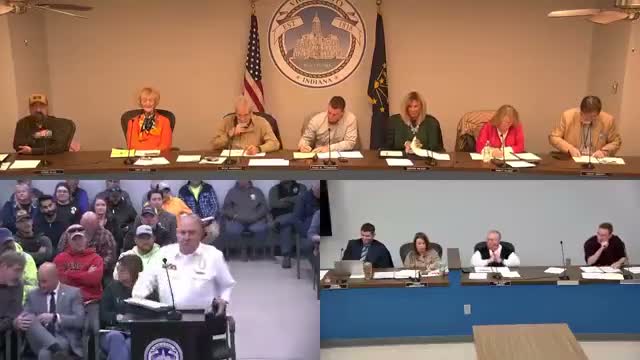
Summary
After hours of public testimony from firefighters, police and technical experts and extended council questioning about procurement, funding and technical safeguards, the Vigo County Council amended and approved a $1,887,500 appropriation to add three radio tower sites and equipment to expand coverage and capacity on the statewide Motorola public-safety network.
The Vigo County Council voted unanimously to approve a $1,887,500 appropriation to expand the county’s public-safety radio network, approving a five-site, Motorola-based upgrade the county’s 9-1-1 advisory committee recommended.
The measure, amended downward from an advertised ceiling, funds three additional tower sites and related equipment and will be paid from local public-safety revenue streams. Council members pressed presenters and Motorola representatives for details about procurement, warranties and long-term maintenance costs before the vote.
Why it mattered: County public-safety leaders told the council the current two-site system has long left gaps in radio coverage and suffers capacity strain during major incidents. “This upgrade will eliminate the coverage gaps that first responders have battled for decades,” a fire-union representative said in public comment, while radio-committee chair Scott Dalton called the situation “critical,” saying the committee’s testing shows repeated busy signals and dropped communications during high-demand events.
What proponents said: Battalion Chief Scott Dalton and union leaders stressed life-safety risks from marginal coverage and capacity limits; a union firefighter said simply, “First responders’ lives,” to emphasize urgency. The county’s radio committee argued single-source procurement from Motorola is appropriate because the county is expanding an existing Motorola-compatible statewide system and because integrated vendor accountability reduces the risk of post-construction interoperability failures.
What opponents and questioners raised: Several council members and independent technicians urged caution. Chris Doty, a local two-way radio technician, requested independent verification and a robust acceptance test plan so the county can “prove the coverage before they would pay.” Council members asked whether the county could build and own separate towers or use alternative redundancy strategies such as SmartConnect (cellular failover), phased radio upgrades, or mobile repeaters. Legal and finance staff addressed procurement timing and fund sources.
Funding and procurement details: Presenters said the appropriation will come from local public-safety/local income tax and related public-safety funds; Motorola offered a multi-year financing option and pricing that included discounts available in 2025 pricing. A Motorola representative said some special finance discounts applied only to 2025 pricing and estimated the total discount at roughly $500,000–$600,000 compared with later-year pricing. The project includes multi-year warranty/maintenance terms through the early 2030s; county staff said annual post-warranty maintenance costs would be budgeted in future years.
Council action and next step: After lengthy questions and a motion to reduce the appropriation to a lower final figure, the council amended the appropriation to $1,887,500 and approved it by roll call vote, 7-0. Council members asked staff to document expected multi-year payments and to pursue arrangements to help local agencies upgrade radios at discounted prices. The county will sign a vendor contract and proceed with the tower builds and equipment installation under the plan presented.
Closing note: Supporters framed the vote as a safety decision to reduce the risk of missed or failed communications during major incidents; critics sought additional independent acceptance testing and staged upgrades to reduce fiscal and operational risk.