
UN brief: Afghanistan faces deepening humanitarian crisis as funding and women’s access shrink
Get AI-powered insights, summaries, and transcripts
Subscribe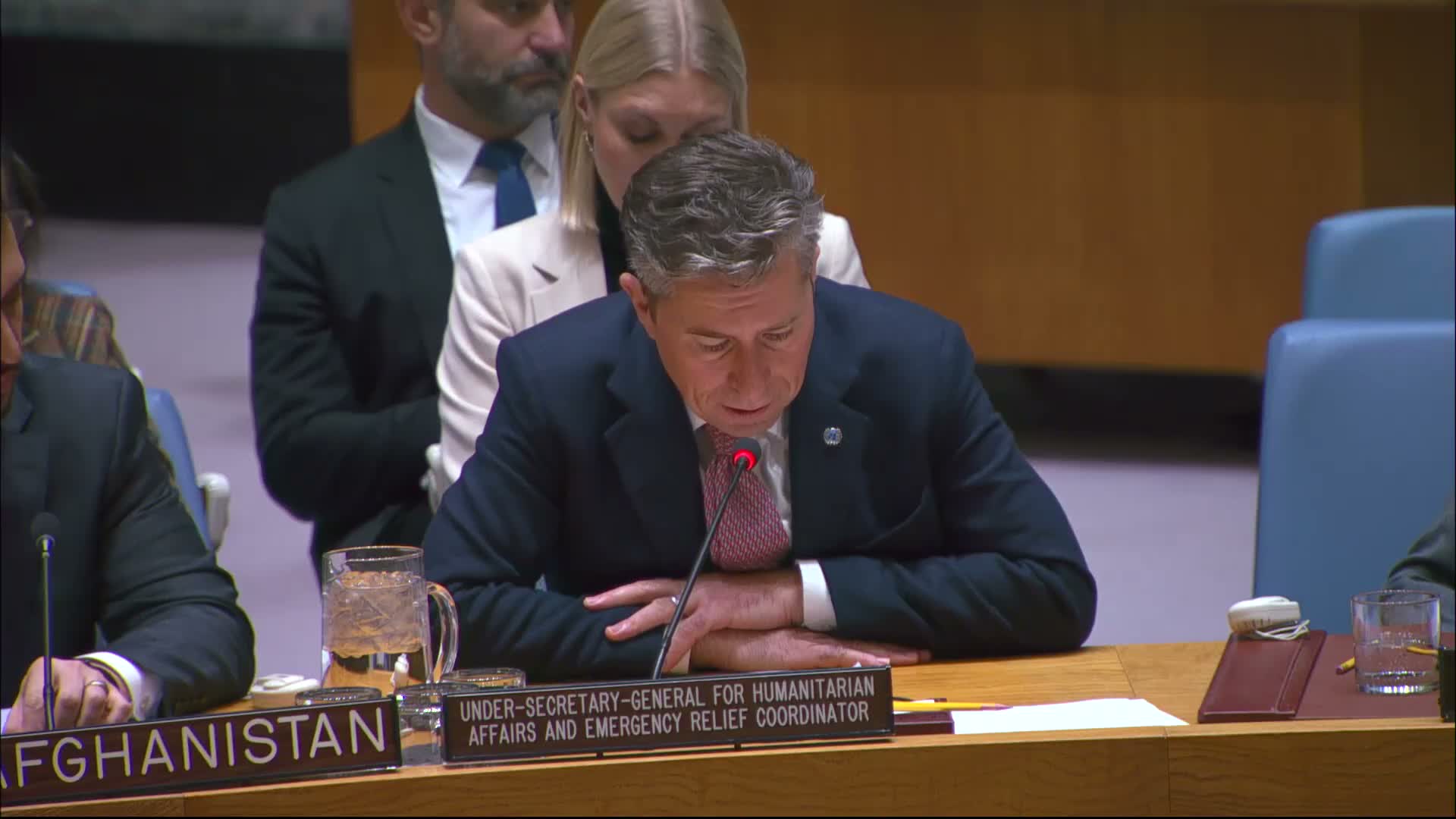
Summary
Tom Fletcher told the Council that funding cuts, natural disasters and restrictions on women humanitarian workers have intensified Afghanistan’s crisis; he appealed for continued use of the humanitarian exception in UNSCR 26 15 and urgent funding, including a $1.7 billion Afghanistan request and a $23 billion global appeal.
Tom Fletcher told the Council that Afghanistan is in a severe humanitarian crisis driven by overlapping shocks, restrictive policies affecting women and girls, decades of conflict and recent, large funding cuts. "Nearly 22,000,000 people will need our help in 2026," Fletcher said, and he urged continued support for the humanitarian exception in resolution 26 15 to keep essential operations running.
Fletcher said the UN is seeking $1.7 billion for Afghanistan to reach 17.5 million people but has hyper-prioritized interventions to target roughly 3.9 million people at greatest risk given current funding shortfalls. He warned that hunger has increased for the first time in four years and that roughly 17.4 million people are now food insecure in the country.
Reporting from recent field visits to Kabul, Kandahar and Kunduz, Fletcher described the scale of population movement: "Over 2,600,000 Afghans returned in 2025," he said, with more than 4,000,000 returning over the past two years. He said women and children made up about 60% of returns this year and noted that about 2,500,000 Afghans remain in Pakistan, many of whom have recently seen their legal status revoked, raising the risk of further mass returns.
Fletcher described recent natural disasters—two major earthquakes in August and November that killed thousands and destroyed homes and villages—and drought conditions affecting roughly 3.4 million people into the winter months. He said the UN has released over $40,000,000 from the OCHA-managed Central Emergency Response Fund (CERF) to support the surge in returns, earthquake response and drought preparedness.
A central concern in Fletcher’s briefing was access and restrictions on women humanitarian workers. He said national women UN staff were barred from entering UN compounds in early September and that, "Unacceptable," he called the continuing limits. He added that in late October almost all national women humanitarian workers were prohibited from operating at the Islam Kala Reception Center along the Iranian border, where thousands of returns had been reported daily; this, he said, limited women’s access to essential protection and health services. "We need them. Afghanistan needs them," Fletcher said of women humanitarian staff.
On legal and operational facilitation, Fletcher explained the humanitarian exception to resolution 26 15, saying it permits essential operational payments—rent on state-owned premises, withholding of taxes on NGO staff income, utilities, visas and work permits, security costs for UN compounds and movements, import and landing fees, NGO registration and communications equipment charges—measures the UN describes as indispensable for conducting humanitarian operations.
Fletcher also detailed risks and mitigation measures: pressures to amend beneficiary lists, administrative impediments, influence over staff and contractor selection, and the persistent risk of aid diversion. To limit fraud and diversion the UN has strengthened risk-management frameworks, applied standards across agencies, ensured that 15% of cash transfers are fully audited, introduced biometric authentication and ID checks against vetted recipient lists, digitized cash distribution tools, and developed interagency complaints and feedback mechanisms. He said that when diversion is detected agencies halt distributions, engage with de facto authorities, and resume only after strict compliance criteria are met.
On service impacts, Fletcher said underfunding has forced closures and rollbacks of assistance: "about 1,000,000" of the most vulnerable received food assistance during the 2025 lean season, down from about 5,600,000 the previous year; 305 nutrition delivery points have closed; roughly 3,700,000 children are in need of nutrition, including about 1,700,000 at risk of death if not treated; and 422 health facilities closed in 2025, leaving an estimated 3,000,000 people without access to life‑saving care.
Fletcher closed with three requests to the Council: continue to support implementation of UNSCR 26 15, insist that women humanitarian staff be allowed to work without restrictions, and fund the global humanitarian overview appeal he launched—he cited a global ask of $23,000,000,000 to reach 87,000,000 people. "Otherwise, humanitarians will be forced to make even more brutal, deeper cuts with devastating consequences for the Afghan population," he said.
S1 thanked Fletcher for his briefing. The record contains no formal Council action or vote in this transcript; Fletcher’s statements functioned as a briefing and an appeal for continued political and financial support.