Lane County explores WAGA RNG system at Short Mountain and potential $5M to relocate Clean Lane
December 11, 2025 | Lane County, Oregon
This article was created by AI summarizing key points discussed. AI makes mistakes, so for full details and context, please refer to the video of the full meeting. Please report any errors so we can fix them. Report an error »
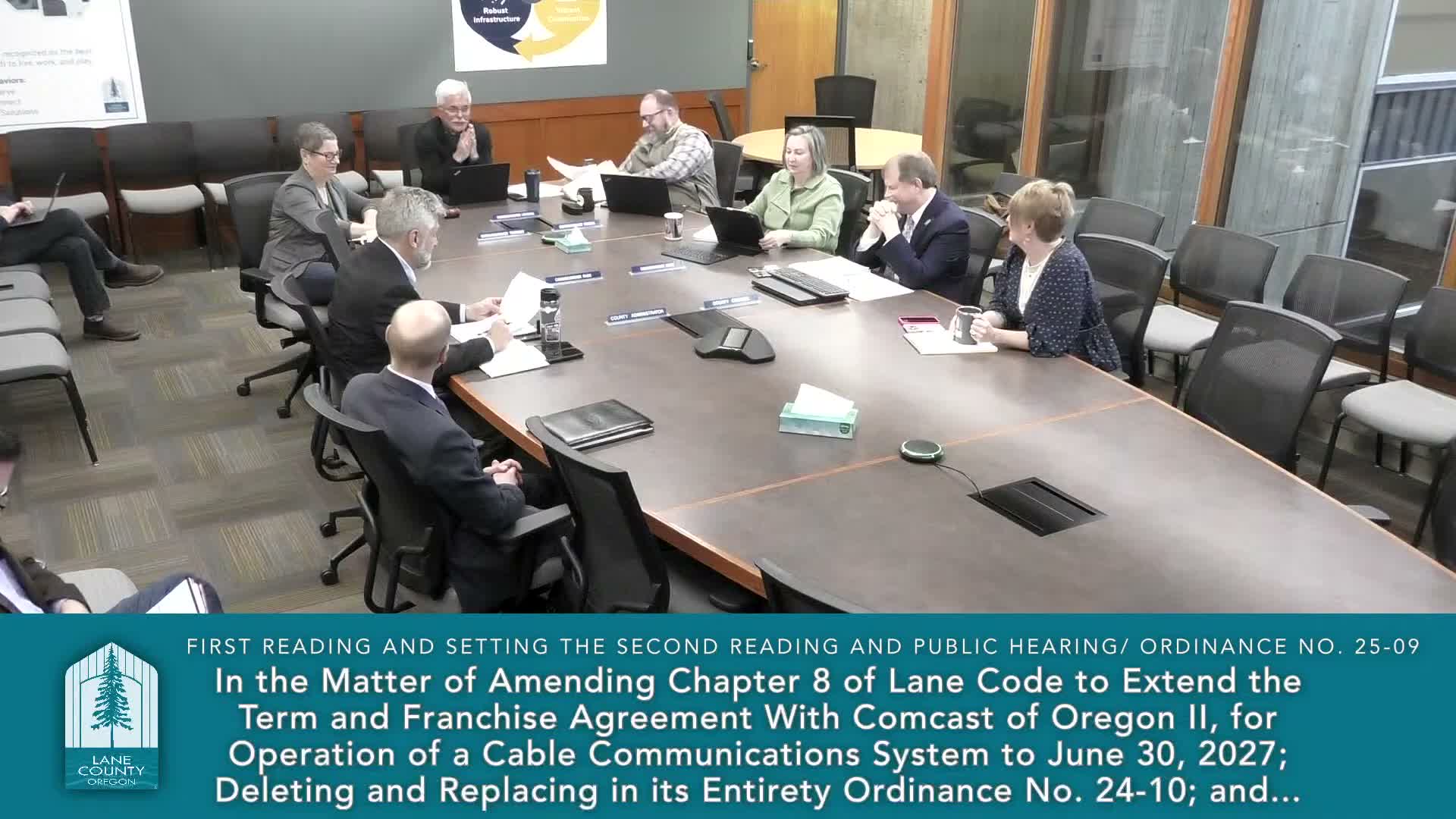
Counsel said EPUD issued an RFP and selected WAGA; the deal is structured across five posted documents including a tri‑party master agreement, an assignment/assumption (EPUD transfers gas rights to WAGA), an amended and restated landfill-gas use agreement (25-year term), transition/decommissioning terms and a royalty agreement describing how revenues will be shared. Counsel said WAGA has 32 facilities in operation, 16 under construction, and that Lane County would host the first WAGABOX in Oregon.
Counsel described the WAGABOX 2 as able to handle up to 2,000 cubic feet per minute (CFM); county staff said current collection is about 1,850 CFM and they used conservative assumptions in projections. Counsel said WAGA would invest about $600,000 upfront to improve the county’s collection system and commit roughly $250,000 per year (budgeted in three-year blocks) for ongoing maintenance and upgrades to increase capture. "WAGA is proposing to install what they call a WAGA box 2. That has the capacity to handle up to 2,000 CFM," counsel said.
Two interconnect options were presented: (1) WAGA installs a private 2‑inch line to Northwest Natural for about $7.46 million (would serve the WAGABOX alone); or (2) Northwest Natural installs a 4‑inch line (approx. $11.3 million) that could serve both WAGA and a Clean Lane facility. Counsel said the county would be responsible for the cost delta of roughly $3.8 million if the board chooses the Northwest Natural 4‑inch option to accommodate Clean Lane and the leachate line.
On revenues, counsel said the royalty schedule gives WAGA the largest share up to $6 million in annual sales, shifts partner shares in the $6–9 million band, and becomes 50/50 above $9 million. Using conservative pricing ($18.50 per unit) and current collection assumptions, counsel estimated about $1.4 million in gross receipts, roughly $1,000,000 of which would first cover EPUD’s replacement power cost, leaving about $400,000 annually to be split 50/50 between EPUD and Lane County during the initial 15 years and thereafter flowing to the county.
Board members asked detailed questions about decommissioning EPUD equipment, taxation of leased property at the site, how the $250,000 rolling maintenance pool works, where unspent maintenance funds reside, whether the county is "fracking" the landfill (staff emphasized no drilling beyond landfill fill and that "pressurizing" means better extraction control), nitrogen removal and proprietary WAGA processes for scrubbing nitrogen, and the timing required for permits and construction. The WAGA board has approved the agreement and EPUD has considered it; counsel requested the board take up formal orders next week so the project can preserve a potential federal tax credit (counsel said an internal revenue code incentive could yield roughly $3 million, divided among partners, if the construction window is met).
Counsel also presented Item 13c: a proposal to explore siting the Clean Lane facility at Short Mountain given the possible gas interconnect. He said thorough scoping is complete but advancing to design/engineering and interconnect would require authority to expend money. Counsel asked the board whether to continue pursuing Short Mountain and said staff would seek authorization to spend roughly $1.26 million on engineering and up to $3.8 million for the interconnect delta — about $5 million in total — if the board wants to pursue relocation. Counsel highlighted that the Goshen site remains under appeal at the Land Use Board of Appeals (LUBA) with a decision due by Dec. 24, and staff said they would return next week with a set of draft orders and more precise cost estimates, including separate leachate-line costs.
Commissioners offered mixed but largely favorable comments: Commissioner Farrar framed captured methane as an asset and urged clarity on allocations and impacts of diversion; Commissioner Buck praised the public–private partnership approach; other commissioners pressed for clearer cost and funding sources before committing. Counsel and staff committed to return with detailed pricing, draft orders, and options next week that would preserve tax-credit eligibility and keep both Short Mountain and Goshen siting options open pending the LUBA decision.
Next steps: staff will provide cost breakdowns for the leachate line and trenching options, estimated timelines and financing options, and draft orders for the board to consider next week. The board will decide whether to authorize engineering and interconnect expenditures and whether to relocate Clean Lane to Short Mountain after receiving those materials.
Don't Miss a Word: See the Full Meeting!
Go beyond summaries. Unlock every video, transcript, and key insight with a Founder Membership.
30-day money-back guarantee
Sponsors
Proudly supported by sponsors who keep Oregon articles free in 2025

