
UN briefing warns winter and strikes on power infrastructure are deepening Ukraine’s humanitarian crisis
Get AI-powered insights, summaries, and transcripts
Subscribe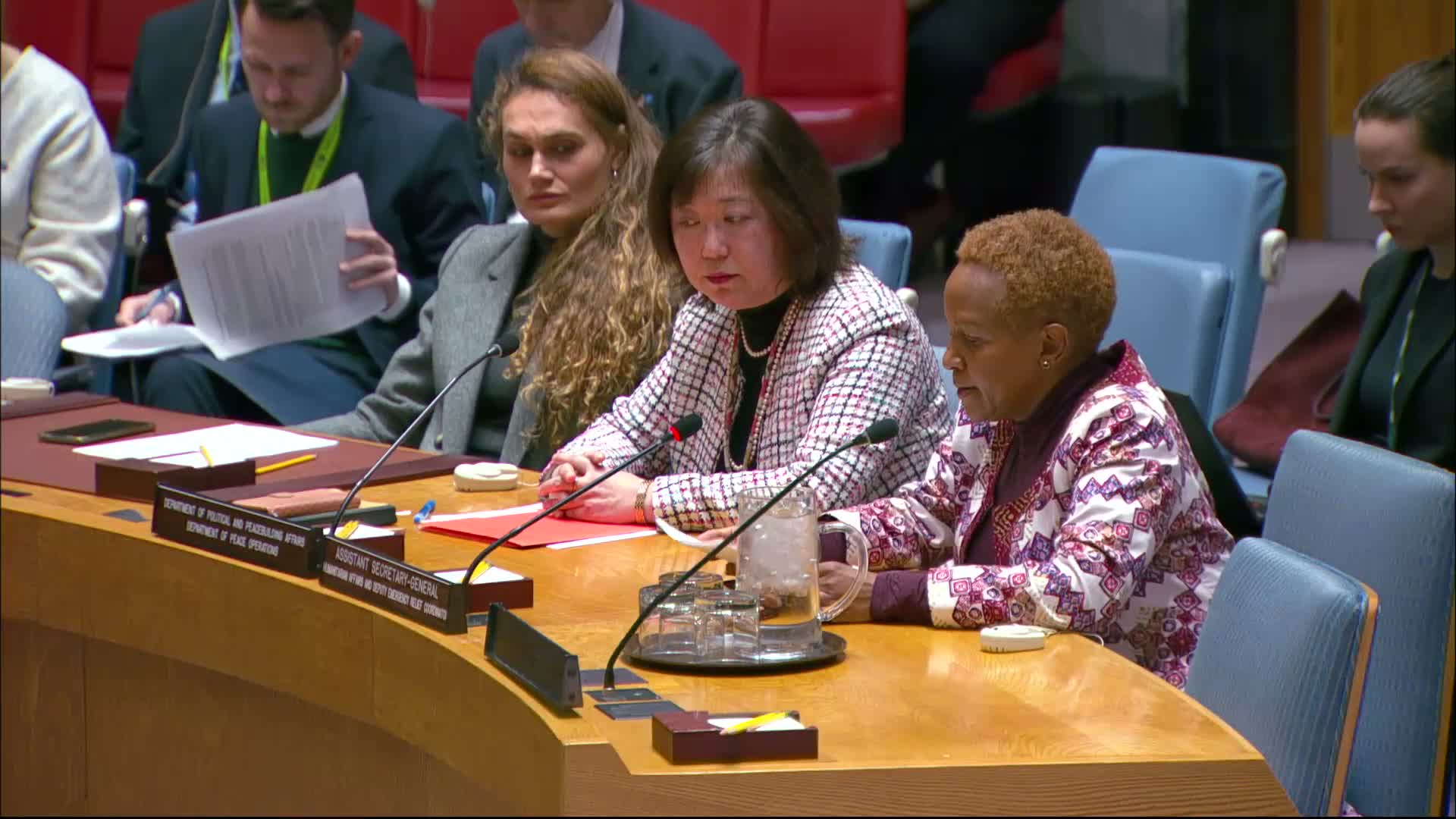
Summary
Joyce Muswea told the council that missile and drone strikes have damaged energy and health infrastructure in Kharkiv, Odesa and the Dnipro region, causing prolonged blackouts, increasing evacuations and leaving winter response plans underfunded.
Joyice Muswea briefed the council that continued missile and drone strikes across Ukraine have exacted a heavy toll on civilians and critical services as winter deepens. She said strikes often occur at night in freezing temperatures and “kill and injure civilians,” while damage to energy systems is producing prolonged blackouts that cut heat and water to entire apartment blocks.
Muswea said recent strikes hit critical energy infrastructure in Kharkiv, Odesa and the Dnipro region, and that repair teams cannot keep pace with the damage. She warned that rolling blackouts of 12 to 18 hours in several oblasts are leaving families without heat and water and that a missile strike in Odesa last week destroyed a substation that also served a displacement centre.
Quoting a clinician on frontline effects, Muswea said, “people can survive without electricity for a time, but not without heat,” and stressed that elderly patients can decline within hours without heating. She also reported that WHO has verified hundreds of attacks on health care this year that have killed, injured or crippled health services at a moment when illnesses and hypothermia risks are rising.
Humanitarian partners have pre‑positioned winter clothing, blankets and thermal supplies in frontline oblasts, expanded collective centres and deployed mobile health teams. Muswea said 44 convoys so far this year reached about 50,000 civilians in the hardest‑to‑reach frontline communities, but access to some front‑line areas remains “extremely challenging” because of active hostilities, damaged roads and security restrictions.
Muswea warned funding shortfalls are constraining winter operations: only 65% of the $279,000,000 required for the winter response plan has been received, forcing cuts to services including cash assistance, heating support, mental‑health care and protection for women and girls. She cited the global humanitarian overview that estimates 10,800,000 people will need assistance in 2026 and that $2,300,000,000 is needed to reach 4,100,000 people.
The briefing highlighted aggravated needs in places already difficult to reach, including Liman where roughly 3,000 civilians were described as out of reach of regular assistance, and reports that families are rationing supplies. Muswea also noted accelerated voluntary evacuations across Donetsk and Kharkiv oblasts where repeated shelling has made it impossible to guarantee minimal services.
Muswea reiterated that international humanitarian law requires protection of civilians and civilian objects and that indiscriminate or disproportionate attacks are prohibited. She drew attention to the recent meeting of states parties to the Anti‑Personnel Mine Ban Convention and voiced UN concern about reports that a state intends to withdraw from the treaty, a development she described as part of a worrying retreat from rules meant to protect civilians.
She closed by urging council members to take three steps: ensure the rules of war are upheld in practice; facilitate unimpeded humanitarian access; and fund humanitarian action in line with the scale of need. Muswea warned member‑state decisions in the coming weeks would determine whether families face the winter with or without heat, medical care and shelter.