
Speakers urge Pittsburgh council to preserve Housing Opportunity Fund and eviction-prevention programs
Get AI-powered insights, summaries, and transcripts
Subscribe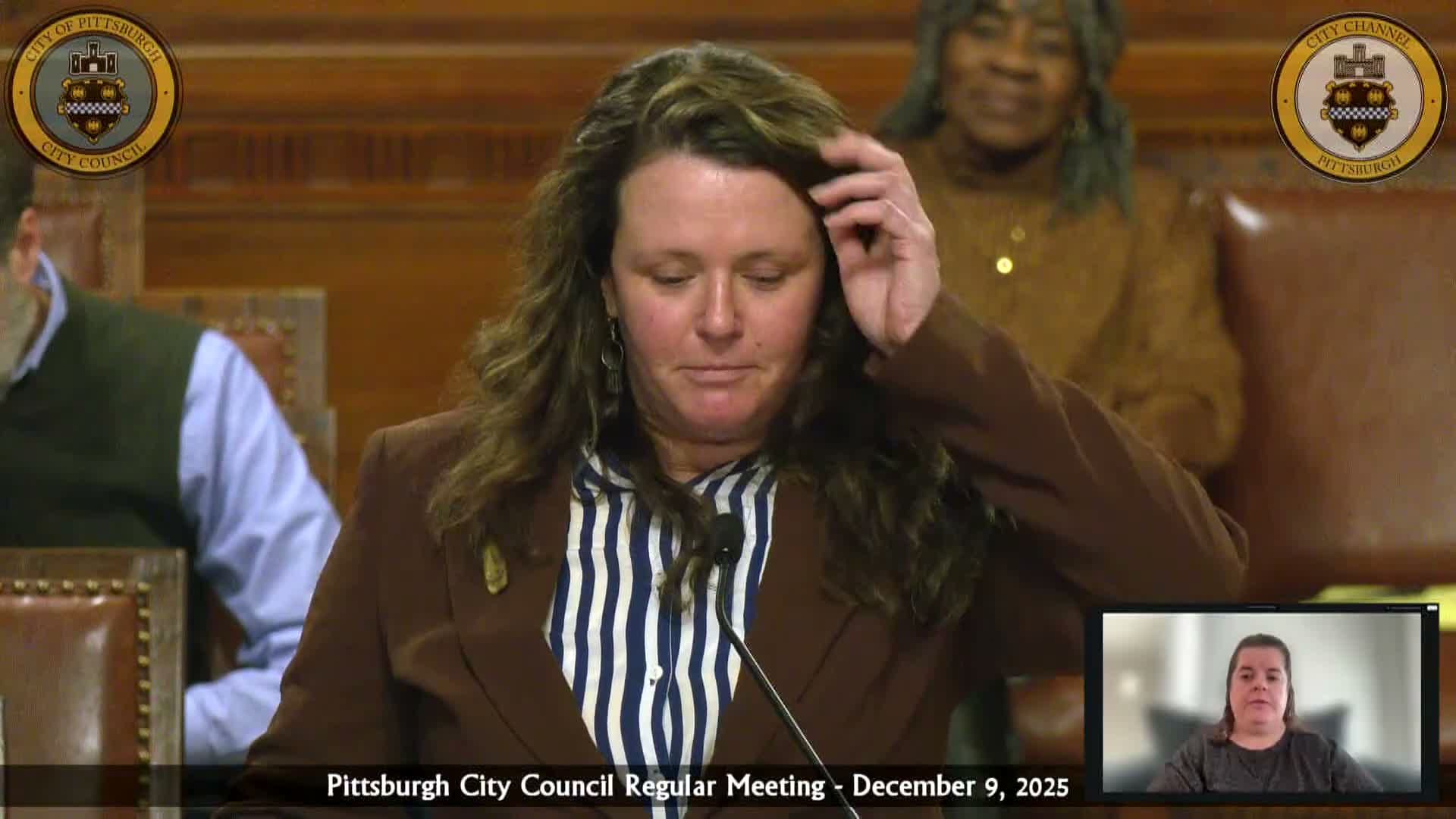
Summary
Nonprofit leaders and legal-aid attorneys told City Council that cuts to the Housing Opportunity Fund and Stop the Violence funds would end eviction-prevention programs that helped thousands of Pittsburgh families, citing program outcomes and revenue history tied to the realty transfer tax.
Speakers at Pittsburgh City Council’s Dec. 9 meeting urged members to protect the Housing Opportunity Fund and related eviction-prevention programs as the council weighs the 2026 budget. Nonprofit leaders and legal-aid attorneys described the funds as essential to keeping people housed and reducing the downstream cost of evictions.
Abby Rae Lacombe, executive director of Rent Help Pittsburgh, told the council her organization “directly serve[s] and prevent[s] displacement for more than 2,000 families every year,” and that the Housing Opportunity Fund is “a primary local source that makes this possible.” She said those programs produce high rates of positive outcomes for tenants who receive legal help and rental assistance.
Natalie Ryan, director of housing stabilization at Action Housing, provided citywide totals from 2021–2024: “more than 11,371 City of Pittsburgh families received rental assistance that prevented eviction,” a sum she said amounted to “over $55,000,000.” Ryan emphasized that the people most at risk include seniors and families with children and urged council to “maintain full funding for rental assistance.”
Bob Damewood, staff attorney with Regional Housing Legal Services, traced the funding history of the Housing Opportunity Fund and the 1% realty transfer tax (RTT) that supports it. Damewood said the RTT generated $16 million in one year and was on track to generate about $13 million next year; he warned that keeping RTT revenues while cutting the HOF would be “a fundamentally dishonest thing” to do.
Suane (Spoken as “Swain/ Suane” in testimony) Uber, who manages eviction-prevention programs with a legal-aid partner, said Lawyer of the Day programs and outreach funded by HOF and Stop the Violence funds reach only parts of the city and that cuts would halt planned expansions. “If funding is cut from either source, these families will continue to face homelessness,” she said, and described coverage gaps across magisterial district lines.
Council members acknowledged the testimony while noting the city’s budget shortfall and the need to prioritize competing demands. Council previously adopted a ‘will of council’ on the 2026 budget that calls for further joint work with the mayor’s office and the Office of Management and Budget to address concerns before the Dec. 31 fiscal deadline.
Next steps: council will continue budget hearings and committee discussions this week; multiple budget hearings for the Office of Management and Budget and other departments are scheduled in the following days.