
Eugene budget committee hears updated forecast, recommends $10 million PERS side account and one‑time investments to shore reserves
Get AI-powered insights, summaries, and transcripts
Subscribe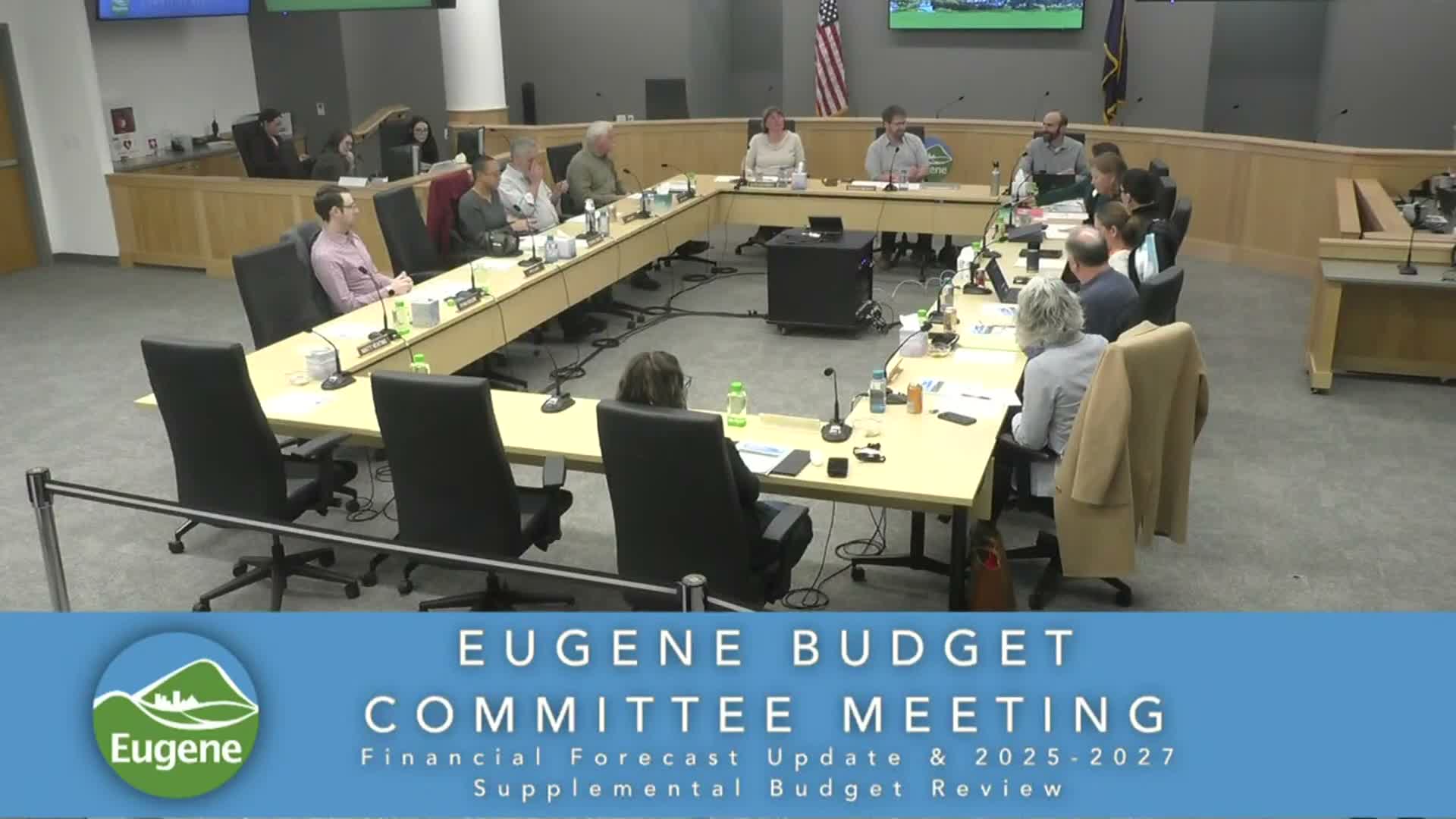
Summary
Staff told the Eugene Budget Committee that lower assessed value growth and collection assumptions reduce property tax revenue by $4.3 million over six years and that a combination of an $8 million PERS lump‑sum contribution (with a $2 million state match) and one‑time allocations would help protect reserves and buy down future pension costs.
EUGENE — City finance staff presented an updated six‑year general fund forecast on Dec. 3 that reduces projected property tax revenue and shows a structural imbalance requiring roughly $2.2 million per year in ongoing reductions in the next biennium if no other actions are taken.
Senior financial analyst Maurizio Badalico said staff lowered the assumed taxable assessed value growth rate from 3.6% to 3.5% and reduced the assumed property tax collection rate from 95.6% to 95.5%, changes that together shrink projected property tax revenue by about $4,300,000 over the six‑year forecast period. He also cited a drop in taxable building permit values in FY25 and the expiration of certain tax preferences as contributors to weaker near‑term revenue growth.
The forecast shows the city’s biennial reserve target at about 4% of biennial expenditures (roughly $17 million per biennium). Under current assumptions, the updated reserve trajectory trends downward, and staff said a future ongoing reduction strategy of around $2.2 million per year would be required to meet the reserve target in later years.
"While we have a balanced budget this biennium, under today's point‑in‑time assumptions, a future ongoing reduction strategy of $2,200,000 per year starting in the next biennium would be needed to achieve the target reserve level," Badalico said.
To reduce long‑term pension costs, staff proposed participating again in the Public Employees Retirement System (PERS) Employer Incentive Fund. The December supplemental budget would include an $8,000,000 lump‑sum city contribution and a $2,000,000 state match, creating a $10,000,000 side account. Staff estimated the full amortization savings at $12,400,000 and about $1,000,000 per year of general fund savings over the six‑year forecast.
"This program allows PERS employers to make the lump‑sum payment to pay down unfunded actuarial liability," said Twyla Miller, the city’s chief financial officer, describing the $8 million contribution and the anticipated 25% state match. "It seems like a good investment and a way we can impact our costs."
The committee also reviewed one‑time allocations proposed in the December supplemental budget. Miller summarized $10.8 million in general fund resources rolling forward and proposed uses including $1.4 million for unhoused response (shelter costs, housing navigation, parking enforcement and transitional housing support), $1.0 million reappropriated for affordable housing programs, nearly $700,000 for fee assistance for housing development, and $300,000 to cover SDC (system development charge) gaps for qualifying affordable housing projects.
Other one‑time general fund requests totaled about $3.8 million and included the $8 million PERS EIF participation (with the $2 million match), a contract‑tracking system upgrade, a sustainability program implementation allocation ($291,000), a $35,000 pilot for vehicle ownership navigation through community court, $200,000 for strategic planning staff, and a 0.85 FTE senior program coordinator to support ADA work.
Miller highlighted non‑general fund investments and reappropriations including roughly $1.9 million for fleet and equipment purchases, $1.2 million for regional wastewater projects, $2.6 million for new airport projects, and roughly $139 million in grant funding being recognized or reappropriated across funds (about $68 million for airport projects and $43 million for transportation capital projects).
Community Safety Payroll Tax (CSPT) investments called out in the supplemental include just over $900,000 for an expanded downtown response clean team, about $181,000 to expand the Fund for All Youth and related youth programming, $325,000 for dawn‑to‑dawn shelter support, $200,000 for hazardous property abatement, and $100,000 to purchase thermal imaging cameras for fire response.
City staff emphasized the forecast’s sensitivity to inflation and other uncertainties, including the December 2024 Oregon legislative change establishing a PERS hazardous position classification (which will raise employer contribution rates beyond the forecast horizon) and the approaching expiration of a stormwater fee that had been funding park services. Staff also noted that the Oregon Office of Economic Analysis estimates roughly a 25% chance of recession in the near term.
Committee members asked staff for follow‑up on items including the large assessed‑value drop at Valley River Center (staff said an appeal had been filed and they would investigate), the timing and scale of potential state shelter funding in FY27, and the mechanics and cap considerations for the PERS EIF contribution. Staff said the city applied for an $8 million deposit and reserved matching funds; they chose that amount based on fiscal prudence and to avoid reserving match funds they could not reasonably deposit.
The December supplemental budget will be presented to the City Council on Monday with a public hearing; supplemental materials will be posted online Friday, Dec. 5. The committee did not take a formal vote on the supplemental package at this meeting; council action is expected after the public hearing.