
Yellowtail rockfish benchmark: scientists say stock healthy but revised age-weighting and new indices lower catch limits
Get AI-powered insights, summaries, and transcripts
Subscribe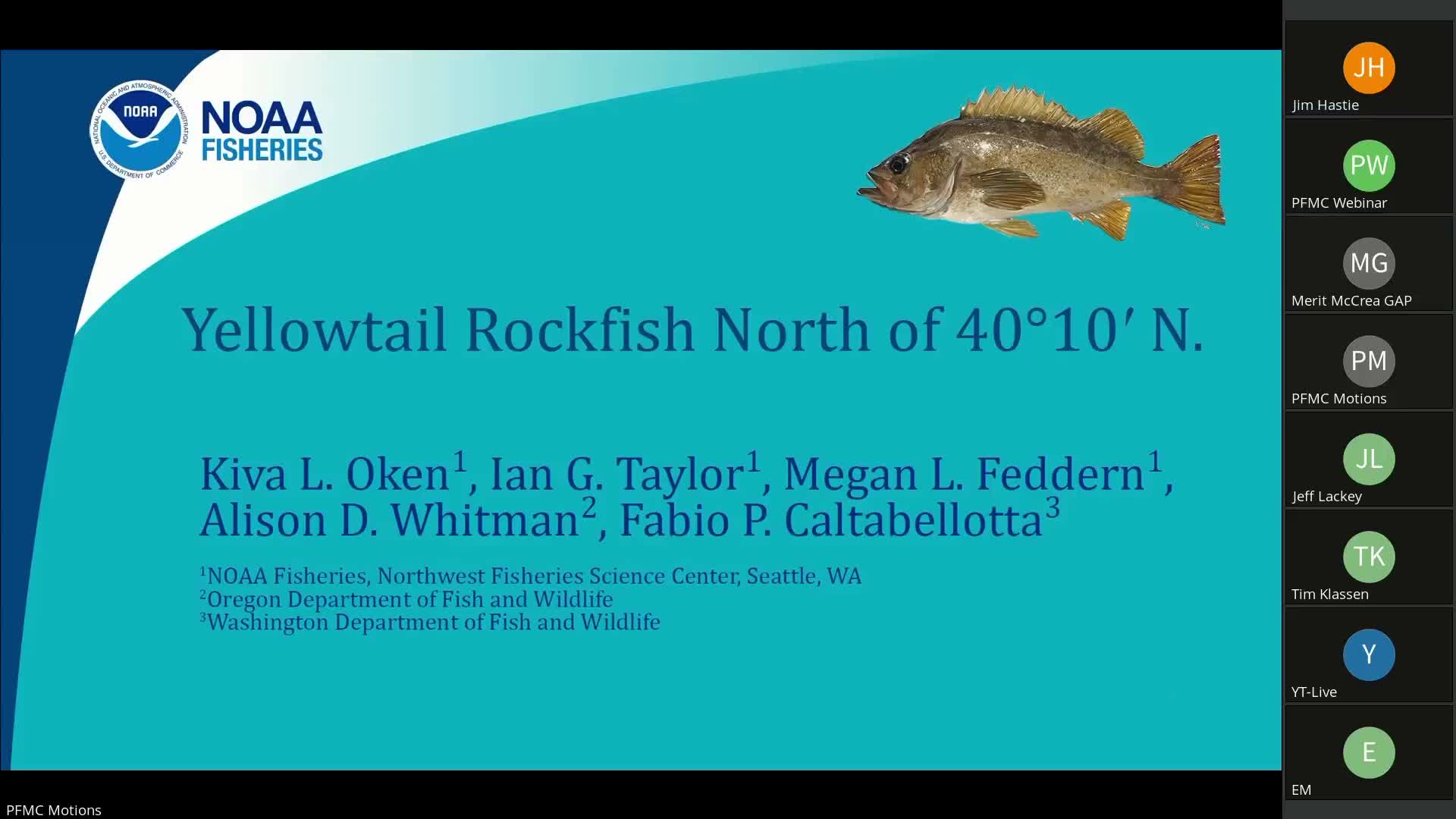
Summary
Lead assessor Kiva Oken told stakeholders the northern yellowtail rockfish stock is healthy (fraction unfished ~62% in 2025) but processing changes to commercial age samples and extended survey time series reduced OFLs compared with previous models.
Kiva Oken, lead assessor for the northern yellowtail rockfish benchmark, presented the 2025 assessment and fielded questions at a Pacific Fishery Management Council outreach session.
Oken said the assessment estimates fraction of unfished spawning output in 2025 at "around 62%," well above the Council's 40% management target, and age-4-plus biomass near 93,000 metric tons. She explained, however, that the OFLs produced by the current model are lower than in the 2017 model. The principal driver was a change in the way commercial age samples were processed: the Scientific and Statistical Committee recommended catch-weighting age samples so that samples from trips or states with proportionally larger catch count more in the age composition. Oken said that reweighting yielded relatively more older fish and fewer younger fish in the age frequencies, which affected estimated natural mortality and reduced OFLs.
Oken also described sensitivity and exploratory analyses. She said the team ran a sensitivity that incorporated an index from the West Coast groundfish observer program; that index was not included in the base model but was used to check whether fishery-dependent signals matched survey patterns. "We did a sensitivity model that had an index of abundance from the observer program," she said, and added that a methodology review proposal will be prepared for the SSC to develop rigorous ways to use such observer data.
Audience members raised several technical concerns: how avoidance behavior (fishers avoiding yellowtail) affects indices, what fraction of trips are sampled for biological data, and whether seasonal or market effects bias CPUE signals. Oken described multiple sensitivity checks (vessel-specific CPUE, day-of-year effects and vessel-by-day interactions) and said she "looked really hard" for signals that would indicate a coastwide increasing population consistent with fishermen's reports but found no fishery-independent or fishery-dependent data source that clearly supported such a trend.
Next steps: analysts will continue methodological work on incorporating observer data and documenting bridging analyses to explain changes from the 2017 model; the assessment will go forward through the STAR/SSC review process and Council consideration.