
Board debate over girls' sports resolution turns into extended public confrontation; language revised before vote
Get AI-powered insights, summaries, and transcripts
Subscribe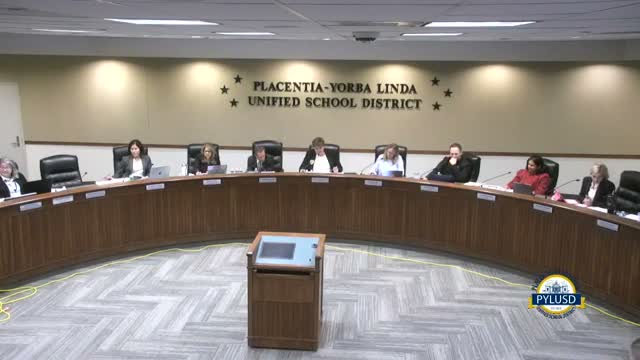
Summary
Trustees debated a proposed resolution on Title IX and girls' sports (Resolution 24‑23) amid large public turnout. Legal counsel recommended narrowing the "therefore" language; trustees discussed replacing the operative paragraph with language used by other districts and sending copies to state officials.
The Placentia‑Yorba Linda Unified School District Board of Education spent a large portion of its May 6 meeting debating a proposed resolution (24‑23) addressing fairness in girls' interscholastic sports.
Trustee Blades introduced the measure saying it affirmed support for ‘‘women playing against women and men playing against men’’ and framed it as advocacy for female athletes' competitive fairness and safety. Public comment on the item was extensive and sharply divided: supporters urged the board to defend girls' sports, while opponents — including civil‑rights groups, medical professionals and parents — warned the board that state law and the California Education Code afford protections for students on the basis of gender identity and cautioned the district about possible legal risk and exclusionary consequences.
During debate Trustee Quintero proposed alternative language that the district's counsel said would mirror resolutions adopted elsewhere: to reaffirm support for Title IX and to call on athletic governing bodies to uphold fairness for female athletes. District legal counsel advised the board that language creating or directing district enforcement policies could create legal exposure and suggested using wording similar to other California districts that sends the board’s position to state officials rather than directing district staff to adopt restrictive local policy.
Board members expressed sharply different views. Some trustees and many speakers from the audience emphasized protecting competitive fairness for girls and asked for explicit policy advocacy. Other trustees and several public speakers argued the resolution should not be used to adopt local rules that conflict with state law, and urged legislative advocacy rather than local regulatory action.
The board paused to revise the operative paragraph by replacing language that would have explicitly supported district policies restricting participation with language that: affirms the district’s commitment to Title IX; asks athletic governing bodies to uphold fairness; and forwards copies to the governor, the Legislature, the California Department of Education and the California Interscholastic Federation. Legal counsel stated that change would lower the risk that the board would be interpreted as directing policy contrary to state law.
On‑record public comments and on‑dais exchanges were recorded throughout the debate. The transcript reflects the board amendment process and extended public reaction; the meeting minutes reflect the board’s on‑record discussion and subsequent vote activity. (Final tallies and any further implementation steps should be confirmed in the board minutes and the official resolution packet.)