
Superintendent briefs board on state school-code changes: cyber funding, wellness checks, K–3 reading screenings and FAFSA requirement
Get AI-powered insights, summaries, and transcripts
Subscribe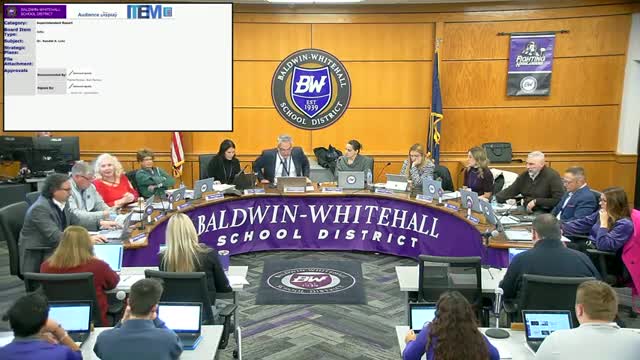
Summary
Superintendent Hector Lutz told the board that the state budget package included substantial school-code changes affecting cyber charter funding and reporting, wellness-check requirements for cyber programs, mandatory K–3 reading screenings with parent notifications and intervention plans, expanded notification timelines for weapon incidents, and a future requirement that graduating seniors submit a FAFSA or opt‑out form.
Superintendent Hector Lutz told the Baldwin-Whitehall board that the recently finalized state budget carried a set of school-code changes with multiple operational implications for local districts.
Among the changes discussed, Mr. Lutz said districts must retain a cash option for admission fees even where venues have moved to cashless payments; certification grade-span rules were adjusted (with primary and secondary certificate definitions described), and new constraints on cyber charter funding and reporting may reduce district payments for certain items such as transportation. The superintendent noted that cyber charter schools now must submit a wellness-check policy showing at least one visible, real‑time contact with every student each instructional week and that districts should anticipate aligning their practices where they run their own cyber programs.
Lutz highlighted that the school code now requires districts, charters and cyber programs to notify parents, guardians and relevant employees of incidents involving possession of weapons on school property within 24 hours. He also flagged residency-verification tightening for charter schools (minimum twice‑annual checks) and changes that require districts to respond to 'Safe to Say' type reports and resolve them within 30 days.
On literacy, the superintendent said the code phases in structured reading and requires K–3 competency screenings (beginning, middle and end of year) with mandated parent notifications and individualized reading intervention plans for students identified with deficiencies (effective in future school years). In a later phase, starting with the high school class of 2027, students must submit either a FAFSA or an opt‑out form prior to graduation, although districts may not withhold diplomas for noncompliance.
Mr. Lutz told the board that many of these provisions will require updated administrative regulations and additional guidance from the state; he recommended staff and the board review the issued materials and prepare ARs where necessary. He also called attention to expanded school safety grant opportunities and competitive grant rounds that the district expects to pursue.