
PUC hearing: advocates say income-qualified community solar promised in 2022-25 plan delivered no bill credits; utility points to rollover and development timet
Get AI-powered insights, summaries, and transcripts
Subscribe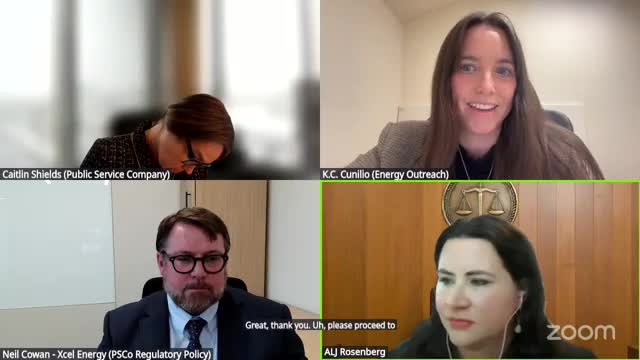
Summary
At a Colorado Public Utilities Commission hearing, Energy Outreach Colorado said income-qualified (IQ) community solar capacity approved for 2022'25 delivered no bill-credit benefits during the plan; Public Service defended interconnection timelines, noted prior-vintage deliveries and a rollover to 2026, and opposed an automatic RESA-funded direct-payment remedy.
Kelly Rosenberg, the administrative law judge overseeing Colorado Public Utilities Commission proceeding 25ADash0194E, heard competing accounts Wednesday about whether the IQ components of the company's 2022'25 renewable energy plan have produced the bill-credit benefits the plan and settlement projected.
Andrew Bennett, vice president of advocacy at Energy Outreach Colorado, told the hearing that EOC's records show thousands of income-qualified customers on a community solar wait list and that, "we've had 3 years and a month or so of basically nothing being interconnected." Bennett urged the commission to consider targeted remedies for IQ customers who have paid into the Renewable Energy Standard Adjustment (RESA) but have not received planned community-solar bill credits.
"These customers are not receiving the benefits," Bennett said while summarizing EOC's calculation of foregone benefits and urging a $5 million-per-year, five-year energy-assistance program to bridge the gap until projects produce bill credits.
Public Service Company of Colorado witnesses agreed that, as of snapshot data in admitted discovery, the company had not interconnected the IQ-dedicated capacity approved in the 2022'25 plan. Robert "Neil" Cowan, a manager in regulatory administration for Public Service, answered during cross-examination that the company's table reflected "0 megawatts" interconnected for certain IQ standard-offer and RFP components during the plan period, while noting the company had 6 MW of previously approved company-owned IQ gardens in service and 8 MW under construction from an earlier plan.
Cowan and other company witnesses repeatedly characterized the discovery tables and progress reports as a "snapshot in time," emphasizing that projects are at different stages of development and that some approved capacity rolls forward into the next plan. Under the parties' settlement, Cowan confirmed, roughly 206 megawatts of unbuilt third-party Solar Rewards community capacity would roll to the next plan and parties proposed bringing forward about 100 MW of Inclusive Community Solar (ICS) capacity for 2026 (together creating availability of roughly 306 MW in 2026 to enable developers to pursue federal IRA tax-credit windows).
Counsel for Energy Outreach Colorado pressed the point that capacity "made available" in a plan does not translate into realized bill credits for recipients until projects interconnect and produce energy. EOC highlighted its discovery-derived figures suggesting an average monthly community-solar bill credit of about $60 for an IQ subscriber (about $720 per year) and more than 9,000 IQ customers on EOC's wait list who could have benefited had more IQ-dedicated CSG capacity come online.
Public Service witnesses said the company has prioritized completing legacy company-owned projects and that some capacities are progressing through study, interconnection agreement, and construction stages. Patrick Murphy, Public Service's manager of program policy and strategy, pointed the commission to the company's quarterly "rainbow chart" stakeholder update showing many projects in study, design or construction phases and said the company would continue to make capacity available for developers to pursue interconnection.
The judge admitted multiple documentary exhibits offered during cross-examination, including the company's discovery attachments and EOC's supplemental materials. Administrative Law Judge Rosenberg asked parties to address in statements of position by December 18 how Section 40-2-124(1)(g)(1)(D) (as cited in the settlement record) or other authorities should be read with respect to EOC's funding proposal, and signaled she would weigh the evidentiary record and legal arguments in a recommended decision.
What remains unsettled in the record is whether the commission should require a directed remedy for IQ customers who paid into the RESA but did not receive planned community-solar bill credits during the 2022'25 plan; Public Service argued that prior-plan vintages, program rollout timing and the planned rollover undermine a finding that the company failed to deliver benefits, while EOC argued the delay imposes ongoing affordability harms and proposed interim assistance as a bridge.
The proceeding continues on written filings: parties will file statements of position and any joint filings the settling parties agree to for the judge's consideration. The judge administratively admitted the exhibits the parties offered for the record and will issue a recommended decision that addresses the contested issues.