
Throne Labs presents self‑contained 'throne' restrooms and local data to Mountain View committee
Get AI-powered insights, summaries, and transcripts
Subscribe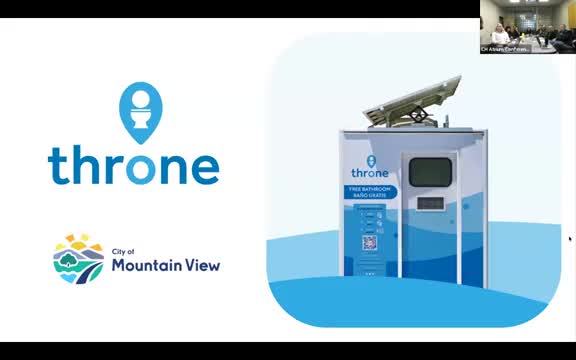
Summary
Private vendor Throne Labs showed committee members a solar‑powered, self‑contained smart restroom with phone entry, tap‑card access for people without phones, remote monitoring, and a service tier pricing model. Presenters cited network data but noted further staff analysis is needed before any local deployment.
Throne Labs representatives introduced their self‑contained, smart public restroom — branded a "throne" — during an informational presentation to the Mountain View Downtown Committee. The item was presented as informational only; no committee action was taken.
Ben Simons (Throne Labs account executive) and Seth Heinzmann (co‑founder/COO) described a standalone restroom that requires no water, sewer or fixed power connections; instead it uses onboard wastewater and clean‑water tanks, solar power, ventilation, a flushing toilet and a running sink. Entry is typically via a phone (QR code that auto‑populates a text message) but Thorne Labs also described tap cards distributed via local agencies for people without phones.
The presenters said the company runs local operations and hires cleaners and technicians (operations center noted in Hayward) and provides 24/7 remote monitoring. They described a typical service model as a flat monthly fee based on an assigned service tier (calculated from expected uses), with maintenance, vandalism repairs and pumping included. Throne Labs said contracts commonly run 12 months to gather useful deployment data.
Company data cited during the presentation included roughly 1,000,000 uses across the Throne network, about 18 units in the Bay Area and an average user clean rating of roughly 4.3 out of 5. The presenters said local Caltrain‑line Thrones had recorded 35,096 uses as of the evening before the meeting and reported an average of about 12 uses between cleans. They also offered an operational claim — that deployments are associated with a 50% decrease in public defecation in some sites — which the company described as network data.
Committee members asked about access for people without phones, ADA and emergency procedures, cleaning cadence and cost. Presenters said tap cards can be assigned through local service providers but lack direct texting capability (meaning staff must manage card deactivation and reinstatement). They described a 10‑minute time limit inside the unit with voice prompts in English and Spanish, warnings at 5 and 8 minutes, flashing lights at 10 minutes, and an automatic door opening at 10 minutes and 20 seconds to allow emergency access. Presenters added that some customers have emergency entry mechanisms (Knox box) and that the remote monitoring team and an emergency phone number permit remote opening if needed.
Throne Labs said customers receive quarterly reports and account management access to uptime and usage metrics (the company cited an example uptime of ~98% in Martinez). The presenters invited committee members to visit a Sunnyvale site and offered to provide further studies and follow‑up materials.
Chair and staff reminded members the item was informational and that any consideration of procurement or local deployment would require staff analysis and appropriate city processes.
The committee did not take action on the presentation; staff said it would follow up with Throne representatives for additional briefings if the committee wishes to add the topic to a future work plan.