
Springfield councilors promise workshops, procurement follow-up as residents press for fair access to city properties
Get AI-powered insights, summaries, and transcripts
Subscribe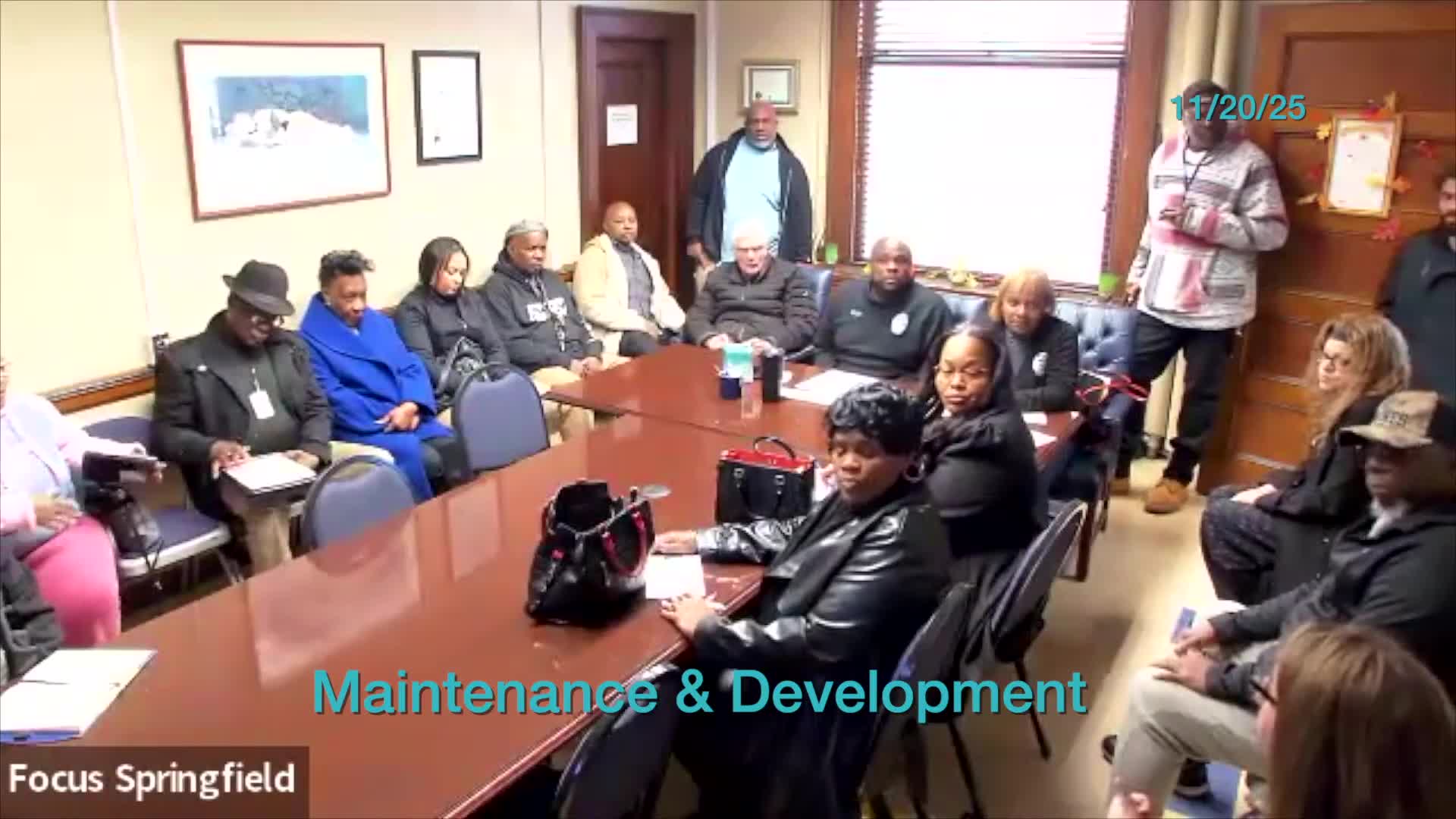
Summary
Residents and councilors pressed city staff for clearer notice and technical assistance for city property sales and contracting; staff said RFPs post on the Office of Procurement website and the treasurer maintains an email list, and councilors agreed to schedule technical‑assistance workshops and a procurement follow‑up meeting.
SPRINGFIELD — Residents at a November maintenance and development meeting urged city leaders to do more to make property sales and contracting opportunities accessible to longtime local buyers and minority‑owned firms, and councilors said they would pursue training and outreach.
"Any RFP or bid that the city puts out goes up on the Office of Procurement website," a city staffer said, adding that the treasurer's office maintains an email list that receives notifications whenever city property is offered for sale. "If it's a property that's being sold through a request for proposals, it will be on the Office of Procurement website."
Members of the public said that despite those channels, many neighborhood residents do not see notices and that out‑of‑town investors frequently buy local houses. A People for People representative asked, "What is the checks and balance for us that protects our homes?" and urged help for first‑time buyers and those priced out of the market.
Councilor Whitfield told the meeting she wants to level the playing field by increasing advertising and by requiring, where appropriate, that experienced developers partner with emerging local developers so newcomers can gain experience. "If you partner the emergent developers with the developers that win, that has to be a part of the contract," Whitfield said.
City staff described three main disposal methods: public auction (handled by an auctioneer and publicly advertised), requests for proposals (RFPs) when the city seeks a particular kind of redevelopment, and a statutory abutters‑only sale process for small lots. Staff said RFPs allow the city to impose conditions (for example, owner‑occupancy or affordability requirements) and that, when appropriate, the city packages properties with state rehab funds to support redevelopment.
Staff also summarized how RFPs are evaluated: the city sets scoring criteria — such as prior experience (typically shown by comparable projects), demonstrated access to funding, and the quality of a proposed development plan — forms a committee of multiple departments plus a council or neighborhood representative, and sends rankings to procurement, which compares scores with bid amounts to select the most‑advantageous compliant proposal. "The minimum amount of time that the state permits an RFP to be out for disposition is 30 days," the staffer said.
Contractors and residents raised accountability concerns about low bids and later change orders. One contractor said bidders sometimes underprice work and then rely on change orders to recover costs; staff said change orders are reviewed by an independent cost reviewer and the city monitors frequent change‑order patterns.
Councilors and staff agreed to next steps: schedule a technical‑assistance workshop (recorded and offered online), arrange a follow‑up session that includes procurement staff to answer detailed questions, and form an ad hoc committee next January to streamline permitting and building processes. The city also encouraged residents to sign up for the treasurer's email list and to monitor the procurement office website for solicitations.
City staff and councilors named several outside resources that can provide training and back‑office support to emerging developers, including the Black Economic Council of Massachusetts, the Latino Economic Development Corporation, MassDevelopment and Common Capital.
Councilor Milo Brown closed the meeting by thanking attendees and saying the council would continue the conversation. "This is not the last meeting," he said. "We gotta work more together."