State Water Board authorizes Santa Ana SEP funds to support regional monitoring programs
Get AI-powered insights, summaries, and transcripts
Subscribe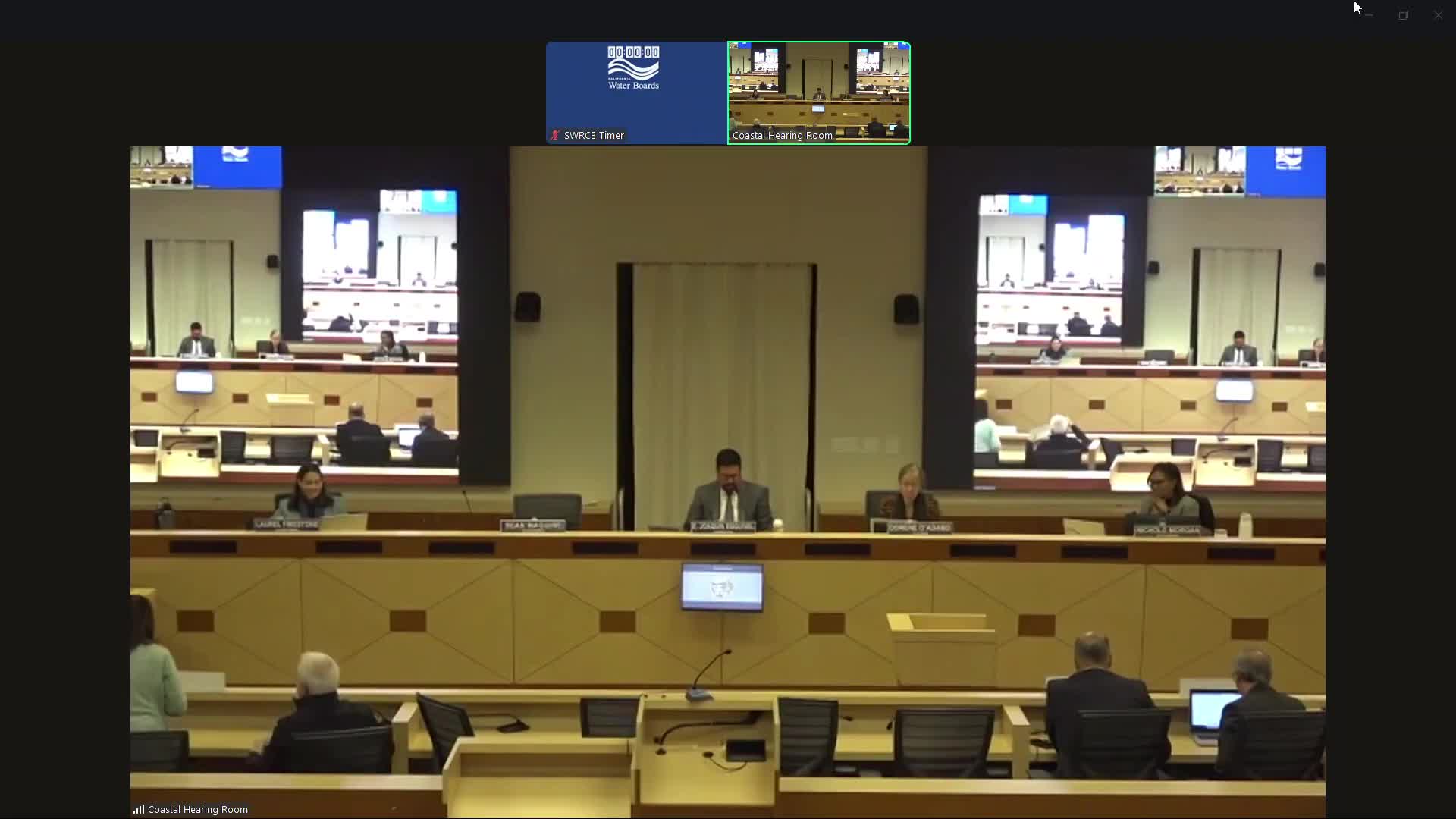
Summary
The board approved a resolution allowing aggregation of supplemental environmental project (SEP) funds to finance two Santa Ana regional monitoring programs administered by SCCWRP, citing chronic monitoring funding gaps; the vote was unanimous among members present.
The State Water Resources Control Board voted unanimously on Nov. 19 to authorize the use of supplemental environmental project (SEP) funds to support regional monitoring programs in the Santa Ana region.
Paul Ciccarelli, an attorney with the state board's Office of Enforcement, and Chuck Griffin, a senior engineer for the Santa Ana Water Board, presented a proposed resolution to authorize SEP funding for the Southern California Bight (marine) and Southern California Stormwater Coalition (inland watershed) regional monitoring programs administered by the Southern California Coastal Water Research Project (SCCWRP).
Griffin told the board the SEP policy permits the state board to authorize regional monitoring SEP programs and that aggregation of mandatory minimum penalties and smaller discretionary liabilities helps create viable projects. "Allowing settling parties to deposit funds into an account and aggregate until they reach a sufficient amount promotes worthy steps within our region," Griffin said.
Board members praised the approach as a pragmatic way to fund under-resourced monitoring programs. Vice Chair Doreen D'Adamo moved adoption; another member seconded. The clerk called roll and Vice Chair D'Adamo, Board member Nicole Morgan, Board member Laurel Firestone and Chair Joaquin Esquivel voted 'Aye.' The resolution was adopted.
Staff said the region collects roughly $770,000 in penalties annually and that SEP-funded monitoring would not replace core programmatic monitoring but could fund supplemental regionwide studies and reporting.