
Contra Costa and Anaheim pilots show credit trading can accelerate stormwater capture, but permit rules and watershed boundaries pose risks
Get AI-powered insights, summaries, and transcripts
Subscribe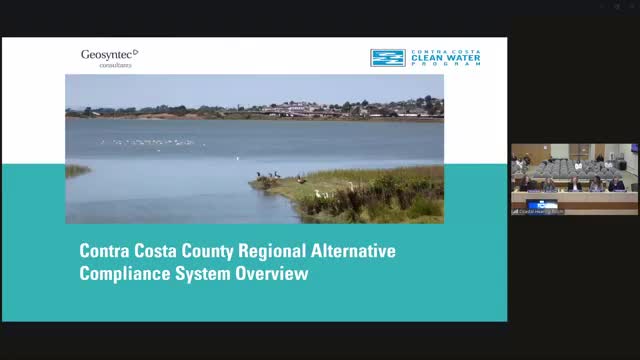
Summary
Two regional pilots — Contra Costa’s REC system and Anaheim’s municipal credit bank — are already moving from design into limited implementation: Contra Costa has a JPA/CFD rollout planned; Anaheim reports roughly $5M in credits sold. Both programs flagged key hurdles: long‑term O&M funding, JPA governance, legal templates, and MS4 permit watershed delineation that, if too small, can strand credits and slow water quality gains.
Two credit‑trading pilots presented to the board show how off‑site compliance can be used to accelerate stormwater capture, but both speakers cautioned that regulator guidance and watershed delineation in MS4 permits will determine whether programs scale.
Lisa Austin and Rinta Parkins described the Contra Costa Clean Water Program’s REC (Regional Alternative Compliance) system: a JPA would administer certification and a tracking tool, equivalent units ("equivalent acres greened") would be generated by off‑site green stormwater infrastructure, and a Community Facilities District (CFD) would be used to secure long‑term O&M funding. Phase 1 developed the framework and pilot exchanges; phase 2 is implementation with 12 of 21 member agencies interested in joining the JPA and a phased rollout targeted through FY 28–29. Presenters recommended that the State Water Board provide model JPA/CFD documents, standardized reporting templates, a statewide technical advisory committee, and funding to set up similar systems in other regions.
Keith Linker described Anaheim’s credit bank model, developed over several years with regional board engagement. Anaheim’s approach makes the city the initial credit generator and maintains a credits bank that developers may voluntarily buy instead of building on‑site BMPs. Linker said Anaheim has already placed major projects into the ground (Majesco Park, La Palma/Richfield and others), estimates substantial capture (Majesco ~150 acre‑feet/year from a 220‑acre drainage area) and reported nearly $5 million in credit sales to date. He warned that MS4 permit language that defines credit trading areas too narrowly (small watersheds) could strand credits: if buyers and sellers must match within very small watersheds, there may be no early buyers and credit generators cannot justify up-front investment.
Both presenters urged consistent state‑level guidance, model legal documents, and funding support to lower transaction costs and avoid region‑by‑region interpretation. Board members asked for clarity about pilot design, audit provisions, and watershed delineation; presenters recommended larger watershed footprints and a phased pilot period to demonstrate program integrity and financial viability.