
Marshall County introduces draft ordinance to regulate battery energy storage systems
Get AI-powered insights, summaries, and transcripts
Subscribe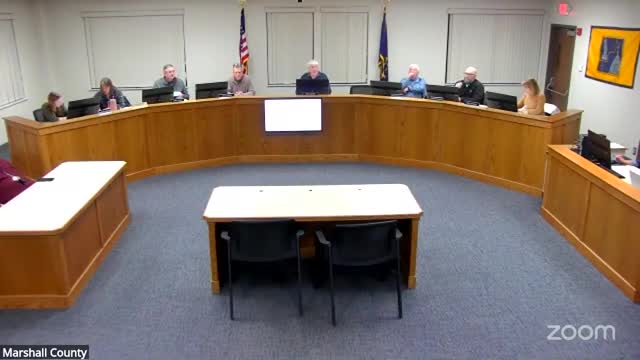
Summary
The Planning Commission publicly introduced a draft ordinance to regulate battery energy storage systems (BESS) — covering permitting, setbacks, safety, emergency response, decommissioning and financial assurance — and sought feedback; no vote was taken and staff will refine language after further legal and stakeholder review.
Marshall County’s Planning Commission on Nov. 20 introduced a detailed draft ordinance (PC‑24‑05) to regulate battery energy storage systems and solicited public and commissioner feedback; no vote or recommendation was taken at the meeting.
Staff presented the draft ordinance as a working document that would amend Articles 3, 6, and 13 of the county zoning/building code and that required further legal review before any vote. The ordinance would apply to battery energy storage systems with a rated nameplate capacity equal to or greater than 1 kilowatt and would require applicants to obtain a special‑use permit from the Board of Zoning Appeals and an improvement location permit from the Building Commissioner, among other approvals.
Key technical and site standards read aloud by staff include: - Application documentation: project summary with approximate nameplate capacity (kW and MWh), anticipated equipment manufacturers, operator and ownership chain, and contact information for operators and emergency contacts. - Setbacks and siting: minimum zoning setbacks plus a proposed 500‑foot setback from adjacent property edges for BESS components; minimum spacing of 20 feet side‑to‑side and 12 feet end‑to‑end between units; a 15‑foot maximum height for containers or dedicated buildings. - Safety and security: 8‑foot security fencing (no razor wire), required signage (danger/high voltage and emergency contacts), perimeter cameras with visibility of property lines, and clearance of combustible vegetation within 20 feet of units. - Fire and emergency response: a two‑part decommissioning plan, emergency response plan and coordination with local fire and emergency agencies, and for Tier 2+ facilities a requirement for two water sources capable of providing 2,000 gallons per minute (pumps to be tested and wells certified on a schedule). - Decommissioning and financial assurance: an escrow, bond or letter of credit sufficient for decommissioning costs, periodic replenishment of funds, five‑year reviews of financial assurance, and county authority to complete decommissioning at owner expense if obligations are not met; removal requirements include excavation to 48 inches below grade for project improvements. - Operational oversight and monitoring: annual operation and maintenance reports, initial and annual EMF/ELF baseline studies at site boundaries and adjacent residences, and local inspection rights by county staff and third‑party professionals retained by the county.
Commissioners and the public raised multiple questions. One commissioner asked whether the 500‑foot setback is measured to property lines (staff confirmed it is), and several sought clearer definitions for the two decommissioning plans and stronger language about financial replenishment. Concerns were raised about water use and whether large pump requirements could affect local aquifers; staff said the 2,000 gpm requirement is an emergency‑response guideline and that any use of a body of water would require the proper permitting (DNR/IDEM as applicable). A public commenter, Bill Woodward, asked whether the rule is intended for current projects or for prospective future proposals; staff replied the ordinance is to provide standards for future applications.
Safety observations introduced during the vendor/industry discussion drew attention: staff said an industry emergency‑response expert advised that, for lithium‑ion battery fires, water can be counterproductive and that "the safest method or safest thing to do if one of these actually does start to burn, is to let it burn." The draft includes provisions for cooling adjacent units, sprinkler systems under limited circumstances, and coordination with local responders and training obligations for facility operators.
Several commissioners complimented the detail in the draft, noted that many Indiana counties have adopted similar BESS ordinance language, and asked staff to incorporate clarifications (definitions, decommissioning parts, parent company financial responsibility, and drainage/road‑use language) before the public hearing stage. The commission indicated it will continue to refine the draft, consult legal counsel, and schedule a public hearing at a future meeting.
No formal vote was taken on PC‑24‑05 on Nov. 20.