
Santa Fe ceremony marks signing of bill the speaker says will raise living wages for local workers
Get AI-powered insights, summaries, and transcripts
Subscribe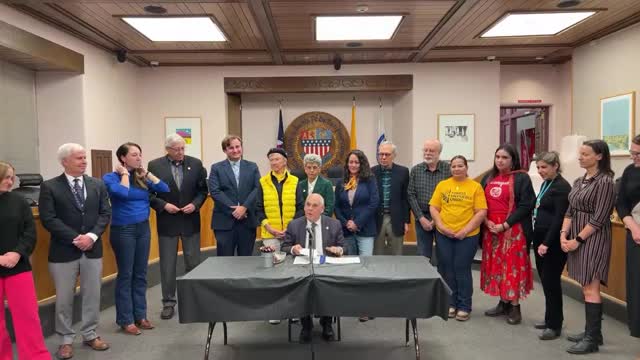
Summary
At a ceremonial signing in Santa Fe, an unidentified speaker said a newly passed city bill will affect about 9,000 people (roughly 20% of the city's workforce) and result from months of outreach and compromise involving city staff, community groups and university researchers.
An unidentified speaker at a Santa Fe signing ceremony celebrated passage of a city bill the speaker said "will affect probably 9,000 people who work in the city of Santa Fe," calling the event "a ceremony of appreciation and gratitude first and foremost."
The speaker said the proposal—described in remarks as an increase in the living wage—was shaped by months of consultation with city council members, community organizations and university researchers. "People were open minded. People were open hearted," the speaker said, and credited community outreach that "ultimately reached thousands of Santa Fe residents."
According to the speaker, the bill will benefit about 20% of the city workforce and is intended to help workers "live and work in Santa Fe while keeping our mom and pop small businesses alive." The speaker framed the measure as part of a broader policy package that included a recent vote on "chapter 14" (an excise tax referenced in the remarks), a stabilization plan for Hopewell Mann, progress on a Midtown project and a governor-led childcare proposal mentioned as making childcare free for everyone. The transcript does not provide the bill number, the bill text, implementation dates or a vote record.
The speaker named several partners and contributors who supported development of the proposal: The Food Depot, the restaurant association, university researchers at UNM (one person referred to as Riley White), nonprofit groups (including Somos and a "Chain Breaker" team), hospitality industry representatives and city staff. The speaker also thanked city manager Mark Scott Williams and advisor Rob Gould for leadership throughout the drafting and outreach process.
At the close of remarks, the speaker invited those involved to step forward to sign the measure and collect a pen and a commemorative coin, and noted media interest in the issue. The speaker said the ceremony was complete and invited attendees to refreshments. The transcript records the ceremonial signing and acknowledgements but does not record a roll-call vote, the bill's ordinance number, or an effective date for the change.