
Commission reviews Transportation Safety Plan section on workforce and emergency‑responder safety
Get AI-powered insights, summaries, and transcripts
Subscribe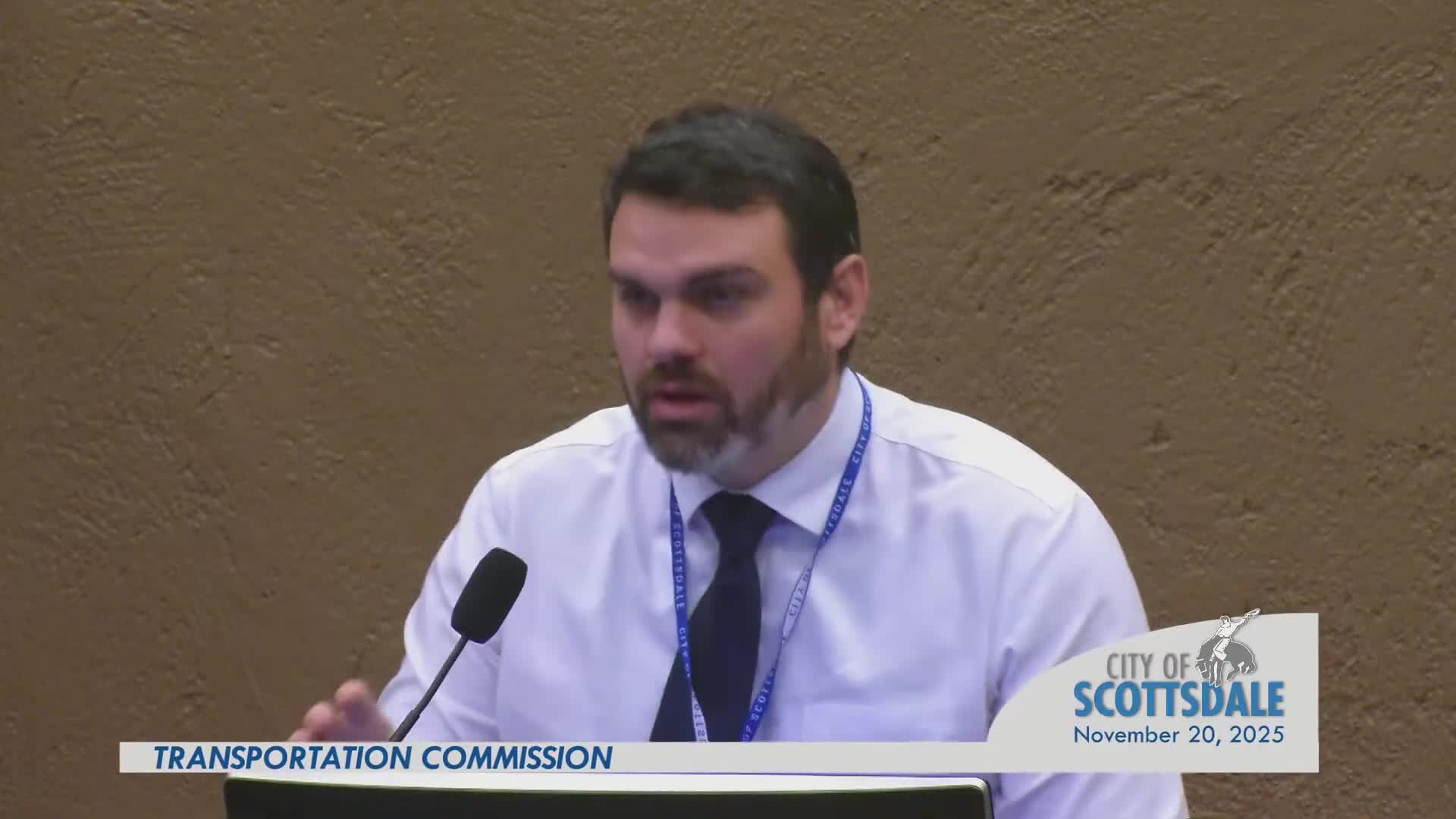
Summary
Staff proposed a framework to protect city workers, contractors and emergency responders in the right of way emphasizing elimination of conflicts, engineering protections, speed management, training and near‑miss reporting. Fire staff described thermal‑runaway risks for lithium‑ion batteries and an aggressive heat‑stress program for responders.
Transportation staff presented a Transportation Safety Plan section focused on workforce and emergency‑responder safety in the public right of way. Nathan Domingue said the goal is to protect city employees, contractors, emergency responders and the traveling public across roadways, alleys, paved paths and trails.
Domingue listed common hazards—work‑zone intrusions, approach speeds, complex traffic interactions, visibility and vulnerable road users—and proposed a hierarchy of controls: eliminate exposure where possible (work outside the travel way), engineering protections (lane tapers, buffers), administrative controls (traffic control plans, public information and outreach), and PPE only as the last resort. He emphasized training, TCP credentialing and routine reporting of incidents and near misses for continuous improvement.
Domingue said accessible detours and temporary transit platforms are important to protect bicyclists, pedestrians and transit riders when sidewalks or bike lanes are closed. He cited the Chaparral Underpass example where fencing prevented people from entering an unfinished underpass and noted that temporary routes must be monitored to avoid degradation.
Captain Sasha Weller of the Scottsdale Fire Department described responder‑side risks and mitigation. Weller summarized common incident types (crashes, hazardous materials, flooding, EV and e‑bike fires) and stressed scene protection: "Our primary goal is always, life safety." He explained the risks of thermal runaway in lithium‑ion batteries and described containment and removal procedures for EV battery incidents and smaller e‑bike events.
On heat exposure, Weller said the department uses an aggressive heat‑stress program tied to a red‑flag condition when the heat index exceeds about 100–105; measures include daily notifications, limiting outdoor training, hydration/electrolyte budgeting (he cited $15,000 for recruit academy electrolyte replacement over June–July), vital‑sign monitoring on working incidents and enforced work/rest cycles with mobile rehabilitation units.
Commissioners asked about private landscaping crews in the right of way, temporary lighting on overnight construction, and monitoring of temporary pedestrian detours. Staff committed to look into regulation/compliance for private contractors, to emphasize night‑lighting for overnight sites, and to include guidelines for temporary path maintenance in the safety plan.
The commission did not vote on the plan at this meeting; staff will incorporate feedback and return with final language and any recommended implementation steps.