
Colorado board reviews stewardship‑fee options, staff recommends 8–12¢ per ton for long‑term CO2 storage
Get AI-powered insights, summaries, and transcripts
Subscribe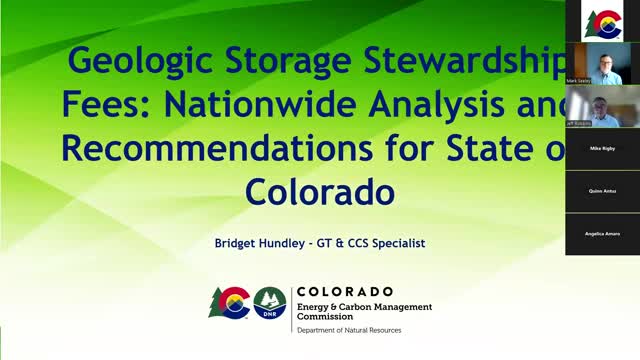
Summary
At its first formal meeting, the Colorado Geologic Storage Stewardship Enterprise Board heard staff recommend a stewardship fee of 8–12¢ per ton to fund long‑term monitoring and maintenance of Class 6 geologic CO2 storage sites; the board voted to post the white paper and invite written public comment ahead of a future January meeting.
The Colorado Geologic Storage Stewardship Enterprise Board met Nov. 18 and heard staff present a white paper recommending a stewardship fee range of 8 to 12¢ per ton of injected CO2 to fund long‑term monitoring and integrity maintenance of geologic storage sites.
Bridget Hundley, ECMC geothermal and CCS specialist, told the board the recommended range ‘‘is expected to balance expected long term stewardship costs with fund self sufficiency,’’ and said monitoring is likely to be the largest ongoing expense taken from the Fund. Hundley’s presentation reviewed Monte Carlo and project case studies, comparisons with other states, and statutory constraints the board must follow when setting a fee.
Benjamin Boudreau, assistant attorney general and counsel to the board, reviewed the board’s statutory authority and the standard the board must meet: the fee must be ‘‘reasonably related to the overall cost of the long term stewardship services’’ established under HB 25 11 65 and related law. Boudreau also clarified that the board would not set the fee at this meeting; it may consider doing so after public input at a later session.
Mark Selen, ECMC geothermal and CCS supervisor, said ECMC has submitted nearly all components of its primacy application to the U.S. Environmental Protection Agency and described the federal review process. ‘‘As of October, our primacy application is a 100% complete…in the hands of EPA,’’ Selen said, and staff expects a Federal Register notice and public comment period in 2026 with a potential EPA decision in spring 2026.
Board members questioned several fee assumptions. Bob Randall asked whether staff had evaluated legacy oil and gas wellbores near the De Nova project in the eastern plains; Mike Rigby of ECMC replied that Class 6 regulations require project‑level, wellbore‑by‑wellbore evaluation and remediation so legacy wells are not leakage pathways before injection permits can be issued.
Director Murphy and other board members also discussed whether some case studies’ inclusion of carbon‑credit purchases was relevant to the board’s stewardship focus. Hundley said purchasing carbon offsets was included in some referenced analyses but that the board would decide whether such an expense aligns with the enterprise’s responsibilities to protect public health and the environment.
For transparency and public input, counsel Boudreau recommended three motions: post the staff white paper online, direct ECMC staff to publish a process and deadline for written public comments ahead of the board’s next meeting, and reconvene in January to consider public comment and, if ready, set a fee. The board voted to post the white paper and to direct staff to establish a written public‑comment process; both motions carried by voice vote.
Chair Jeff Robbins then moved to adjourn and reconvene on Jan. 27 at 9 a.m.; the motion carried. (The transcript contains two different years for the January reconvening—Boudreau referenced Jan. 27, 2025 when recommending public comment, while the chair’s adjournment motion records Jan. 27, 2026.)
The board’s responsibilities include setting a per‑ton stewardship fee that complies with statutory limits, maintaining a fund separate from ECMC operating accounts for long‑term stewardship activities, and ensuring the fund is reasonably related to projected long‑term costs. Hundley noted statutory constraints such as TABOR reporting and an initial fiscal cap referenced for the Fund.
Next steps: the white paper will be posted to the enterprise’s web page and ECMC staff will publish a written‑comment process and deadline; the board will reconvene in January to review public comments and may set the stewardship fee if it has sufficient information.
Sources: Board presentations and remarks by ECMC staff, the Colorado Energy Office, and counsel during the Nov. 18 meeting of the Geologic Storage Stewardship Enterprise Board.