
Flagstaff adopts a formal fleet 'EV‑first' and rightsizing directive; staff outline infrastructure and training needs
Get AI-powered insights, summaries, and transcripts
Subscribe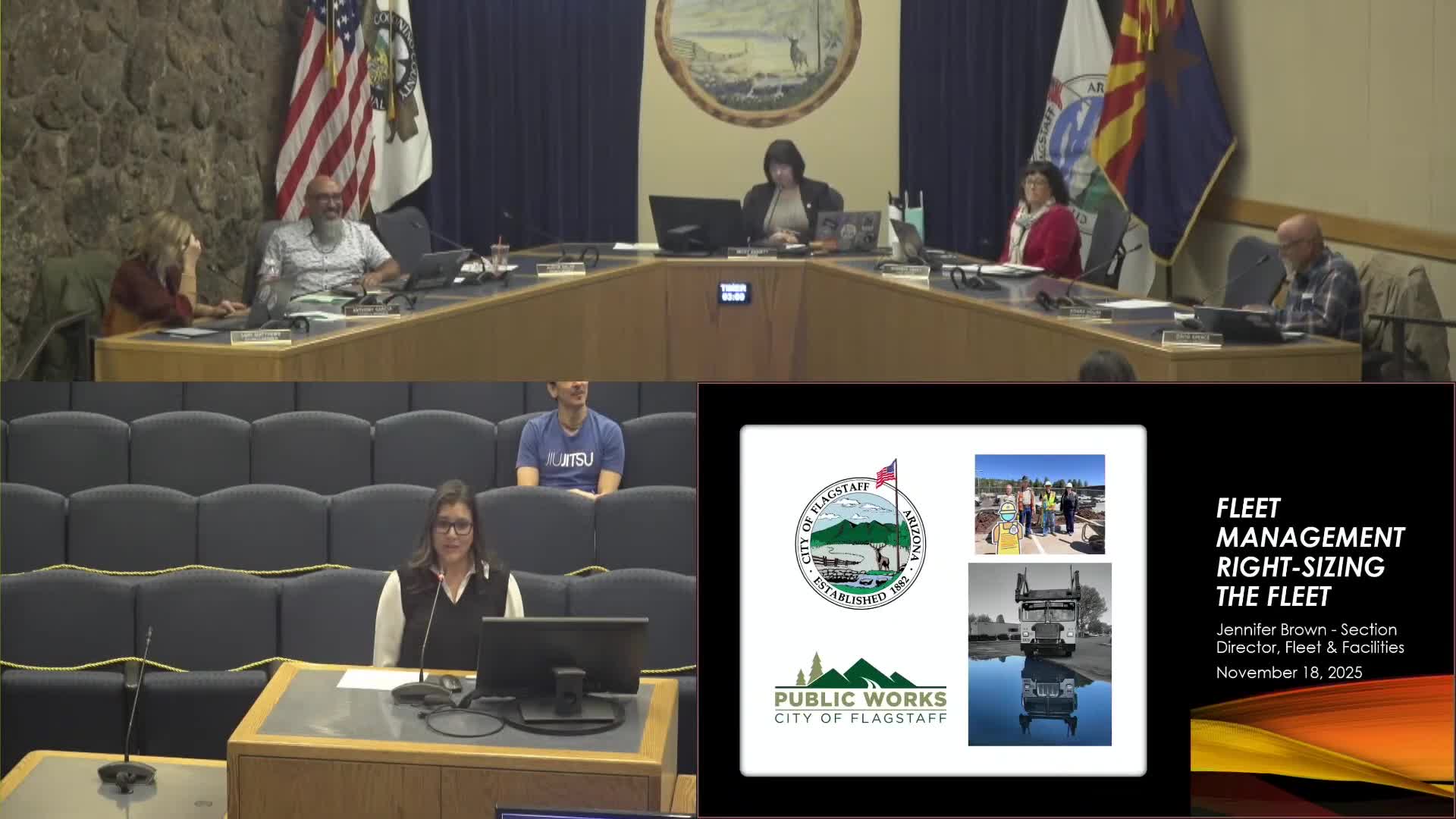
Summary
Fleet staff presented a new right‑sizing and EV‑first directive for city vehicles: review by a Fleet Management Committee, shared vehicle pools, EV evaluation for light‑duty classes, and coordination on charging infrastructure. Staff noted 23 all‑electric vehicles in service, infrastructure limits and the need to train EV technicians.
The council received a presentation Nov. 18 on a new fleet right‑sizing directive and an EV‑first approach meant to align city vehicle procurement with Flagstaff’s carbon neutrality goals while maintaining operational readiness.
Fleet staff reported the city operates roughly 769 pieces of equipment, including 255 light‑duty vehicles that are the primary candidates for electrification. To date the city has 31 plug‑in or hybrid vehicles and 23 all‑electric vehicles; staff cited 55 existing Level‑2 charging points across city facilities but noted fast‑charging capacity and distribution remain constraints.
The new directive establishes a Fleet Management Committee that will review vehicle requests, assess utilization and promote shared pools for under‑used vehicles (the fleet team monitors utilization and flags vehicles under ~5,000 miles). Staff said procurement will apply an EV‑first test for electrifiable classes and that significant purchases (heavy equipment, fire apparatus) will remain ICE until technology and charging infrastructure mature. Staff also noted there are currently no EV‑certified maintenance technicians and that training and safety procedures for high‑voltage systems are priorities.
Council members praised the directive’s process controls, emphasized the need for continued electrification, and asked staff to accelerate infrastructure planning and technician training. Staff committed to continue seeking grants for charging infrastructure and to coordinate multi‑division planning and budget requests.