
Milwaukie considers targeted land-banking, right-of-first-refusal and modest pilot fund
Get AI-powered insights, summaries, and transcripts
Subscribe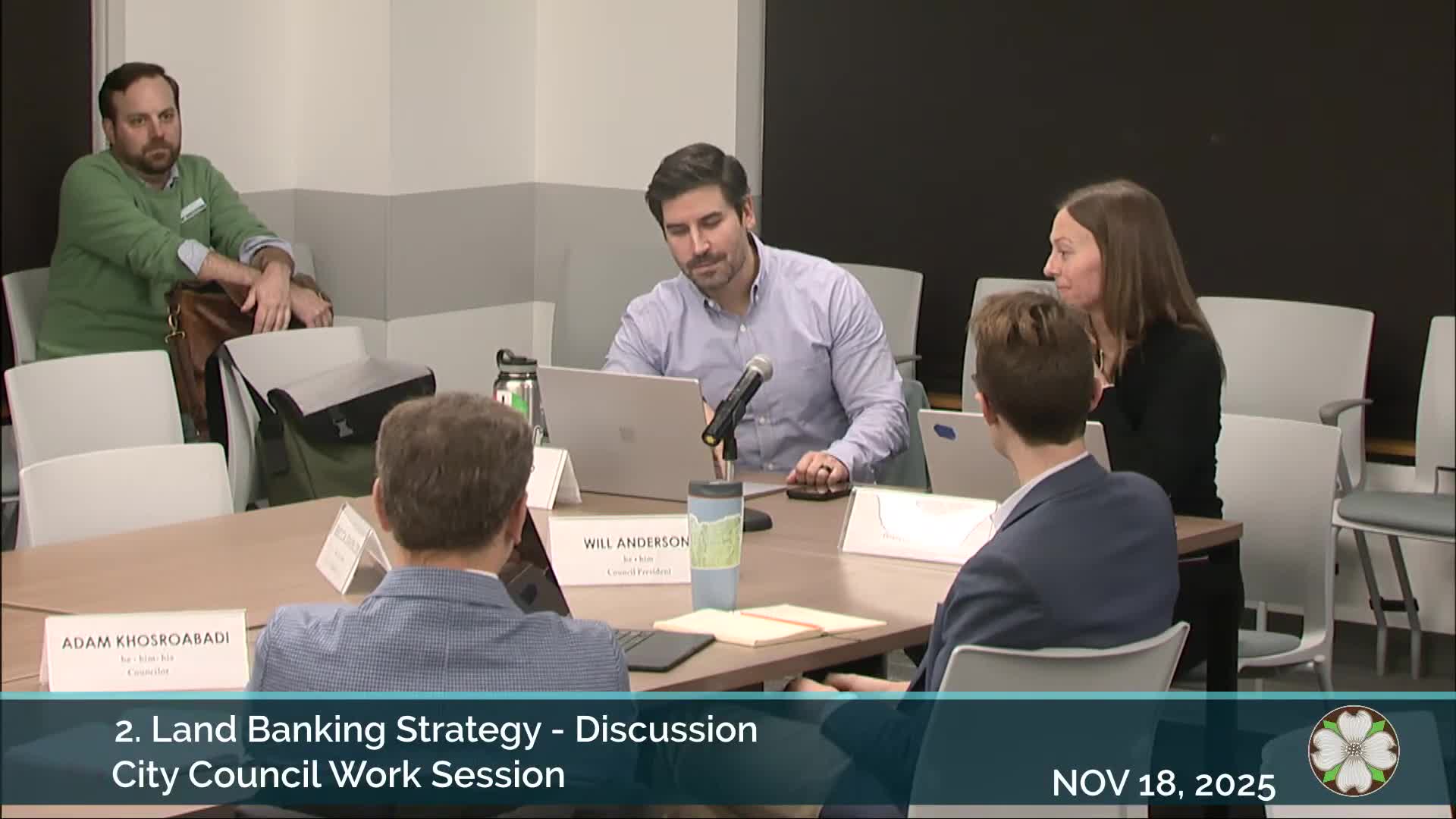
Summary
City staff presented options for a targeted land-banking policy, including a right-of-first-refusal ordinance limited to specific parcels, and council discussed funding options (CET, URA, grants) and the need for partner-led acquisitions; council asked staff to return with funding scenarios and legal precedents.
Mandy Bird, the city's development project manager, presented land-banking options at the Nov. 18 work session, framing two approaches: (1) a resource-intensive formal land bank with a dedicated fund and staff capacity, and (2) a middle-ground, targeted policy framework that uses tools such as a right-of-first-refusal on selected parcels and partnerships with nonprofit fiscal sponsors.
Bird said the right-of-first-refusal approach could be used selectively: "I'm not necessarily thinking that Milwaukie would do like a blanket policy across the whole city, but we could look at certain areas of the city or target certain properties," she said. Under that model the city would ask sellers in defined areas to provide notice and a short window for the city or partners to assemble financing before the property went to market.
Council discussion focused on feasibility, timing and funding. Councilors suggested notification windows on the order of 60-90 days and raised concerns about legal challenges and the perception of government intrusion: one councilor said the idea "irks" them because it can feel like the government is requiring owners to offer the city the first sale opportunity. Staff committed to researching Portland's use of similar tools and any legal precedents.
Funding options were central to the debate. Councilors proposed dedicating or exploring sources such as the city's CET (community enhancement/trust) funds, reorienting URA district capital funds, creating a modest pilot acquisition fund, and partnering with community land trusts or nonprofit sponsors to avoid the city acting as a long-term landlord. Councilors also noted a prior state bill to fund land-banking did not pass this session and urged staff not to expend significant time unless realistic funding pathways are identified.
Practical points raised included the city's limited capacity for real-estate marketing and property management and the opportunity to focus on a small number of county-owned or scattered-site parcels (councilors cited roughly 16-18 such sites in city limits) where the city might partner with nonprofits to acquire units for affordability rather than undertake a full-scale land-bank program.
Next steps: staff will research precedent, legal risk and funding options and return with scenarios for a modest pilot fund and a targeted policy framework. No ordinance was adopted on Nov. 18.