
Cure Violence program reports declines in murders in targeted Grand Rapids neighborhoods, officials say
Get AI-powered insights, summaries, and transcripts
Subscribe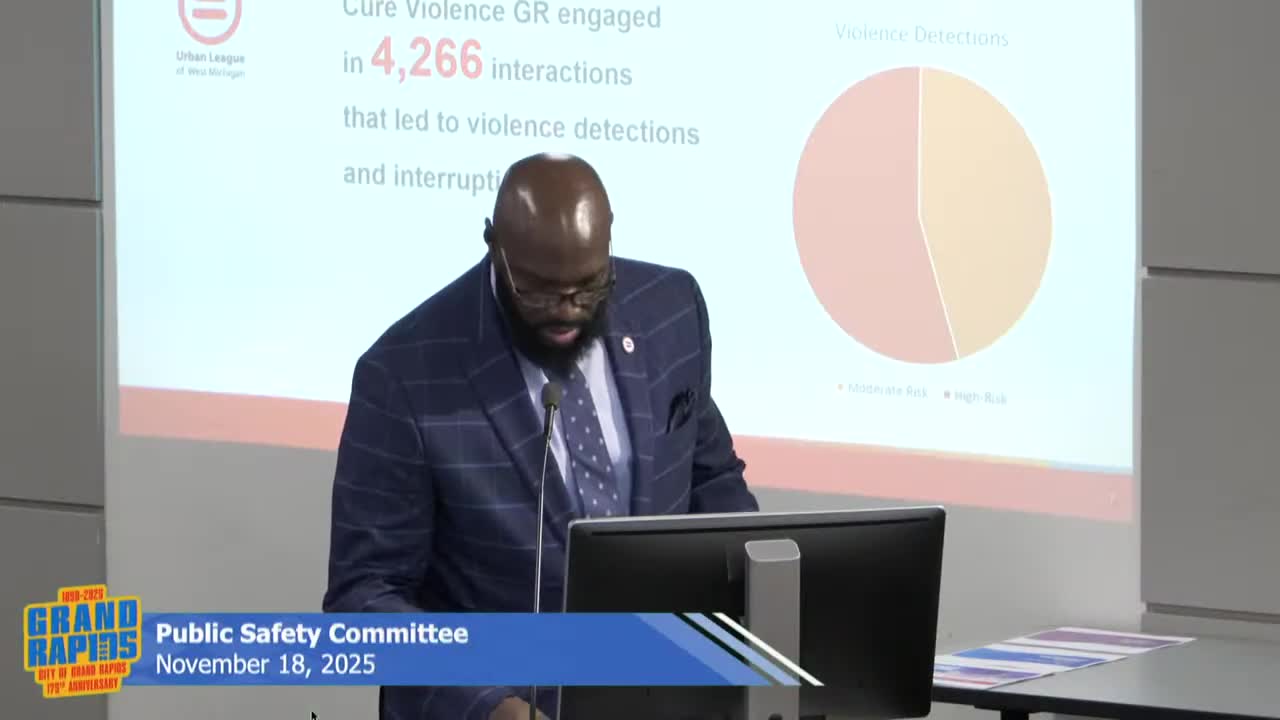
Summary
Presenters from Cure Violence and the Grand Rapids Urban League told the Public Safety Committee that program activity in fiscal 2025 included thousands of street interactions and reported sizable decreases in murders across three target areas; officials urged caution about attributing cause and pledged to provide ward‑level breakdowns and benchmarking.
Brent Davis and partners from the Grand Rapids Urban League presented the Cure Violence 2025 annual report to the Grand Rapids Public Safety Committee, saying the community‑based program’s interrupters and outreach specialists engaged thousands of residents in fiscal 2025 and helped connect high‑risk individuals to wraparound services.
The presenters said Cure Violence operates on a public‑health model that focuses on interrupting conflicts, treating people at highest risk and changing community norms. "Imagine our city without violence," Brent Davis told commissioners, describing the program’s emphasis on credible messengers canvassing neighborhoods to intervene before conflicts escalate.
Jeff Ridgeway, Cure Violence program manager, reported that the Grand Rapids program recorded 4,266 interactions during fiscal 2025 and identified 127 interruptions in which staff say they prevented or de‑escalated violent behavior. Ridgeway highlighted community mobilization events and two participant success stories — an artist who exhibited locally and a set of students who improved school performance after engagement with outreach specialists — as examples of individual impact. He also cited research estimates from the National Institute of Criminal Justice Reform on the avoided economic costs of prevented fatalities and nonfatal shootings.
Dr. Steven Wirce, the program’s data analyst, presented ward‑level trends across three adjacent target areas over the past 54 months through fiscal 2025. He reported substantial percentage declines in murders in the program’s target areas and mixed results for aggravated assaults: the 1st and 3rd Ward target areas showed downward trends while the 2nd Ward showed a recent increase in aggravated assaults even as murders fell there. "If we look at the last three fiscal years, the data are moving downward in the first and third ward target areas, and slightly upward in the second," Dr. Wirce said, while noting the difficulty of attributing citywide crime declines to any single intervention.
City leaders and committee members repeatedly noted that crime trends are multifactorial. Mayor Mary LeGrand and other commissioners emphasized that correlation does not prove causation and asked staff for benchmarking and disaggregated ward data. Dr. Wirce said benchmarking data exist but were not included in the presentation; presenters agreed to provide a ward‑by‑ward breakdown and additional context on staffing and database reporting.
Program staffing and funding were discussed: presenters said the Cure Violence site has the equivalent of 11 FTEs when fully staffed — including a site director, program manager, site supervisor, a full‑time mental health staffer, and an 8‑member street team (four interrupters and four outreach specialists). On funding, presenters said the program currently receives a federal grant and that the city discussed a $750,000 contract for the coming year; early seed funding for the local pilot included $600,000 from CoreWell, presenters said. Officials noted the program still relies in part on private fundraising to expand services.
The committee asked for clarity on program metrics, staffing, and sustainability. Staff and presenters committed to supplying a ward breakdown of interactions and to providing benchmarking against comparable cities. No formal action was taken on funding or program structure during the meeting.
What’s next: the committee requested additional data and a ward breakdown of interactions, and city staff said they would provide the requested information at a future meeting.