
Committee adjusts retention policy language, recommends creating Oklahoma County IT Council
Get AI-powered insights, summaries, and transcripts
Subscribe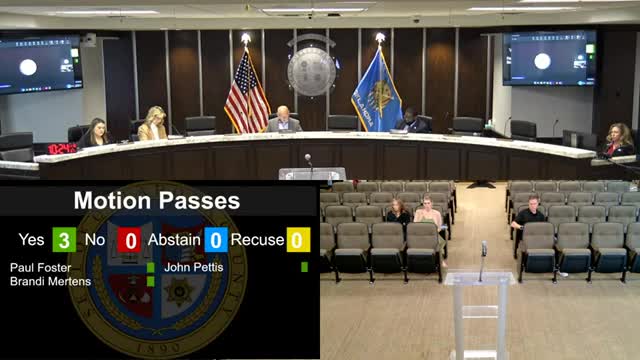
Summary
After Iron Mountain reviewed an amended records retention policy, the committee struck language requiring policy amendments to be approved by this committee, discussed allowing elected officials to extend retention beyond statutory minimums with documentation, and voted to recommend a resolution creating an Oklahoma County Information Technology Council to the BOCC.
The Policy & Governance Committee reviewed an amended county records retention policy and schedule presented by Chris Whitaker of Iron Mountain and recommended a related resolution to the Board of County Commissioners to create an Oklahoma County Information Technology Council.
Whitaker reviewed edits that narrow the policy’s scope to "BOCC departments and elected officials" and replace prior references to the Policy & Governance Committee with the proposed Oklahoma County Information Technology Council for several roles, including training and oversight. He said the changes also assign responsibility for records management training to the information technology council and direct the county manager to provide the retention policy and schedule to all the board and elected officials.
A key policy issue was language allowing elected officials or directors to retain records for longer than statutory minimums. Committee members debated whether that flexibility would create inconsistent treatment across offices. Unidentified Speaker 1 urged caution, asking why a policy that standardizes destruction practices would create an exception. Cody (named in discussion) argued offices have unique business needs and that elected officials should be able to hold records beyond minimum requirements provided they keep documentation explaining the deviation.
The committee approved a motion to omit a highlighted sentence that would have required all amendments or variations to be approved by Policy & Governance, and directed staff to refine language so deviations above statute are documented. Whitaker noted the policy adds a baseline for approved destruction methods and guidance for off‑site storage that references vendor handbooks and best practices.
On a separate but related agenda item, the committee discussed resolution 2025-4449 to create the Oklahoma County Information Technology Council — an eight-person council with representation from each elected official’s office. Dane described the council as a county-level IT steering body to address major technology strategy and change-control items. The committee voted to recommend the resolution to the BOCC.
Next steps: staff will revise the policy language to document how elected-official exceptions will be recorded, send both the retention policy and schedule to legal for signoff, and may call a special meeting if the revisions require rapid action so offices (notably the sheriff’s) can transfer or dispose of documents per the new schedule.