
RTA officials brief McHenry County on new transit funding and governance changes under state bill
Get AI-powered insights, summaries, and transcripts
Subscribe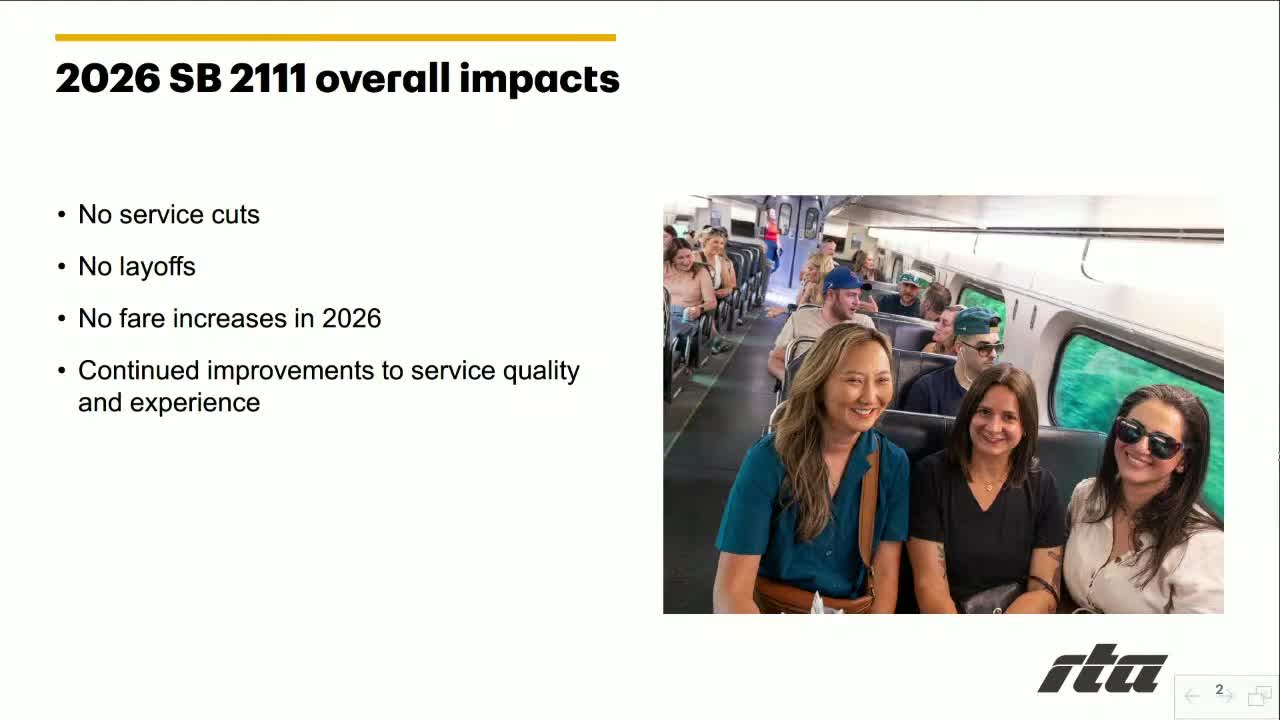
Summary
RTA representatives updated the McHenry County Board on state legislation (cited in the record as Senate Bill 2111) that will add roughly $1.25 billion in annual operating funding statewide and an estimated $478 million annually to the RTA region, lower the statutory fare recovery ratio and move governance toward a Northern Illinois Transit
RTA representatives visited the McHenry County Board Nov. 13 to outline major changes in a recently approved state transit bill (referred to in the meeting as "senate bill 21 11"). Director Sager framed the legislation as transformational: the bill is expected to bring about $1.25 billion in new annual operating funding to transit statewide and an estimated $478 million annually to the RTA region, provide capital resources for a multi-year program and avoid near-term service cuts, layoffs and fare increases.
Key elements explained by RTA staff: the bill establishes a larger regional funding pool (major revenue from motor-fuel sales tax and an RTA sales-tax component), shifts governance into a new Northern Illinois Transit Authority (NITA/NIDA) with new appointment structures and an expanded board, and temporarily reduces the legally required fare "recovery ratio" from 50% historically to 25% (transitioning toward 20% in later years) to align funding expectations with post-pandemic ridership realities. Kevin Buyso (RTA CFO) noted timing details: some revenues would not materialize until mid-to-late 2026, so reserves and transitional plans will be used to avoid service cuts in 2026.
Board concern and next steps: members asked clarifying questions about supermajority definitions for major decisions under the new board structure and requested continued Collar-Counties coordination to preserve regional interests. RTA staff said IDOT and transition working groups will hire consultants and refine details during the implementation phase; the RTA board must act on some reallocations within statutory timelines next year.
Why it matters: the legislation alters the revenue base, governance and capital planning for transit across the Chicago region and the Collar Counties; local officials said they will monitor the NITA transition to protect Collar-County priorities and ensure capital investments (including potential projects in McHenry County) are equitably considered.