
Peabody committee presses for clearer e-bike rules, discusses registration and seizures
Get AI-powered insights, summaries, and transcripts
Subscribe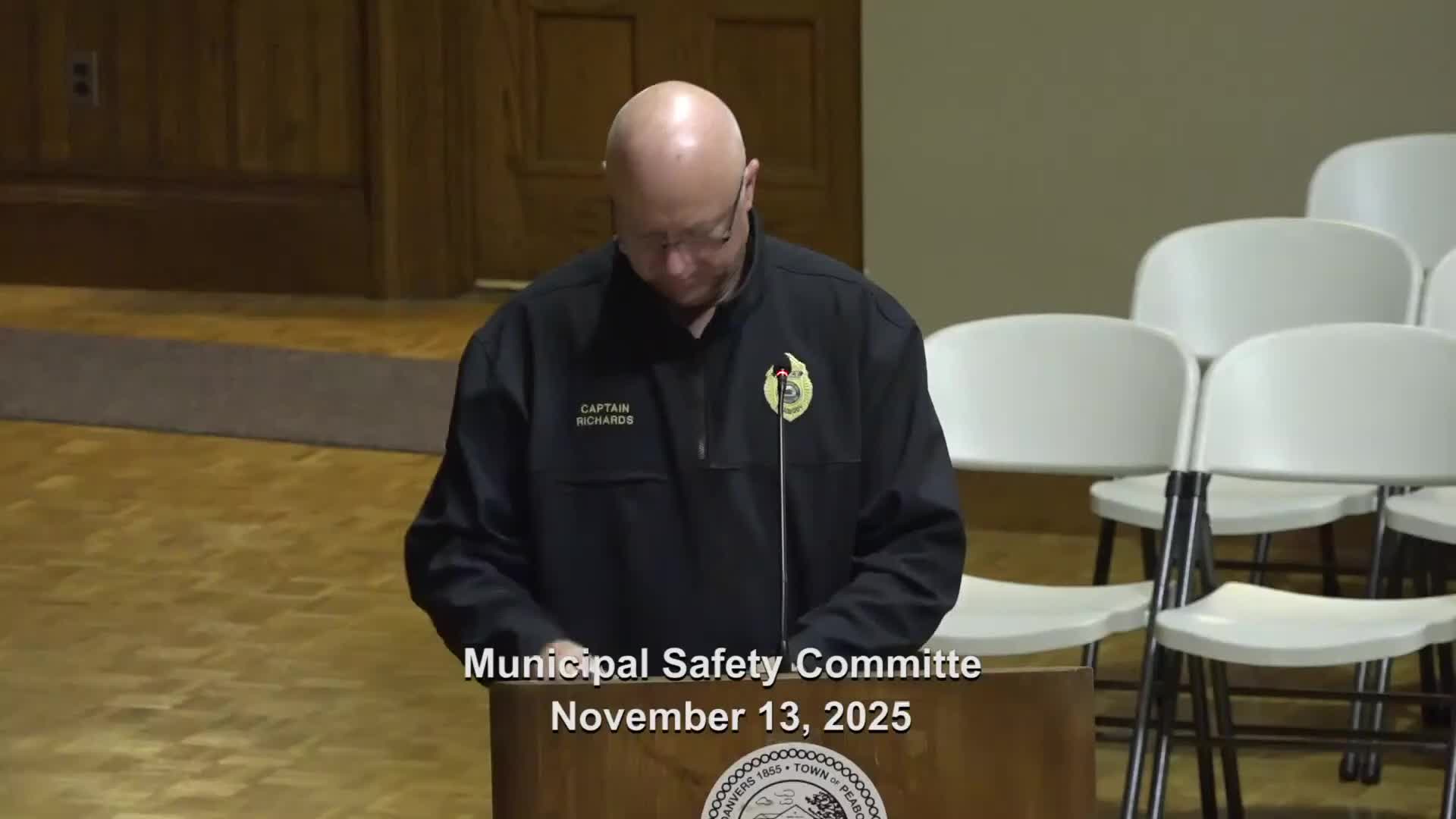
Summary
At a Nov. 13 municipal safety committee meeting the Peabody police outlined enforcement challenges for electric bikes on sidewalks and the Independence Greenway; councilors discussed registration, 15-day seizure authority, education and a possible ordinance amendment, and residents urged action after near-misses.
Peabody City’s Municipal Safety Committee on Nov. 13 heard from Captain Kevin Richards about the city’s limited tools to curb dangerous electric-bike use and discussed potential ordinance changes, registration and education.
Captain Richards told the committee that Massachusetts currently treats many e-bikes under bicycle laws rather than motor-vehicle rules and described three classes of e-bikes: “the two first classes ... are supposed to have a maximum of 20 miles an hour” while a newer class can go “up to 28 miles an hour.” He said the city’s recent installation of a mast-arm traffic signal helped reduce crashes at the Lowell/Endicott/King Street intersection, but that e-bike enforcement on sidewalks and the Independence Greenway is constrained by both ordinance language and practical staffing limits. “Ebikes are not allowed on sidewalks anywhere,” he said, and added that existing city ordinance does not explicitly address e-bikes on the Greenway.
Councilors proposed several approaches. Councilor Gamache suggested state-level registration and local visible tags so officers can follow up without high-speed chases: “the only way that the police department can enforce or follow-up without a chase is a tag, a vehicle tag, just like motorcycles have.” Captain Richards said state lawmakers are considering bills but warned plates can be obscured and registration would not eliminate evasive behavior. Councilor Walton urged caution so older residents who use e-bikes as mobility aids are not barred: “we don’t want ... to prohibit people’s legal and fun and reasonable use of a mode of transportation.” Several councilors endorsed stronger seizure language for reckless use — a minimum 15-day hold — as an enforcement tool already allowed in some cases.
Residents and councilors flagged safety and response limits. Leslie Kordomache of 210 Washington Street told the panel she regularly sees middle-school–age riders on sidewalks without helmets and sometimes running lights: “I see kids that are 11, 12 years old ... they don't wear helmets ... I think it's pretty dangerous.” Committee members and the captain agreed enforcement is often educational—seizures or warnings for young riders—because by the time officers arrive complaints are usually gone. Richards recommended using camera footage (body, business, Ring cameras) to identify riders and noted the department is recruiting: five officers are in the academy and the department hopes to hire roughly 15 more, but recruits will require months of field training.
The panel discussed alternatives that stop short of criminalizing all e-bike use: targeted ordinances that distinguish assistive, low-speed e-bikes from modified, high-speed models; mandatory seizure for reckless riders; and public education in schools and through ‘safe routes’ programs. Richards said he will work with the parks department and the city solicitor to draft ordinance language if the council wants to pursue a ban on specific sidewalks or pathways.
The committee did not take a formal vote to change law at the meeting, but members asked staff to prepare options and legal language for future consideration.