
Council introduces 605 Davis special‑use ordinance after heated public comment; affordability amendments fail
Get AI-powered insights, summaries, and transcripts
Sign Up Free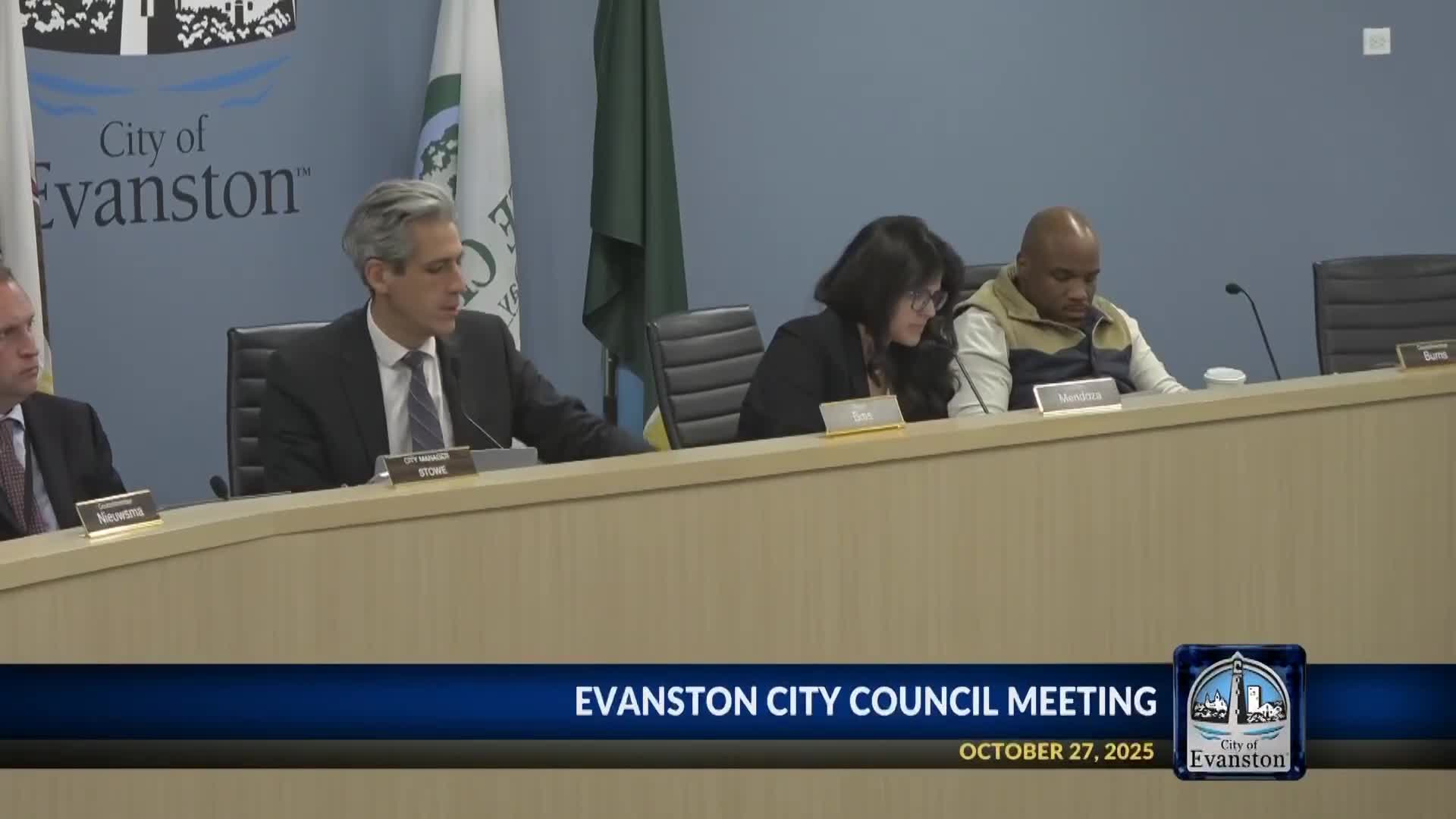
Summary
After hours of public testimony, the City Council introduced an ordinance to allow a proposed 31‑story mixed‑use plan development at 605 Davis Street, voting 5–4 to move the project forward for subsequent hearings.
The City Council introduced ordinance 66‑O‑25 on Oct. 27, a special‑use and plan‑development ordinance to permit a proposed mixed‑use tower at 601–615 Davis Street and 604–608 Chicago Avenue (the "605 Davis" project). The motion to introduce the ordinance passed on first reading 5–4; it was an introduction, not final approval.
Council member Herakaris moved introduction of the ordinance and Council member Ailes seconded. The clerk recorded the roll call: Ailes, Nussbaum, Burns, Herakaris and Harris voted in favor; Suffredan, Davis, Rogers and Kelly voted against introducing the ordinance.
The ordinance is for a large, high‑density development proposed by Vermilion Development and Campbell Coyle; the plan would provide roughly 419 units with 84 on‑site inclusionary (affordable) units under the developer’s proposed affordability schedule and would rely on the Illinois affordable housing special assessment program (tax abatement) to reach the pro forma necessary for financing.
Public testimony filled much of the meeting. Supporters — including Rezoning for Better Evanston, Downtown Evanston (Special Service Area No. 9), building‑trades representatives, Interfaith Action of Evanston and many residents — told the council the project would add housing supply, produce more affordable units than the city has recently completed under its inclusionary program, bring customers to downtown businesses and expand long‑term tax revenue. "Supporting this project means supporting economic diversity, community stability, and a future where Evanston is affordable for everyone," Roger Williams, president of Rezoning for Better Evanston, said during public comment.
Opponents pressed multiple lines of concern: the project’s height and massing relative to the downtown plan (including claims it lacks the intended upper‑story setbacks), the scale of the property‑tax abatement, the size and market orientation of the proposed units (many studios and one‑bedrooms), and potential impact on District 65 and D202 school finances. Speakers asked the council to seek more on‑site family‑sized units and expressed unease about the prospect of a long‑term tax abatement that delays full tax receipts to taxing districts for years.
Council members proposed amendments on the floor. Council member Kelly moved to require 15% on‑site affordability rather than the higher percentage in the developer’s proposal; that motion failed for lack of a second. Later, a motion to require 30% on‑site affordable units for the development was introduced and failed in a recorded vote (2–7). The developer’s representatives told council the project pro forma is financeable only under the current abatement level and that commercial financing and equity investors require a minimum return (they said the team was targeting about a 7% return on cost). Campbell Coyle counsel David Riefman and Chris Dillian presented those financing constraints to the council.
What happened next: The ordinance was introduced for future consideration (not adopted). Council members and staff discussed next steps and the project will return for further hearings and votes under the usual land‑use and ordinance process.
Why it matters: The project would add hundreds of units and 84 units of on‑site affordable housing under the developer’s rubric, but it also raises tensions about whether tax incentives and variances are the right tools to increase affordability and how new development should relate to the downtown’s historic scale. The council’s introduction keeps the project alive for later votes and conditions.
Speakers and roles (selected): Council member Herakaris (mover), Council member Ailes (second), Council member Kelly (opponent and amendment maker), developer representatives Chris Dillian (Campbell Coyle) and David Riefman (counsel), and many public commenters including Roger Williams, Andy Vick, Valerie Kretchmer, Sam Gaiman and others.