
Utah Supreme Court hears challenge to how trial court calculated alimony
Get AI-powered insights, summaries, and transcripts
Subscribe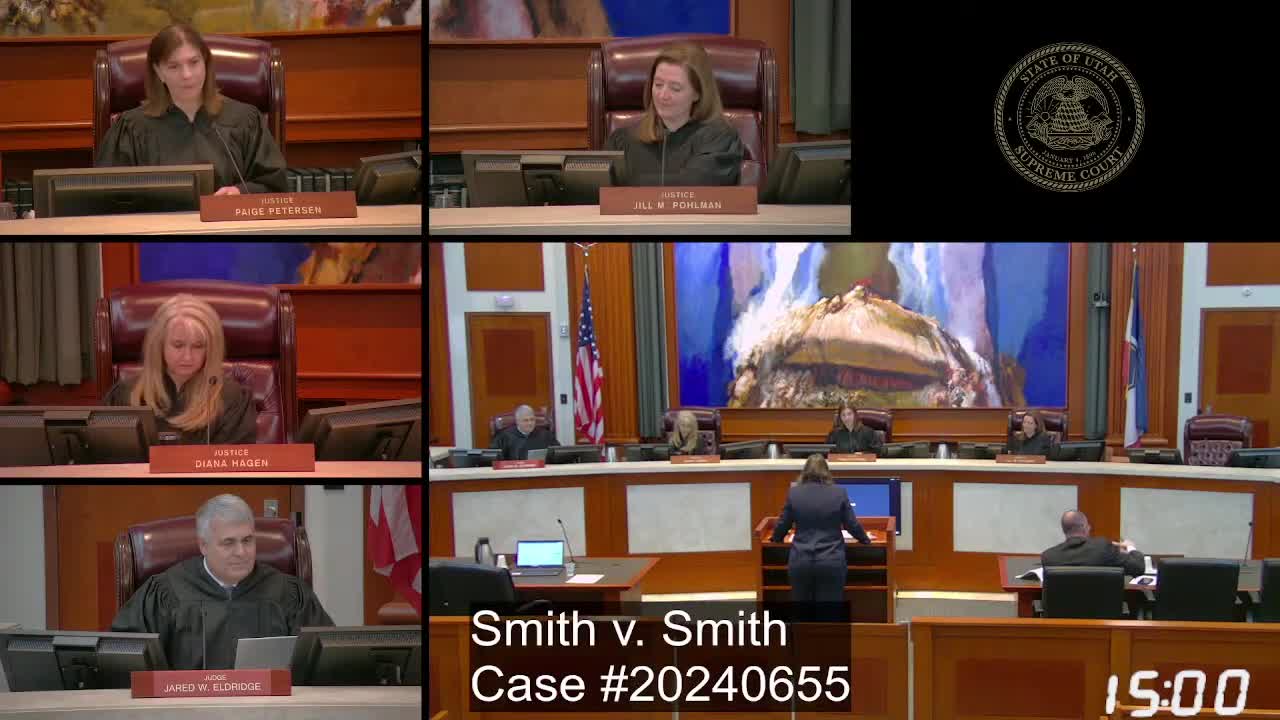
Summary
SALT LAKE CITY — The Utah Supreme Court on Monday heard argument over whether a district court properly calculated alimony by reducing a former spouse’s claimed marital expenses and then equalizing the parties’ incomes to produce a larger award.
SALT LAKE CITY — The Utah Supreme Court on Monday heard argument over whether a district court properly calculated alimony by reducing a former spouse’s claimed marital expenses and then equalizing the parties’ incomes to produce a larger award.
Deborah Bulkley, representing petitioner Jacqueline Smith, told the court that “the starting point in determining alimony in the state of Utah has been ... the financial condition and needs of the recipient spouse,” and that courts must consider the marital standard of living rather than limit awards to “the most basic needs.” She argued the district court erroneously trimmed the petitioner’s claimed expenses to basic needs and then “added back” amounts when it later equalized income, referencing Gardner and related authorities to say the proper procedure requires beginning with the marital standard of living.
Respondent counsel David Pedrazos disputed that characterization, drawing a distinction between equalizing the parties’ standards of living and merely dividing income. He told the court the district judge reduced a number of expense items after examining the record and testimony, and adjusted both parties’ expense lines to reach a fair result given the parties’ reduced combined income at trial.
A central factual dispute at argument was whether the financial materials and exhibit D in petitioner’s addendum reflected the marital standard at separation or only current expenses. The parties’ filings and the trial record contained multiple figures cited during argument: a pre-separation or marital-level listing of $5,193.79 in expenses, a reduced line-item figure at $4,184, an asserted shortfall calculated by the district court of about $910 per month, and a challenged final alimony award of roughly $1,975 per month after equalization. Counsel disagreed on whether evidence beyond the $910 was ever presented at trial to justify award amounts above that demonstrated shortfall.
The justices repeatedly probed the procedural sequence used by the district court. One justice asked whether the $4,184 figure was intended to represent the standard of living “at the time of separation or at the time of trial,” and pressed whether it is permissible for a trial court to pare back documented marital expenditures on grounds of reasonableness when those expenditures are properly supported in the record.
Pedrazos relied on appellate case law he said allows trial courts to adjust line items when declarations or receipts are incomplete; he also emphasized that counsel for the petitioner at trial had, in places, agreed to many of the adjustments the district court made. Bulkley countered that Utah precedent and the statute require the court to start with the marital standard and that equalization should not exceed the recipient’s demonstrated need absent a clear, stated reason.
The attorneys debated statutory interpretation as well. Counsel discussed an operative statute (commonly referenced in argument as 30-3-5 and related recodifications), whether the phrase “may attempt to equalize the party’s respective standards of living” imposes any implicit cap tied to demonstrated need, and how decades of Court of Appeals precedent (including references to Dow v. Dow and other authority) have been applied to limit equalization in practice.
Both sides acknowledged possible ambiguities in the trial record. Bulkley suggested a remand might be appropriate so the district court can clarify whether it improperly reduced marital expenses and, if it departed from the marital standard, explain the reasons for any deviation. Pedrazos argued the record showed the judge was attempting to reach a reasonable, equitable result based on the evidence actually presented.
The court’s questioning also touched on practical evidentiary points: whether receipts or other documentation were presented to prove recurring expenditures (haircuts, nails, travel) and whether the district judge substituted a personal view of reasonableness when evidence supported the marital standard.
The justices did not indicate a likely outcome from the bench. The court took the case under advisement at the close of argument; no timetable for a written opinion was announced.
Proper names and roles referenced in the argument include petitioner Jacqueline Smith and respondent Daniel Smith; trial counsel James Woodall was cited at multiple points during argument; Debbie Bulkley argued for the petitioner and David Pedrazos for the respondent. The hearing included sitting arrangements with a remote Chief Justice and Judge Eldridge joining for the session.
What happens next: the Utah Supreme Court will issue a written decision addressing whether the district court applied the correct procedural sequence in determining demonstrated need, how (or whether) equalization may exceed that need, and whether a remand is required for clearer findings.