
Utah Supreme Court hears challenge to arbitration award tied to an unsubmitted oral‑agreement claim
Get AI-powered insights, summaries, and transcripts
Subscribe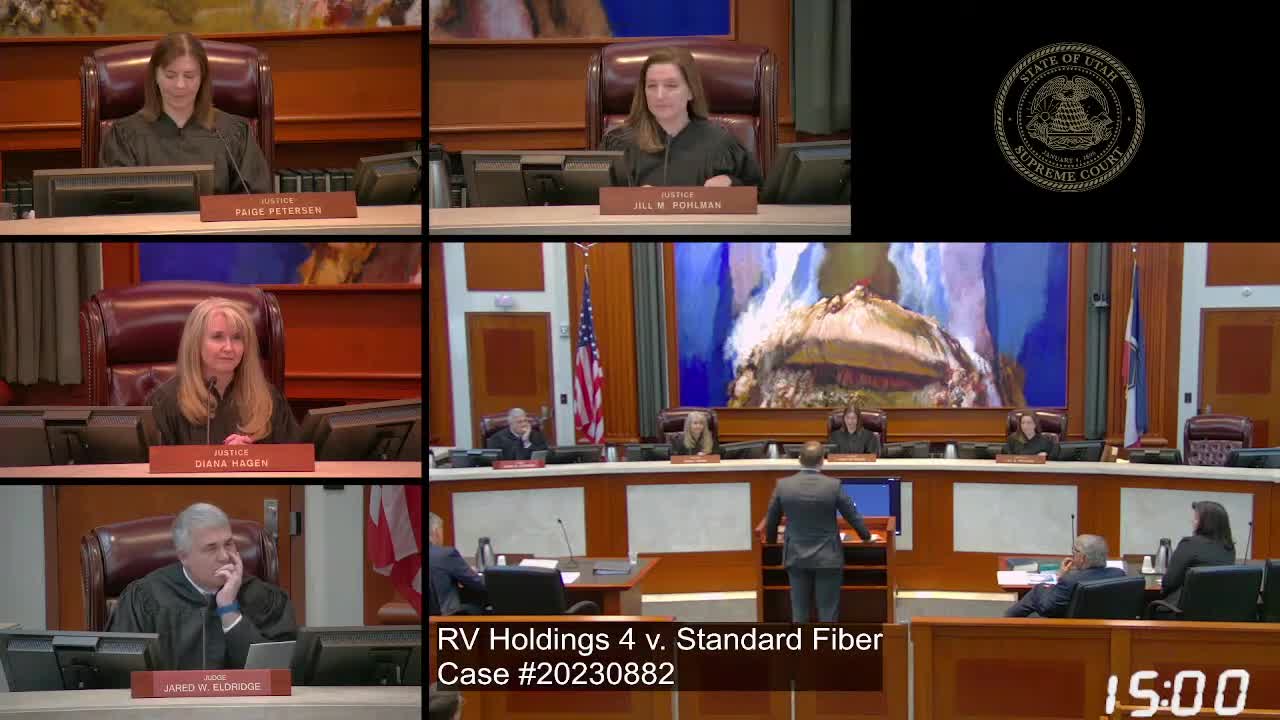
Summary
The Utah Supreme Court heard oral arguments on whether a JAMS arbitrator exceeded authority by awarding damages on an alleged 2014 oral‑agreement claim that appellant counsel says was never submitted against his client.
The Utah Supreme Court heard oral arguments on whether a JAMS arbitrator exceeded her authority by awarding Ridgeview Capital damages for breach of a 2014 oral agreement that appellant counsel said was never submitted as a claim against his client.
"The arbitrator in this case made an award on a claim that was never submitted," appellant counsel Christopher Bates said during argument, urging the court to reverse the district court’s confirmation of the award or to partially vacate it by excising relief tied to the unsubmitted claim.
Bates told the court the arbitrator listed the parties’ claims in detail but did not show any claim against his client for breach of the alleged 2014 oral agreement. He said Ridgeview repeatedly denied the existence of a 2014 agreement in the arbitration and in post‑hearing filings, and that his client had no notice they faced liability under that theory and therefore did not present defenses tailored to it.
Respondent counsel Jefferson Gross said the dispute about management fees and the alleged oral agreement was "front and center" at the arbitration and urged deference to the arbitrator. "An arbitrator may order any remedies as the arbitrator considers just and appropriate under the circumstances of the arbitration proceeding," Gross said, citing Utah Code §78B‑11‑122(3) and the JAMS rules governing remedies.
A central legal question the justices pressed was whether an arbitrator’s remedy must be tied strictly to a formally submitted claim or whether an arbitrator may fashion relief based on defenses and evidence presented at hearing. Several justices asked whether JAMS Rule 9 — which bars consideration of claims without prior notice unless the arbitrator finds no party was unfairly prejudiced — required an explicit finding by the arbitrator that no party suffered unfair prejudice before awarding relief on a theory not clearly pled.
Appellant counsel replied that JAMS provides procedures for amending or submitting claims and that post‑hearing briefing cannot substitute for proper notice to the affected party. He said the district court should have modified or partially vacated the award because excising relief tied to an unsubmitted claim would not affect the remainder of the award.
Counsels also disputed the factual and remedial contours of the case. Appellant said the arbitrator awarded approximately $725,000 for the July 2020–2022 period plus interest based on findings tied to an alleged diversion of investor distributions. Respondent counsel said the arbitration included a three‑day evidentiary hearing, interim awards, and opportunities for parties to object but that the record showed the issues were litigated before arbitrator Judge Westerfield and that many claims were rejected while the management‑fee dispute remained central.
The justices questioned whether the parties had opportunities under JAMS to amend claims or raise objections and whether any failure to object amounted to waiver. Counsels debated whether arbitration practice (where rules can be more flexible than in court) changes the remedy/claim relationship familiar from civil pleading rules.
The court took the matter under advisement and recessed without announcing a decision.
What happened next: The court did not issue a ruling from the bench; the case will be decided after the justices consider written and oral arguments.
Key context: The dispute centers on whether an arbitrator may award damages based on a claim or legal theory that was not individually submitted against the party who ultimately faced liability, and whether the Utah statutes and JAMS rules permit or limit such relief.