
Utah Supreme Court hears argument on whether state constitution protects a common-law "right to resist" unlawful searches
Get AI-powered insights, summaries, and transcripts
Subscribe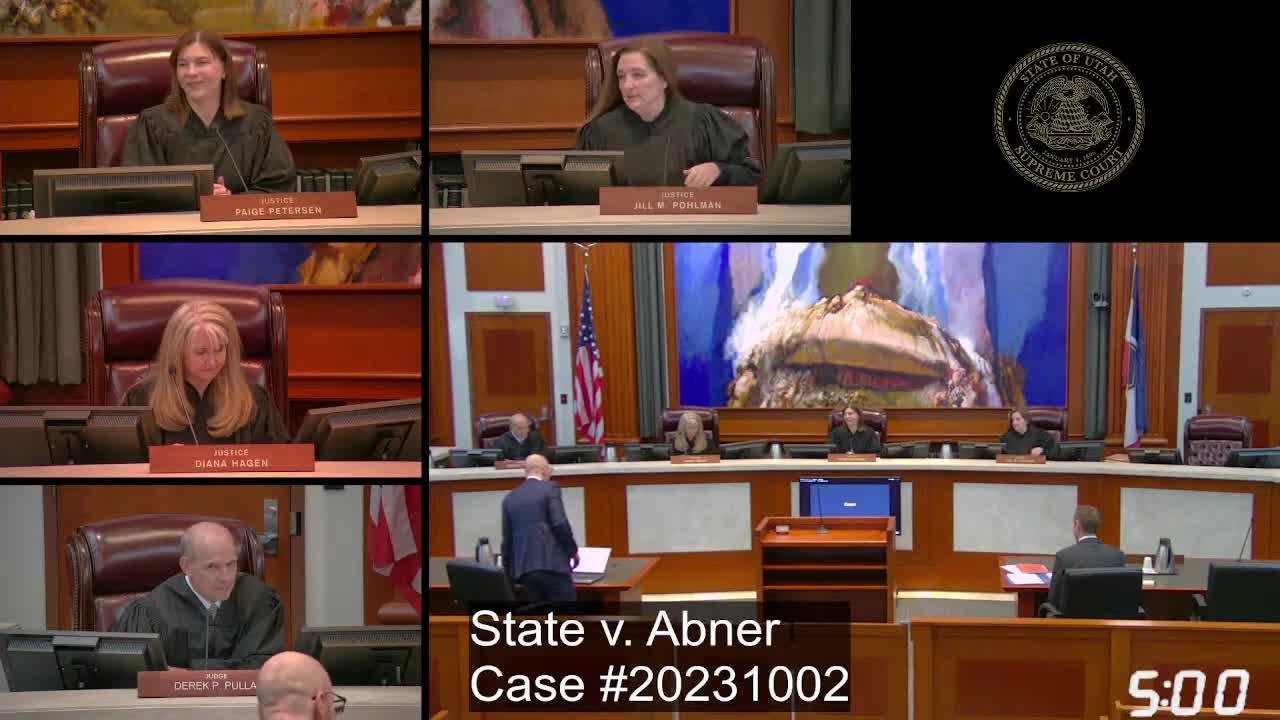
Summary
David Ferguson, counsel for the defendant, asked the Utah Supreme Court to recognize a common-law right under the Utah Constitution allowing resistance to unlawful searches; Jeff Mann, for the State, urged the court to avoid a new constitutional holding and said the record shows a warrant and only limited remedies.
David Ferguson, counsel for defendant Leslie Abner, urged the Utah Supreme Court to recognize a common-law "right to resist" unlawful searches and seizures rooted in the state constitution and historical practice. "There's a common law right to resist unlawful searches and seizures," Ferguson told the justices, arguing that in some circumstances that right should operate like self-defense and could justify either a jury instruction or, in narrow cases with undisputed facts, judicial suppression of evidence.
Jeff Mann, representing the State of Utah, pushed back that the court need not reach a broad constitutional holding to resolve this appeal. He told the court the simplest disposition would be to affirm because officers had a warrant here: "The easiest way for this court to dispose of this appeal and affirm the conviction is by saying, the police had a warrant, therefore, the common law right to resist would not have applied," Mann said. He also emphasized the limited record and analogized the reported defects in execution to technical violations the U.S. Supreme Court declined to make suppressible in Hudson v. Michigan.
At issue is whether Article I, section 14 (and related provisions) incorporate a common-law right that allows a person to resist an unlawful search or seizure, and if so what remedies flow from that recognition. Ferguson argued the right is historically grounded, can mirror self-defense doctrines (requiring imminence and proportionality), and that courts may sometimes suppress evidence when the facts clearly show bona fide resistance to an unlawful intrusion. He pointed to authorities drawing the historical line between void and merely defective warrants and said a void warrant should be treated like a warrantless unlawful search.
Several justices pressed counsel on the practical contours: would the doctrine be a jury question (a justification defense) or a judicial remedy? How should proportionality be measured when the conduct resisted is an arrest rather than a physical attack? Ferguson acknowledged the issues are fact-intensive and urged that the district court’s refusal to hold an evidentiary hearing below left the record too thin; he asked in the alternative for remand to develop facts.
Mann responded that, even if a common-law right to resist were recognized somewhere in Utah practice, it traditionally applied to warrantless arrests and produced a jury instruction rather than mandatory suppression, and that the court should avoid expanding constitutional text to create a new, broad right. He also noted a concession below: he said the prosecutor told the lower court the motion was "well taken" and dismissed the unlawful-entry portion of the case, and that the remaining defects look like technical execution errors that do not justify suppression.
Throughout the argument the justices tested hypotheticals — from plainly unlawful warrantless entries to an extreme scenario of governmental overreach — and raised concerns about original public understanding, textual silence, and the risks of creating a sweeping constitutional exception that would destabilize existing warrant jurisprudence. Defense counsel cited cases and historical sources (including John Bad Elk and other common-law authorities) and asked the court to either recognize a remedial suppression power under section 14 or allow a jury instruction tied to self-defense principles under Article I, section 1.
The court did not rule from the bench. After closing arguments, the presiding justice said the matter would be taken under advisement.