
Evanston technical committee begins rulemaking for Healthy Buildings Ordinance; staff flags $10.4M DOE grant and data work
Get AI-powered insights, summaries, and transcripts
Sign Up Free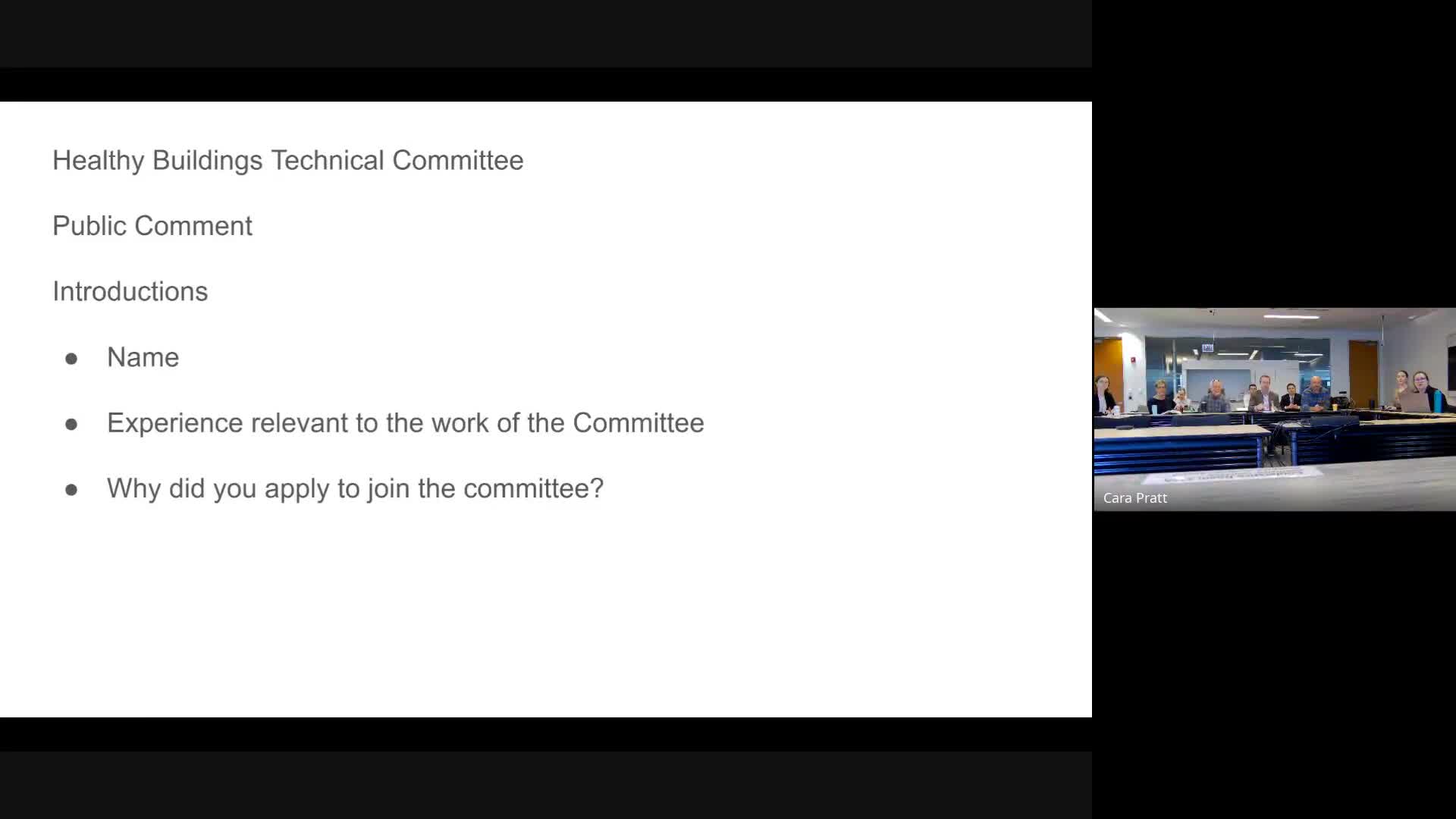
Summary
Evanston’s Health and Buildings Technical Committee convened its first meeting to begin rulemaking under the city’s Healthy Buildings Ordinance, prioritize near‑term tasks and hear staff updates on data, funding and outreach.
Evanston’s Health and Buildings Technical Committee convened its first meeting to begin rulemaking under the city’s recently passed Healthy Buildings Ordinance, hear staff briefings on responsibilities and data needs, and set near‑term priorities including a utility briefing and a review of benchmarking data.
Kara Pratt, Evanston’s chief sustainability and resilience officer, opened the session by describing the work ahead as “a long journey through the rulemaking process for the Healthy Buildings Ordinance.” Pratt told members the committee’s duties under the ordinance include developing implementation rules, recommending final and interim performance standards, defining net‑zero accounting and the use of offsets, and helping design outreach and alternative compliance pathways.
Pratt announced the city had received a $10,400,000 grant from the U.S. Department of Energy intended to support staffing and implementation work, saying the “bulk of those dollars would go to audits at what we define as equity priority buildings.” She added that the grant’s status with federal contacts was uncertain and that there had been no formal communication that the award had been rescinded.
Members and staff prioritized compiling and organizing benchmarking data as an immediate task. Committee discussion repeatedly referenced the BEAM data platform and existing benchmarking records; staff said an intern had begun processing benchmark data and that the body should focus first on reviewing what is already available. Pratt clarified that verification requirements changed under the Healthy Buildings Ordinance: whereas prior benchmarking verification occurred every three years, “verification only has to happen once every five years” under the ordinance’s baseline and interim‑year approach.
Committee members pressed for actionable resources and case studies. Gabrielle Martin, an energy professional on the committee, urged practical examples from jurisdictions and private‑sector projects and flagged utility coordination as a potential bottleneck: “It’s 1 big hurdle with ComEd…they really can’t provide it,” she said, citing recent program delays and limited capacity for some grid upgrades. The committee agreed to invite the utility to a future meeting to discuss capacity, programs and potential support for compliance.
The group also discussed outreach and short‑term funding. Staff said the city was proposing to use approximately $20,260 (not yet approved) from existing local incentive programs and the Evanston Green Homes pilot to support implementation in the near term, with DOE funds intended to expand audit and retrofit assistance for equity‑priority buildings if the grant proceeds. Members recommended creating a public resource hub that compiles technical guides (for example, ASHRAE technical resources and the IMT implementation guide) and real‑world case studies to show how owners have reduced energy use or achieved net‑zero targets.
On targets, staff asked the committee to consider whether the body should phase standards for 2030 (for example, prioritizing energy use intensity targets first), how to define on‑site zero versus a procurement percentage, and at what point offsets or credits would be allowable. Pratt emphasized those are near‑term agenda items.
The committee agreed on two near‑term priorities: (1) review available BEAM and benchmarking data and (2) request a utility briefing (ComEd) to clarify program capacity and timelines. Members also agreed to post compiled resources on the committee’s public web page and to conduct most substantive work in publicly noticed meetings to avoid Open Meetings Act concerns.
By voice vote, the committee set its next meeting for Nov. 19 at 8:30–10 a.m. and a subsequent meeting on Dec. 17. A member then moved to adjourn and the meeting ended.
What’s next: the committee will receive the benchmarking packet and resources staff is assembling, consider invitations to ComEd and other stakeholders, and begin defining property‑type classifications and interim performance standards at its next meeting. The ordinance directs the technical committee to forward recommendations to an accountability board that reports to city council, and staff said the technical committee’s role is intended to be temporary until rules are approved by council.