
Experts at retreat urge farmland protection, local processing and farmer support to strengthen Chatham County’s climate resilience
Get AI-powered insights, summaries, and transcripts
Subscribe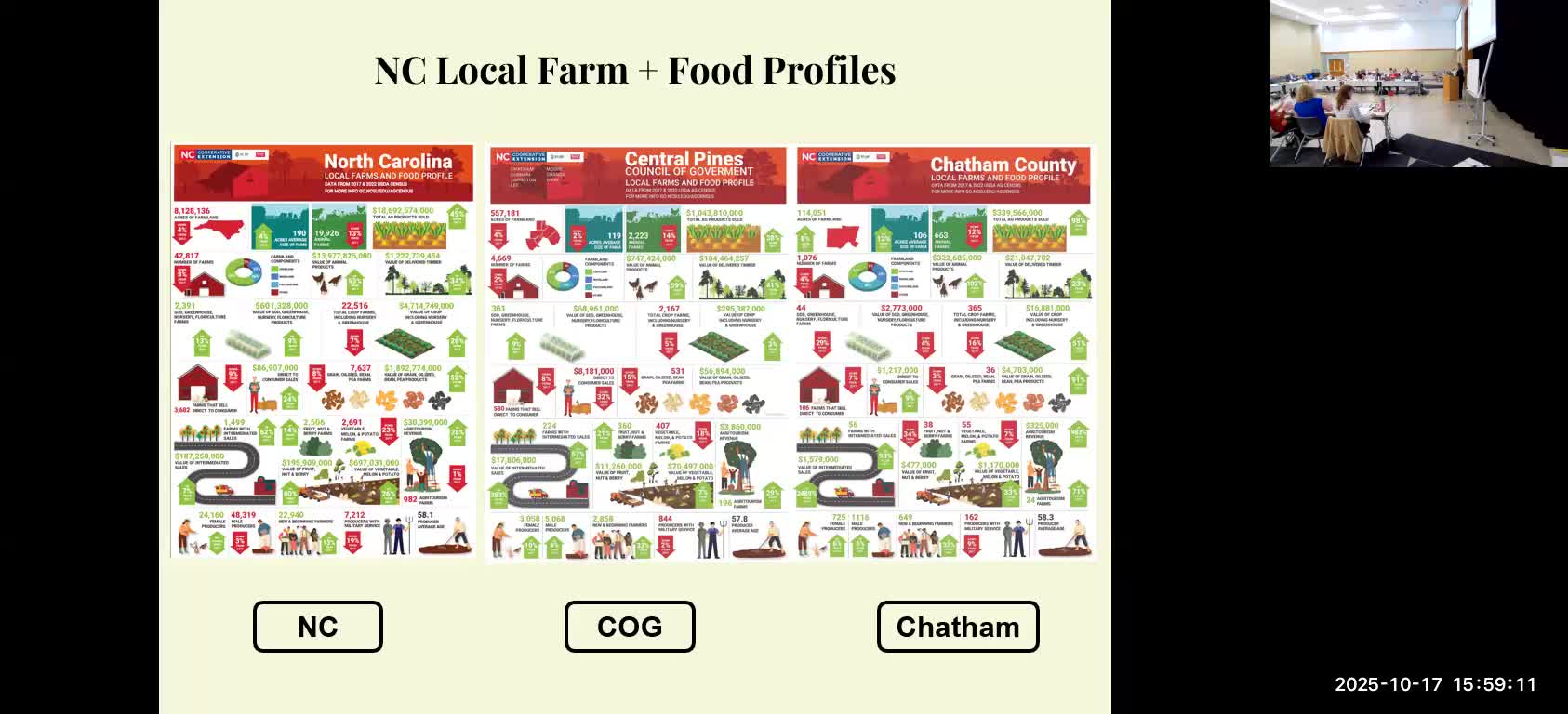
Summary
A farm and food-systems session highlighted Chatham County’s strong agricultural base, rising direct and intermediate sales, and high share of beginning farmers; the presenter recommended protecting prime farmland, expanding cold storage and processing capacity, and funding programs that give new farmers access to land and capital.
Michelle Schroeder Moreno, director of the Center for Environmental Farming Systems at NC State, told the retreat that farmland is a multi-purpose asset for climate adaptation and mitigation and that the county should treat local agriculture as a resilience priority. She presented county-level data (USDA Census comparisons) showing Chatham County’s increases in farmland acreage, direct-to-consumer sales and a large share of beginning farmers.
Schroeder Moreno said the two biggest threats to agricultural land are low-density residential development (fragmentation) and climate impacts, and she urged a suite of responses: farmland-access programs (leases and farm-link matchmaking), succession planning for retiring farmers, farmer navigators to help with contracts and finance, and county efforts to preserve prime soils. “Farmland (and food) is the new oil,” she said, arguing that local production and independent processing reduce supply-chain vulnerability during disasters.
The presenter also identified actionable items county officials can pursue: expand local cold storage and meat-processing capacity to prevent post-harvest losses, prioritize farm-to-institution procurement (schools, hospitals, senior services) and use Cooperative Extension and local colleges to build workforce pipelines. She highlighted existing assets in the region — a strong community-college sustainable-agriculture program, independent processors and active farmer networks — and encouraged the county to use those partners in the planning process.
Next steps: participants suggested adding agriculture-specific indicators to the county plan (farmland acres conserved, value of local sales, number of farms with access to cold storage) and exploring lease/purchase programs that keep land available and affordable for new farmers.