Sequim Council narrows 2026 municipal‑funding rules; staff to pre‑screen applications
Get AI-powered insights, summaries, and transcripts
Sign Up Free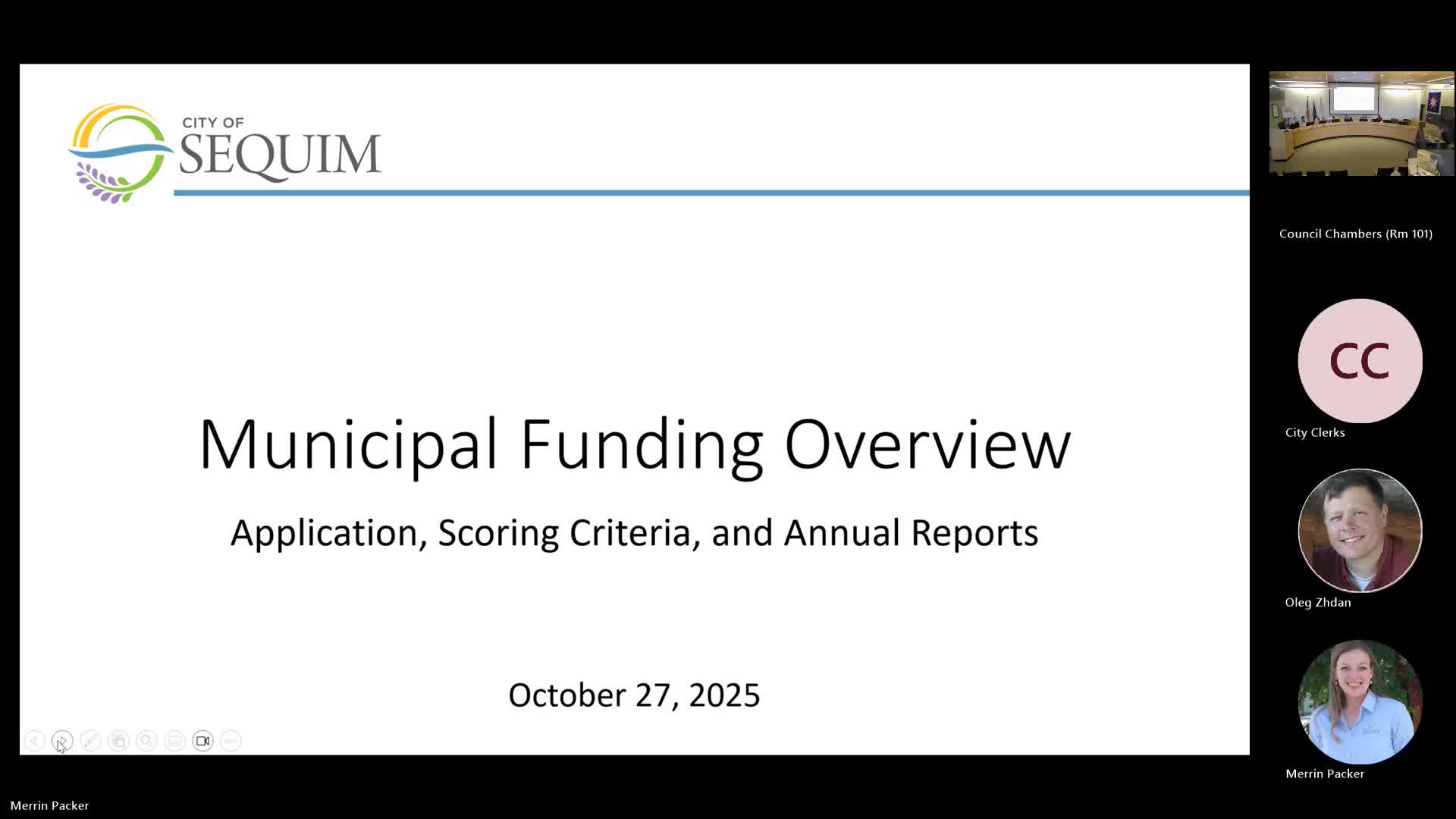
Summary
Sequim — The Sequim City Council on Oct. 27 reviewed a new scoring rubric and set several procedural rules for the city’s 2026 municipal funding program, directing staff to finalize application language and return the materials on the consent agenda.
Sequim — The Sequim City Council on Oct. 27 reviewed a new scoring rubric and set several procedural rules for the city’s 2026 municipal funding program, directing staff to finalize application language and return the materials on the consent agenda.
At a work session and continuation later in the meeting, Maren Packer, the city’s executive assistant, outlined a proposed scoring system that breaks applications into five sections (organization, funding, planning, budget and attestations) and assigns up to 100 points — with a 0–5 bonus for alignment with council priorities. Council members debated how to treat incomplete applications, whether to cap request amounts, how to measure “Sequim‑centric” service, and whether to offer one‑ or two‑year awards.
Council consensus and staff direction
Council instructed staff to perform a pre‑clearance step marking whether an application fits one of the two city funding paths (broad public benefit or health and human services) and to present all applications to council regardless of that pre‑clearance. Staff said it will notify applicants, when time allows, if the pre‑clearance is negative so applicants can revise before final submission.
Council rejected a per‑application cap on requests while reiterating an existing policy that no more than 1.5% of the general fund may be used for municipal funding in total. Members asked staff to continue to require applicants provide proposed budgets and to make clear the overall budget constraint is subject to available funds.
Sequim‑centric deliverables and award terms
Council directed that “Sequim‑centric” apply only to the specific deliverables an applicant would fund with municipal dollars; those deliverables must serve Sequim School District residents. Council set that requirement at 100% of the deliverable’s beneficiaries within the Sequim School District boundary. The council also decided to continue one‑year award terms rather than moving to two‑year awards.
Scoring process and final rubric edits
Council decided not to impose a minimum score threshold that would automatically prevent an application from advancing. For scoring logistics, council chose a hybrid approach: staff will score the pre‑clearance, gate check and reporting compliance sections, while council members will independently score the core domains (community need, measurable outcomes) and category‑specific domains (broad public benefit or health & human services) plus any bonus points; staff will aggregate the scores and present the totals to council.
Staff said it will amend the application and website to cite the relevant Revised Code of Washington (RCW) for the funding categories, clarify ‘‘evidence‑based’’ language to allow ‘‘evidence‑based / best practices’’ where appropriate, and place the scoring rubric and an application webinar on the city’s site to help applicants prepare.
What happens next
Packer said staff will revise the application and scoring materials to reflect council direction and return the documents on the consent agenda at a future meeting so council can adopt final language. No formal ordinance or final vote adopting the scoring rubric occurred at the Oct. 27 meeting; the council’s guidance will be incorporated by staff and brought back for adoption.