
Conference committee adopts Minnesota housing omnibus, approves $15 million target and policy changes
Get AI-powered insights, summaries, and transcripts
Subscribe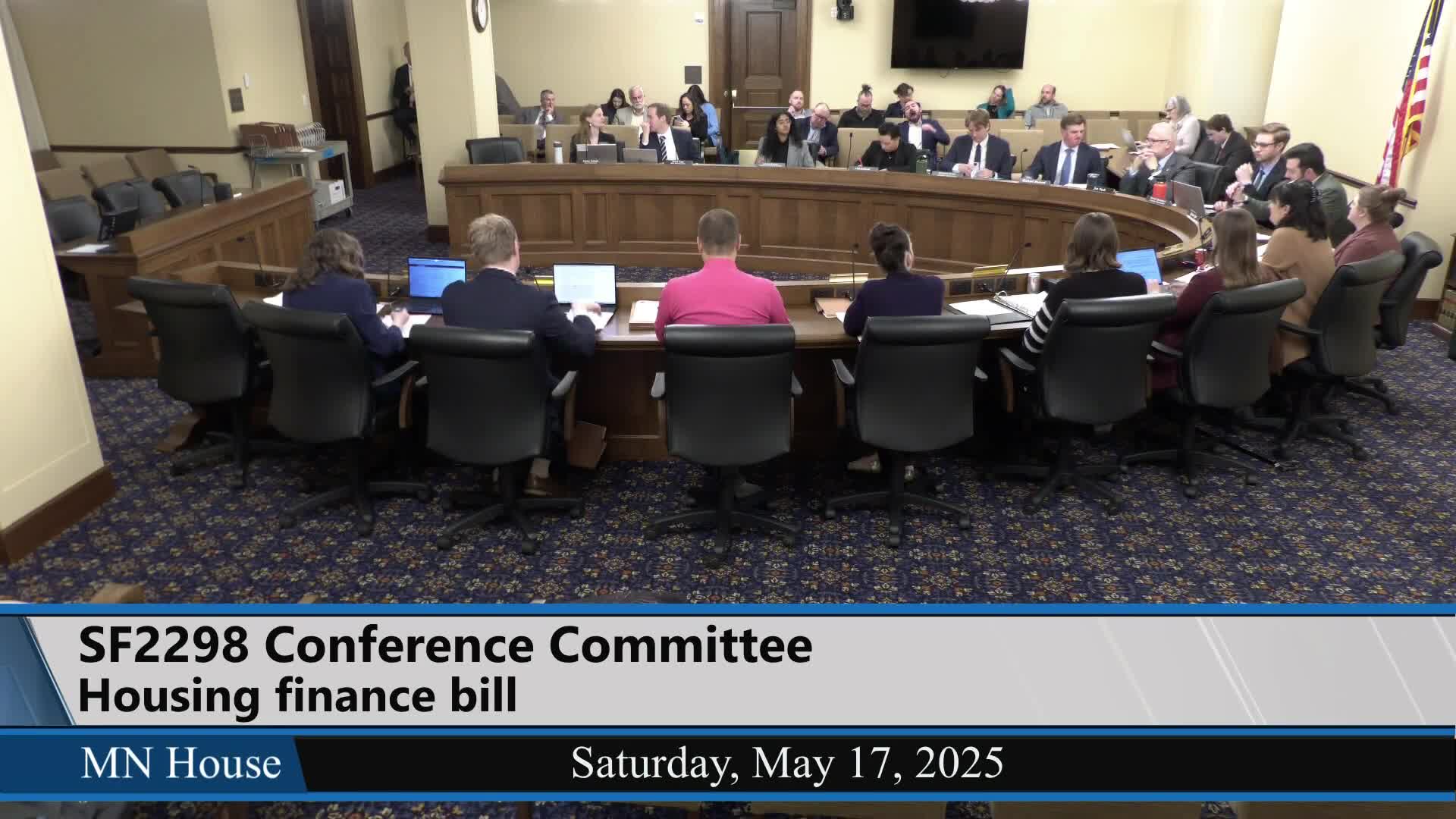
Summary
A conference committee on Senate File 2298 on May 16 adopted the conference committee report and accompanying spreadsheet, approving funding and multiple policy changes for housing programs including first-generation down-payment assistance, FHPAP, and housing infrastructure bond provisions.
The Conference Committee on Senate File 2298 adopted the conference committee report and an accompanying spreadsheet on May 16, approving appropriations and policy language for the 2025 Minnesota housing omnibus.
The committee voted to adopt the spreadsheet dated 05/16/2025 at 10:42 a.m. and then to adopt the conference committee report (coded CCRSF 2298). Both motions were approved by voice vote; no opposition was recorded on the floor of the committee.
The conference committee package implements the negotiated budget targets for housing: a $15,000,000 general fund target for fiscal years 2026–27 and an additional $3,800,000 in fiscal years 2028–29, according to staff briefing materials. Eric Olson, Senate fiscal analyst for the housing committee, summarized that the report meets the global targets agreement and noted two policy edits: the Senate provision restricting administrative costs fell out of the conference agreement, and the Minnesota Housing Finance Agency commissioner must now notify legislative housing committee chairs and ranking minority members before transferring funds.
The adopted spreadsheet and report allocate one-time and ongoing dollars across production, homeownership, and supportive services. Notable change items described by staff include:
- $2,000,000 (one‑time, FY 2026) for the Economic Development and Housing Challenge Program (development and redevelopment). - $2,000,000 (one‑time, FY 2026) for a workforce homeownership program. - $2,000,000 (one‑time, FY 2026) for Greater Minnesota Housing Infrastructure Grants (bringing the development/redevelopment total to $6,000,000 in new one‑time funding on lines summarized in the spreadsheet). - $8,350,000 additional for the Family Homelessness Prevention and Assistance Program (FHPAP) in FY 2026, with an additional $900,000 in the tails (FY 2028–29) noted as a base increase. - $2,000,000 (one‑time) to MMCDC for a community‑based first‑generation homebuyer assistance program and $2,000,000 to a homeowners homeownership assistance fund (total $4,000,000 in FY 2026–27 for homeownership assistance). - A $2,000,000 cancellation in FY 2025 from the single‑family housing program for naturally occurring affordable housing (community stabilization program). - Repeal of a transfer to the housing support account that had been $450,000 starting FY 2025 (staff noted the repeal would yield savings in the near term and different amounts in later fiscal years). - Debt service estimates tied to housing infrastructure bonds: roughly $1,000,000 in FY 2028 and $2.8 million in FY 2029 (approximately $3.8 million across FY 2028–29), and an additional cost of $4,000,000 starting in FY 2030 for the life of those bonds, per the spreadsheet.
The conference report also includes multiple policy provisions across article 3 and article 4. Staff summarized these changes as: expanded outreach in annual MHFA letters to manufactured home park owners about tax credits and notice requirements; extending a wage theft rule tied to low‑income housing tax credit allocations to other political subdivisions; new website information requirements about landlord‑tenant rights; modifications to the State Rental Assistance Program (including using annual income recertification for determining assistance amounts and allowing formula approaches and redistribution of unused funds); expansion of eligible awardees for certain challenge program grants (including charter/contract alternative and tribal contract schools and nonprofits they contract with); and changes to housing infrastructure bond eligibility to allow adaptive reuse for supportive housing and permanent housing affordable at or below 50% area median income.
During member discussion, several committee members praised the bill as a step forward while noting it does not meet the scale of the state’s housing shortage. Representative Nash said, "Guess where they're not looking? They're not looking in Minnesota," in reference to younger potential homebuyers considering leaving the state. Senator Port described first‑generation down‑payment assistance as a caucus priority and said the bill "touches all areas across the continuum: production, stability, [and] down payment assistance." Chair Howard thanked staff and members and warned that prior one‑time investments have created a "cliff" for emergency rental assistance: staff and members noted that fewer families will have access to emergency rental assistance than under 2023 funding levels.
Members also debated a piece of landlord‑tenant language in article 4 concerning heat provision. Senator Lucero and others raised concern about the term "capable of maintaining" heat in the statutory language and the potential ambiguity about spaces not intended for continuous habitation (for example, enclosed porches or crawl spaces). Chair Howard said caucus chairs had negotiated to strike the words "capable of maintaining" to better align with existing law and intent to require landlords to provide heating sufficient to maintain a minimum temperature (68 degrees was referenced in discussion). The committee recessed briefly to consult and then proceeded without formally amending the conference report on the floor; members indicated they would seek a correction mechanism that would not return the entire report to the reviser.
Staff clarified a separate technical change involving prevailing wage language for Low Income Housing Tax Credit (LIHTC) projects: Laura Painter, Senate Housing Committee analyst, said the prevailing wage change is a fix to the wood‑framing rate drafted by the labor commissioner at the request of the building trades.
Formal actions at the meeting were limited to adopting the spreadsheet and adopting the conference committee report. Both motions were approved by voice vote and recorded as prevailing.—The committee adjourned after adopting the report and spreadsheet and indicated the conference committee report will proceed to the floor.
Ending: The conference committee report and spreadsheet were adopted by voice vote; committee members and staff signaled continued attention to housing issues in upcoming sessions and, if federal funding shifts, potential return sessions in the fall to address impacts.