
Conference committee reviews Senate Offer No. 2 to House File 2431, flags funding and policy changes
Get AI-powered insights, summaries, and transcripts
Subscribe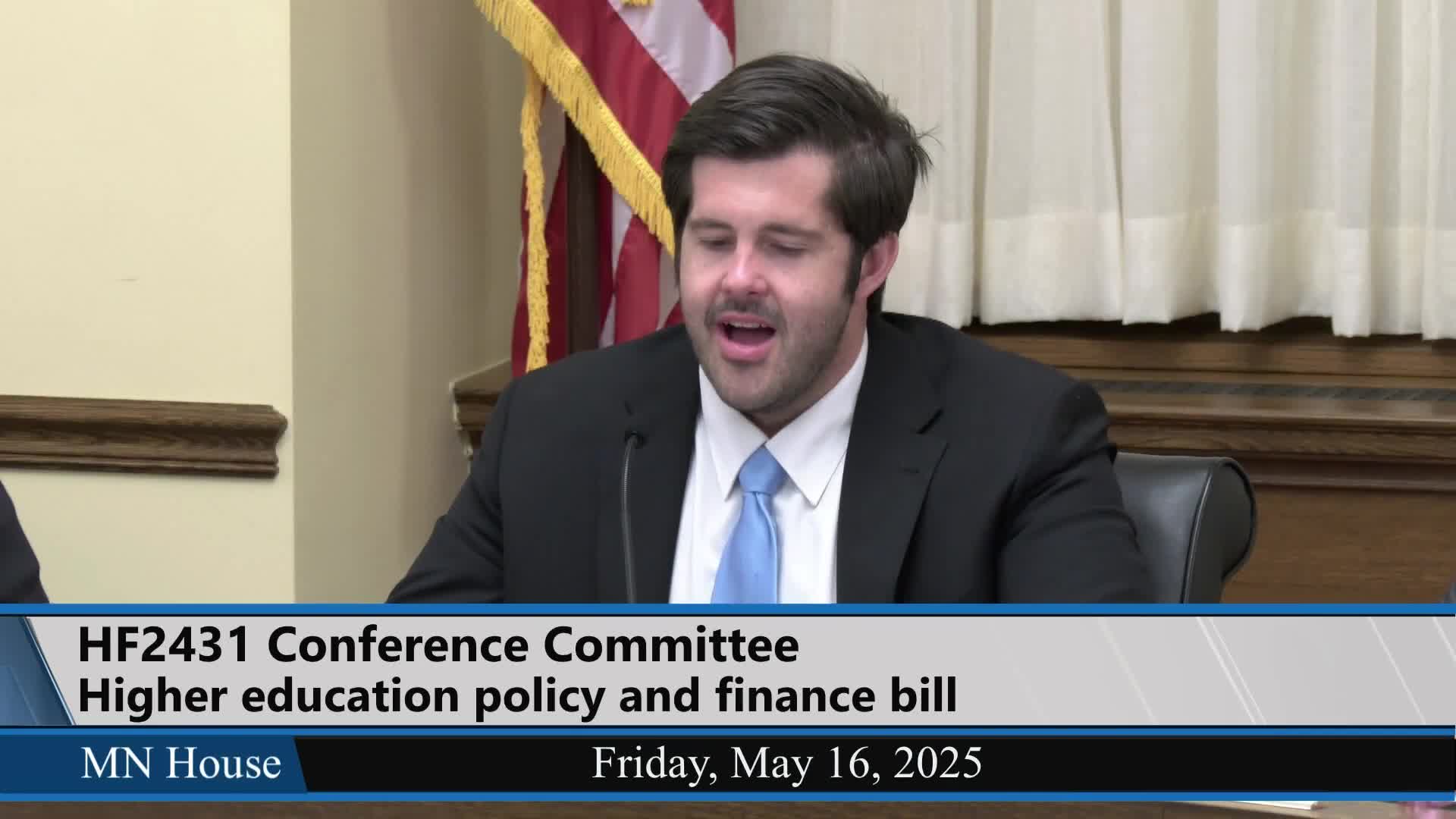
Summary
A Minnesota conference committee met late May 17 to review the Senate27s second offer on House File 2431, highlighting proposed appropriation changes, student-aid formula adjustments and new policy language on campus misconduct and direct admissions.
The conference committee on House File 2431 met May 17 to review the Senate27s second offer, a spreadsheet of appropriation and policy changes that includes altered funding levels for higher-education grants, adjustments to student aid formulas and several policy provisions.
Nonpartisan staff walked members through the spreadsheet labeled "senate offer number 2," noting line-item changes including a proposed appropriation of $35,976,000 in fiscal 2025-27 and $18,310,000 in fiscal 2028-29 for a state grant program, a $1,000,000 per-biennium increase to childcare grants, and a reduction of $2,000,000 per biennium to the base appropriation for cannabis research. Staff also said the Senate27s package would reduce several loan-repayment and student-teacher shortage grants by $500,000 per biennium or smaller amounts and would eliminate ongoing funding for some programs, including economic development research and the Humphrey Forum.
"The senate number 2 proposes an appropriation of 35,976,000 in the '25 through '27 biennium," the nonpartisan staff member said while reading line-item figures. The staff member also told the committee the Senate27s offer includes a $500,000-per-biennium increase for Direct Admissions Minnesota to implement direct admissions for public and charter high schools by the 2029-30 school year, according to the fiscal note referenced.
On student aid policy, the Senate offer would change the floor used in aid calculations: staff reported the Senate proposes setting a floor for negative parental and student contributions at negative $1,350 (replacing an earlier floor of negative $1,500 that had been under discussion). The package also would limit tuition increases to 2% per fiscal year and proposes reducing the living and miscellaneous expense allowance to 109% of federal poverty guidelines, though committee members noted some inconsistencies in the draft language that staff said they would verify with the Office of Higher Education.
Policy provisions include language on campus misconduct that the staff summarized as incorporating House language with Senate additions that would allow either party to request a hearing and would set the minimum standard of proof at the preponderance of the evidence. The Senate also proposed an amendment (A19) to the K-12 direct-admissions program that would allow school districts to opt out one or more high schools; conferees said the amendment text would be circulated and that the fiscal impact of opt-outs would need clarification from the Office of Higher Education.
Committee members commented on several specific items. Vice Chair Coulter asked for clarification about the University of Minnesota-Mayo Foundation partnership funding; staff confirmed the Senate would fund that partnership at 50% of base and would remove eligibility for the Mayo Foundation. Senator Duckworth asked whether the A19 opt-out option might reduce the direct-admissions fiscal estimate; staff said the Senate27s $500,000-per-biennium figure comes from the Office of Higher Education fiscal note and that it was uncertain how an opt-out provision would change the estimate.
Members also raised the status of a summer academic enrichment program that the governor had proposed cutting; conferees said the program (sponsored as a bill by Senator Dzic) has been preserved and funded in successive offers because members wanted to keep it.
The committee approved a motion, made on the record by the committee chair, to allow the meeting to continue up to one hour past midnight; members voted by voice and the motion "prevails," according to the chair. No roll-call vote on that procedural motion was recorded in the transcript.
The committee did not take final votes on the underlying bill during the session. Members agreed to reconvene the following day to continue consideration; the chair announced the committee would meet at 11:45 a.m. on May 18, 2025.
The nonpartisan staff member concluded the hour-long review by saying, "That concludes the review of the spreadsheet, and I'm happy to answer any questions." Several members praised the progress toward a bipartisan compromise and asked staff to circulate amendment text and outstanding fiscal estimates ahead of the next meeting.
The session included public-availability remarks and scheduling but no formal action on the content of House File 2431 during the recorded meeting.