
Planning board adopts ordinance language banning private murals in downtown; city plans public‑art commission process
Get AI-powered insights, summaries, and transcripts
Subscribe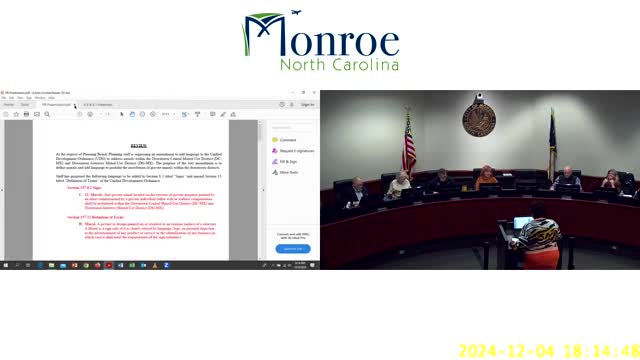
Summary
The board approved an amendment to the sign code and definitions in the Unified Development Ordinance to define murals and prohibit private murals in the downtown central mixed‑use and gateway districts, while staff described a separate city‑led public‑art process for commissioned murals.
MONROE — At its Dec. 4 meeting the Monroe City Planning Board approved a text amendment to the Unified Development Ordinance that defines “murals” and prohibits private murals on private property within the downtown central mixed‑use and gateway zoning districts.
Doug Britt of the planning department presented the amendment, telling the board the proposed definition would read in part that a mural is “a picture or design painted or attached to an exterior surface of a structure.” Under the draft ordinance language presented to the board, “any private mural located on the exterior of a private property, painted by an artist, commissioned by a private individual, either with or without compensation, shall be prohibited within the downtown central mixed use district and the gateway district.” Britt said the proposal adds a definition in the sign section and a new subsection to prohibit private murals in those downtown zones.
Britt and other staff described the change as a temporary regulatory step to prevent privately commissioned murals from being placed in downtown until the city establishes a formal public‑art program. City staff indicated the city is developing a separate process by which murals would be treated as public art, commissioned by the city in coordination with property owners and artists. As staff described it at the meeting, those murals would be proposed through a public process and approved by City Council; staff emphasized that the amendment is not intended to eliminate murals entirely but to ensure downtown murals are subject to a public review and commissioning process.
Several property owners and board members asked whether the change would give the city approval authority over art on private buildings and whether property owners could be charged to participate. Britt said the ordinance would not make existing private murals retroactive — examples already in place would remain — and that the planned public‑art process could include agreements (grants or contracts) between the city, property owner and artist. He said the specifics of fees or agreements had not been finalized and would be part of the separate public‑art program review.
City representative (identified in the meeting as a staff presenter) described plans to bring a public‑art policy and procedures forward to City Council and said the downtown advisory board would likely be involved in the vetting process. Board members discussed themes and design concerns for downtown murals and emphasized a public hearing process.
The board voted to recommend adoption and then adopted the ordinance amendment as presented. The motions carried.
What happens next: staff said the public‑art policy and procedures will be developed for City Council consideration and individual murals proposed under that program would be approved through the public process described by staff.