
Hearing examiner weighs variances to formalize long‑standing auto sales and repair site on Route 1
Get AI-powered insights, summaries, and transcripts
Subscribe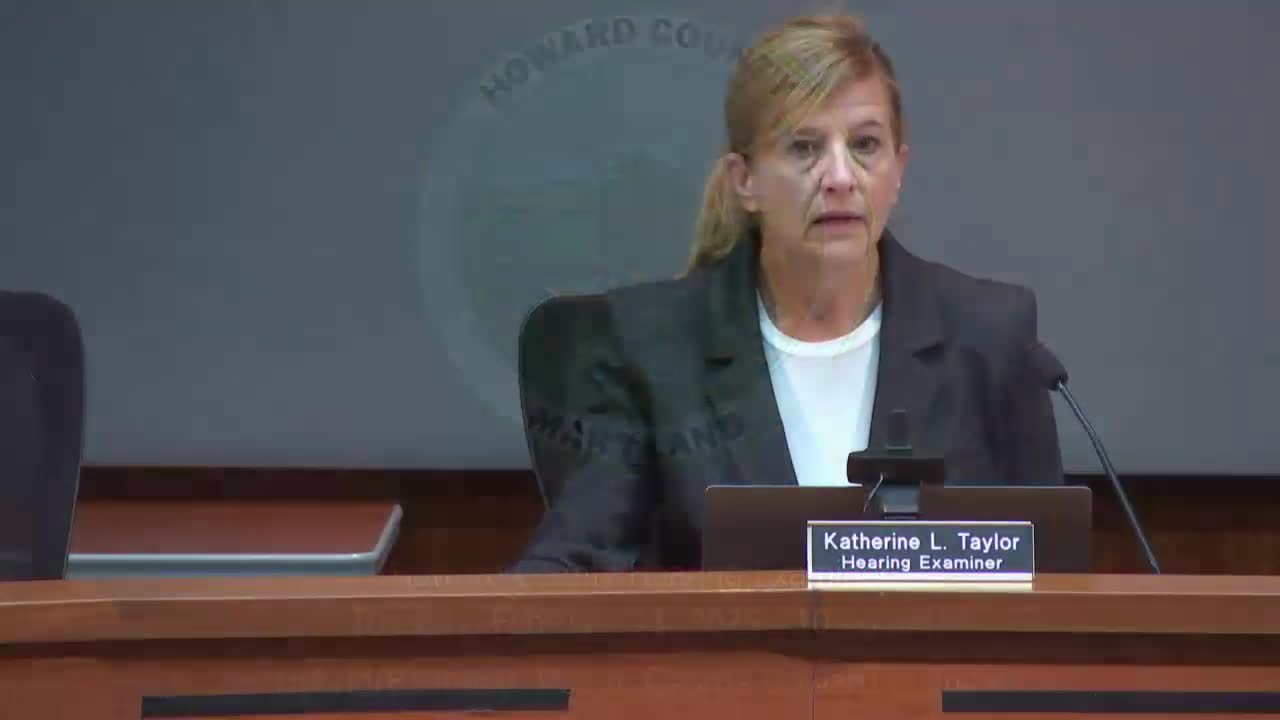
Summary
Howard County Hearing Examiner Catherine Taylor heard Feb. 11 testimony on MLWL LLC’s request for multiple variances to regularize existing buildings, parking and setbacks at a 0.39‑acre property at Cedar Avenue and Route 1; the petitioner offered to remove some paving and add landscaping and the record was closed for decision.
Howard County Zoning Hearing Examiner Catherine Taylor on Feb. 11 heard testimony on a petition by MLWL LLC seeking variances to formalize long‑standing auto repair and limited auto sales uses at a 0.39‑acre property at the corner of Cedar Avenue and Route 1.
The variances requested would accommodate existing buildings and paving that predate current zoning and would modify setback and parking requirements: a negative 0.43‑foot variance for the structure nearest Cedar Avenue, a 5.17‑foot variance for a storage building along Route 1, a request for a zero setback for parking from the ultimate right of way where 10 feet is required, and a reduction of a 30‑foot setback to 18.71 feet along the property’s western edge adjacent to a residential lot (Lot C). The petitioner said it will remove some impervious paving and replace it with landscaping and provide 10 parking spaces.
Why it matters: the requested variances would formally recognize existing site conditions that the petitioner says were created before current zoning lines and that impede redevelopment. Approval would clear the way for the property owner to obtain a state dealer license for limited vehicle sales and to document current site conditions in the county site development plan (SDP).
Robert Vogel, a professional civil engineer called by the petitioner, described the lot as tightly constrained. He testified that the site’s gross area is 0.39 acres and that setbacks and an ultimate right of way reduce developable area: “of the 0.39 acres 0.27 acres is pretty much a burden on the 0.39 acres,” he said. Vogel identified a stream running behind the building labeled “auto repair,” and said the parcel is less than 100 feet wide in one dimension and stretches roughly 200 feet along Cedar Avenue.
Vogel told the examiner that the two small buildings nearest the public streets are shown on a 1979 site development plan (SDP 79049) and that those structures have existed since at least the 1950s; the auto sales use developed later when an on‑site building was used for limited indoor vehicle display. He said additional asphalt areas were added after the 1979 SDP without permits and that the present application will remove some of that paving to provide landscaping that meets county requirements.
On specifics, Vogel said the negative 0.43‑foot variance arises from the requirement to measure setbacks from the “ultimate right of way” for Cedar Avenue — a reservation line the county shows on plans but has not been dedicated — and that the existing building is about four‑tenths of a foot over that eventual right‑of‑way line while remaining inside today’s property line. He described the storage building variance as related to recent State Highway Administration work that placed a sidewalk along Route 1 and reduced the measured distance to the sidewalk.
Taylor and Department of Planning and Zoning staff questioned Vogel about whether the variances are the minimum necessary and about why the petitioner is applying now. Vogel and the petitioner’s counsel said the primary driver was the owner’s need for a state dealer license for limited sales, which requires county sign‑off on a site development plan showing the use. Counsel told the examiner that some requested variances are a “clean up” of existing nonconforming conditions that predate current zoning and that the application proposes no new building construction other than removal of paving and landscaping.
No formal vote or final decision was taken at the hearing. Taylor closed the record at the end of testimony; the hearing examiner will issue a written decision after reviewing the written exhibits and testimony.
Ending: The record was closed Feb. 11; the transcript shows the petitioner submitted a conditional use/site plan exhibit and a demonstrative PDF for the file. The examiner did not announce a timetable for a written ruling during the session.